✍️ 10+ years testing and maintaining cookware daily🔄 Updated April 2026
Stainless steel pots and pans, nonstick cookware, copper cookware, cast iron skillets — each material dulls and discolors for completely different reasons, and each needs a different fix. This guide covers the daily habits, deep cleaning methods, and material-specific techniques that keep every type of cookware shiny, long-term.
I’ve watched expensive cookware turn gray, dull, and spotty in under a year — not from hard cooking, but from three bad habits: wrong washing temperature, air drying, and stacking pans without protection. The pans weren’t damaged. They just looked terrible and their owners assumed they were.
The gap between shiny cookware and dull cookware is almost entirely maintenance. Not products — habits. Here’s every habit that actually matters, organized by material because the rules for stainless steel are genuinely different from the rules for copper or nonstick.
⚡ Quick Answer — How to Keep Cookware Shiny
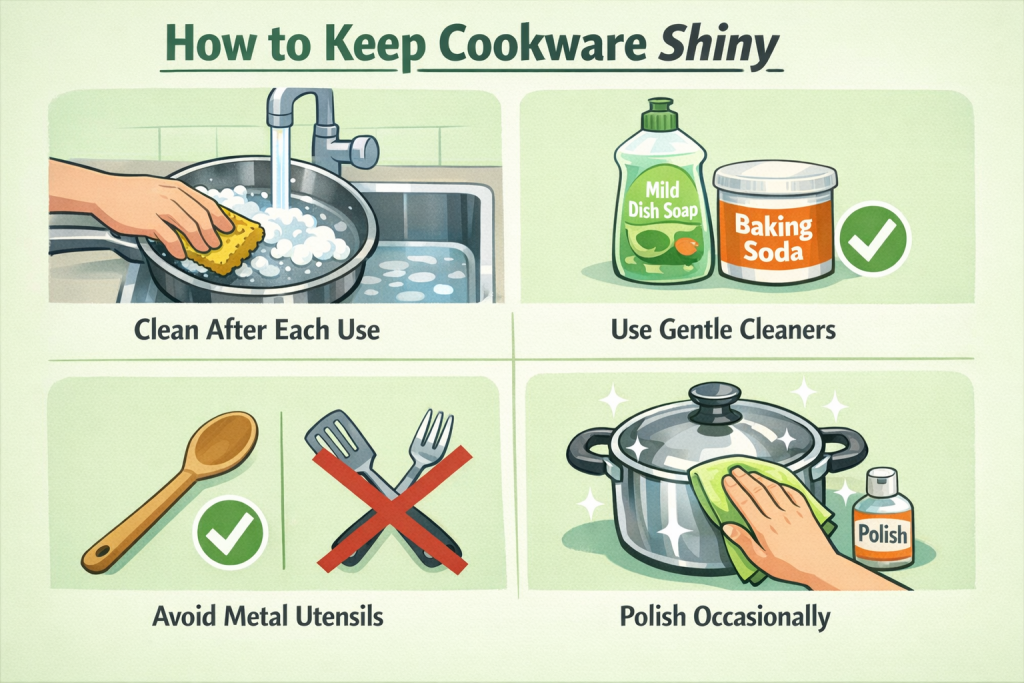
The 6 Core Habits That Keep All Cookware Looking New
Hand wash — always — dishwashers dull every cookware material over time through alkaline detergents, high heat, and extended water exposure
Dry immediately — air drying causes mineral water spots on stainless and copper, accelerates oxidation, and softens nonstick coatings
Never plunge hot pans into cold water — thermal shock warps the base and stresses metal finishes permanently
Match cleaner to material — Bar Keepers Friend restores stainless; lemon + salt works on copper; mild soap only on nonstick; baking soda paste on cast iron
Store with protection — pan protectors or towels between stacked pans prevent the rim-on-surface scratching that dulls finishes invisibly over months
Polish monthly — a microfiber buff after washing keeps stainless mirror-bright; vinegar wipe handles discoloration before it sets
Why Cookware Loses Its Shine — The Real Causes by Material
Shiny cookware doesn’t get dull from cooking. It gets dull from cleaning — specifically from the wrong cleaning methods applied repeatedly over months. Understanding what’s actually happening to each material surface tells you exactly how to stop it.
Stainless Steel: Mineral Deposits and Micro-Scratches
Stainless steel’s shine comes from a chromium oxide layer that forms on the surface and reflects light evenly. Two things disrupt it: mineral deposits from hard water that scatter light unevenly (white haze, water spots), and micro-scratches from abrasive cleaning that create a dull, matte surface texture. Neither is permanent damage — both are surface-level and reversible. The third cause is rainbow discoloration from high heat, which is also purely cosmetic and fixable in two minutes with white vinegar.
Nonstick Cookware: Coating Degradation
PTFE (Teflon) and ceramic nonstick coatings lose both appearance and function through the same process: physical abrasion from metal utensils or abrasive scrubbers removes the coating layer by layer. The pan looks dull because the coating that gave it its dark, uniform finish is thinner and uneven. Unlike stainless steel, this isn’t reversible — once the coating is worn, the pan’s appearance and nonstick performance don’t come back. Prevention is everything here.
Copper: Oxidation and Tarnish
Copper reacts with oxygen in the air immediately and continuously. The copper oxide that forms produces a brownish-black tarnish, which progresses to the distinctive blue-green patina if left long enough. It’s the same process that happens to the Statue of Liberty over decades — copper cookware just does it faster because of heat and moisture exposure during cooking. Tarnish is purely cosmetic and doesn’t affect cooking performance. Polishing restores the shine; the copper itself is unaffected.
Cast Iron: Seasoning Loss and Surface Rust
Cast iron’s dark, slightly glossy surface isn’t the iron itself — it’s the polymerized oil seasoning built up through cooking. Lose the seasoning and the iron underneath is gray, matte, and rust-prone. Aggressive cleaning, acidic foods, soaking, or dishwasher use strip the seasoning and expose the raw iron. Rust forms on exposed iron within hours in humid conditions. Both are fixable, but repeated stripping and re-seasoning gradually thins the base seasoning layer.
Cookware Type
Main Cause of Dullness
Reversible?
Prevention Priority
Stainless steel
Mineral deposits, micro-scratches, chromium oxidation
Yes — Bar Keepers Friend + vinegar
Dry immediately, scrub with grain
Nonstick (PTFE/ceramic)
Coating abrasion, overheating, dishwasher damage
No — coating loss is permanent
No metal utensils, no high heat, no dishwasher
Copper
Oxidation (tarnish), moisture exposure
Yes — lemon + salt or Bar Keepers Friend
Dry thoroughly, polish every 3–6 months
Cast iron
Seasoning loss, surface rust
Yes — re-season restores
Dry on stove, oil after every wash
Carbon steel
Seasoning loss, rust (similar to cast iron)
Yes — re-season
Same as cast iron
Enameled cast iron
Staining, chipping from thermal shock
Partially — stains yes, chips no
No cold water plunge, no abrasive scrubbers
Daily Habits That Keep Cookware Shiny — Across All Materials
Most cookware care guides jump straight to products. The habits matter more. These five practices prevent the dullness before it starts — no Bar Keepers Friend required if you’re consistent with them.
1
Let pans cool before washing — always, for every material
Thermal shock — hot pan, cold water — stresses metal finishes, warps bases, and on nonstick, accelerates coating breakdown. Five minutes of cooling costs nothing. A warped pan base means uneven heat distribution from that point forward — a permanent functional and aesthetic problem.
2
Hand wash with mild dish soap and a soft sponge
Dishwashers run at 55–70°C with high-alkaline detergents and extended water exposure. That combination dulls stainless steel, strips nonstick coatings, tarnishes copper faster, and strips cast iron seasoning in a single cycle. All-Clad, Lodge, Made In, and virtually every quality cookware brand recommends hand washing for appearance and longevity, even when labeling pans “dishwasher-safe.”
3
Dry immediately with a microfiber cloth — no air drying
Tap water contains calcium and magnesium. When water evaporates on any surface, those minerals stay behind as white spots and chalky haze. On stainless steel this looks like permanent damage — it isn’t, but it builds up. On copper it accelerates oxidation. Microfiber dries faster and leaves no lint. This one habit eliminates water spots completely.
4
Clean while still warm — not cold, not hot
Warm pans (5 minutes off heat) clean faster because food residue is still soft. Cold pans mean hardened residue that requires more scrubbing — more scrubbing means more surface abrasion over time. For stainless, deglazing with warm water while still on the stove eliminates most residue before washing even starts.
5
Use the right tool for each material — not one scrubber for everything
A Scotch-Brite non-scratch pad is fine on stainless steel but too aggressive on nonstick. Steel wool restores cast iron but destroys everything else. A soft sponge works on copper but barely touches burnt stainless residue. Keep separate cleaning tools for different pan types — or at minimum, a soft sponge and a medium non-scratch pad.
💡 The 2-Minute Rule
Wash pans within two minutes of plating food, while they’re still warm. The residue comes off with minimal scrubbing. Wait until the pan is cold and you’re fighting hardened protein adhesion that requires baking soda, boiling water, and actual effort. The time investment is identical — the result is dramatically different.
How to Keep Stainless Steel Cookware Shiny
Stainless steel is the most forgiving material for restoration — nearly every type of dullness is reversible. The goal isn’t just cleaning; it’s maintaining the chromium oxide layer that gives stainless its reflective finish and corrosion resistance.
Daily Maintenance for Stainless Steel Pots and Pans
1
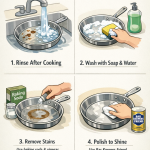
Deglaze while warm — it’s faster than soaking
Splash of water in the still-warm pan, wooden spoon across the surface. Most cooking residue releases in 20 seconds. This prevents the buildup that makes stainless look perpetually dull and brown around the cooking surface.
2
Wash with mild soap, scrub with the grain
Look at your pan in good light — there’s a faint linear brush pattern in the steel. That’s the grain. Scrub parallel to it, never across it. Cross-grain scrubbing creates visible swirl marks that scatter light and make the surface look permanently dull. Scrubbing with the grain keeps scratches invisible.
3
Dry immediately, buff with microfiber
Towel-dry right after rinsing, then buff in circular motions with a dry microfiber. This buffs away any remaining mineral traces and gives the steel a noticeably brighter finish. Takes 30 seconds. Costs nothing.
Monthly Deep Polish for Stainless Steel
Bar Keepers Friend — oxalic acid plus fine feldspar abrasive — is the best product available for stainless steel restoration. Monthly use keeps stainless looking like new without cumulative surface damage. Wet the surface, sprinkle BKF, work into a paste, scrub with the grain for 30–60 seconds maximum, rinse completely within one minute, dry immediately. The surface should brighten noticeably after one pass.
Removing Rainbow Discoloration (Heat Stains)
Rainbow iridescence — blue, gold, purple swirls — is chromium oxidation from high heat on an empty pan. Not damage. Pour undiluted white vinegar directly on the discolored area, wait 2–3 minutes, wipe with a soft cloth, rinse, dry. The stain disappears. To prevent recurrence, don’t preheat an empty stainless pan on high heat for more than 30–45 seconds.
Removing White Spots and Hard Water Haze
Simmer 1 part white vinegar to 3 parts water in the pan for 5 minutes. The acetic acid dissolves calcium carbonate deposits cleanly. Pour out, wipe, rinse, dry immediately. For surface haze without visible spots, a vinegar-dampened cloth wiped across the exterior works in under a minute. Prevention: dry the pan immediately after every wash without exception.
✅ The Pitting Warning (Permanent)
One thing stainless steel genuinely can’t recover from: pitting corrosion. This happens when you salt cold water in a stainless pot, or when chlorine-based cleaners contact the surface. Salt water before it reaches a rolling boil = permanent pockmarks in the bottom of the pan. No cleaning method removes them. Prevention is the only option.
How to Keep Nonstick Pans Shiny and Extend Their Life
Nonstick pans — PTFE (Teflon), ceramic, and hard-anodized — are the only cookware type where “keeping it shiny” is primarily about preventing damage rather than restoring it. Once the coating is worn, the appearance and function don’t come back.
The Rules That Actually Extend Nonstick Life
No metal utensils, ever — metal spatulas, tongs, and whisks scratch the coating with every use. Wood, silicone, or nylon only. This is the single most impactful habit.
Medium heat maximum — nonstick coatings begin degrading above 260°C (500°F). PTFE coatings can release fumes at very high temperatures. Always cook on low to medium heat. Never preheat an empty nonstick pan.
Never use aerosol cooking spray — sprays like PAM build up a sticky residue layer on nonstick surfaces that regular washing doesn’t remove. It accumulates into a dull, tacky film. Use a thin wipe of oil from a paper towel instead.
No dishwasher — one cycle significantly accelerates coating deterioration. All-Clad’s own care guide for nonstick explicitly recommends hand washing to preserve the surface and appearance.
Cool before washing — nonstick coatings are most vulnerable to thermal stress when hot. Cold water on a hot nonstick pan accelerates micro-cracking in the coating.
Daily Cleaning for Nonstick Cookware
Warm water, a drop of mild dish soap, soft sponge or cloth. That’s it. Nonstick’s whole purpose is easy release — if food isn’t releasing, the pan either wasn’t warm enough or the coating is worn. A 10-minute soak in warm soapy water handles any stuck food without abrasive scrubbing. Never use baking soda, Bar Keepers Friend, or any abrasive on nonstick — even mild abrasives accelerate coating wear.
⚠️ When to Replace Nonstick Cookware
Flaking, peeling, or deeply scratched nonstick coating means replacement — not restoration. PTFE flakes ingested in small amounts are generally considered inert by health authorities, but a compromised coating means the pan no longer performs its core function. Replace rather than try to restore. High-quality nonstick (All-Clad, Made In, GreenPan) with proper care typically lasts 3–5 years of daily use.
How to Keep Copper Cookware Shiny and Tarnish-Free
Copper tarnishes fast. I watched a newly polished copper saucepan develop visible oxidation in under a week just from kitchen air. That’s not neglect — it’s copper’s nature. The question isn’t whether it tarnishes but how quickly you address it when it does.
Understanding Copper Tarnish
Copper reacts with oxygen continuously — copper oxide forms immediately and builds into the distinctive brownish-black tarnish. Left longer, it progresses to blue-green patina (copper carbonate). Both are purely cosmetic. Neither affects cooking performance. Many cooks prefer the patina look. If you want the bright reddish-orange shine, regular polishing is required — not optional.
Daily Maintenance for Copper Pots and Pans
1
Wash immediately after cooling — soft sponge, mild dish soap
Clean the interior lining (usually tin or stainless) gently. The exterior copper can take slightly more scrubbing — but never steel wool, which scratches the soft metal.
2
Dry completely and immediately — the most important step for copper
Moisture dramatically accelerates copper oxidation. Never air-dry copper cookware. Dry every surface — exterior, interior, handle, underside — with a microfiber cloth within minutes of washing.
3
Store in a cool, dry location — away from humidity
Ambient humidity oxidizes copper even between uses. A dry cabinet away from the sink is better than a pot rack near the stove where cooking steam reaches it regularly.
How to Polish Copper Cookware at Home
The most effective DIY copper polish uses pantry staples. Made In recommends: equal parts lemon juice (or white vinegar) and coarse salt, mixed into a paste. Rub across the tarnished exterior with a sponge, buff in circular motions, rinse immediately with warm water, dry completely. The acid dissolves copper oxide while the salt provides gentle abrasion. Tarnish disappears within 30 seconds of contact — don’t leave it on longer, it can over-etch the copper.
For heavier tarnish: Bar Keepers Friend powder on a damp sponge, scrub gently, rinse thoroughly. Made In recommends a full polish every six months for regular use pans; every three months if you prefer a consistently bright finish.
🟤 Lacquered vs. Unfinished Copper
Some copper cookware has a lacquer coating applied at the factory — a protective glossy finish that prevents oxidation. Lacquered copper cleans with just a soft cloth and mild soap; acids and polishes strip the lacquer and then the unprotected copper tarnishes faster than ever. To check: if your copper hasn’t changed color or developed any tarnish after months of use, it’s lacquered. Check the care manual before using any polishing method.
How to Keep Cast Iron Dark, Glossy, and Rust-Free
Cast iron’s appearance and performance are the same thing. A well-seasoned, dark, glossy cast iron skillet is a non-stick cast iron skillet. The maintenance habits that keep it looking good are identical to the habits that keep it cooking well.
The Three Habits That Maintain Cast Iron Shine
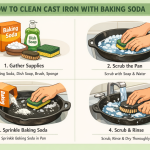
Dry on the stove after every wash — two minutes on low heat after towel-drying drives moisture out of the iron’s pores. This prevents rust spots forming overnight, which are the first visible sign of seasoning loss.
Thin oil wipe while still warm — half a teaspoon of neutral oil (vegetable, Crisco, flaxseed) wiped across the cooking surface and buffed almost entirely off. The pan should look barely shiny. This maintains the seasoning between uses and keeps the surface dark and even.
Cook fatty foods regularly — bacon, sausage, seared chicken thighs. Rendered fat polymerizes onto the iron during cooking, passively building seasoning. A pan used for fatty foods weekly looks better at year five than a pan used only for vegetables.
Restoring Dull or Patchy Cast Iron
Gray patches, dull spots, slightly sticky surface — all signs of compromised seasoning. The fix is a full oven re-season: thin coat of oil across the entire pan (inside, outside, handle), buffed off until barely shiny, placed upside-down in a 450–500°F oven for one hour, cooled in the oven. One session restores the dark, even finish. Two or three sessions in a row (if needed) rebuild a pan that’s been badly neglected.
How to Keep the Exterior of Cookware Clean and Shiny
The exterior bottom of a pan — where it contacts the burner — collects polymerized oil, carbon deposits, and mineral stains faster than the cooking surface. Most people ignore it. It’s the reason pans look dark and grimy even when the interior is clean.
Stainless Steel Exterior
Same method as the interior: Bar Keepers Friend paste, scrub with the grain of the steel (which runs in the same direction on the outside as inside), rinse completely, dry immediately. For routine maintenance, a white vinegar wipe on the exterior after every wash removes water spots before they set. Monthly BKF keeps the exterior matching the interior.
Nonstick Exterior (Usually Stainless or Hard-Anodized)
The exterior of most nonstick pans is stainless steel or hard-anodized aluminum — you can use a non-scratch pad and mild soap. Bar Keepers Friend is safe on stainless exteriors even when the interior is nonstick. Avoid the interior. Never use abrasive scrubbers on hard-anodized exteriors — they permanently dull the finish.
Copper Exterior
The exterior needs the most attention because it’s the visible show surface. Lemon-salt paste or Bar Keepers Friend for tarnish; mild soap and a soft cloth for routine cleaning. The interior lining needs gentler treatment — tin linings especially are soft and scratch easily with anything abrasive.
🔵 The Exterior Bottom Problem
Polymerized oil on the exterior bottom builds up from drips and spills during cooking. Once it bakes on repeatedly, it becomes thick and dark — and it insulates the pan from heat slightly, affecting cooking performance. Bar Keepers Friend handles light buildup. Heavy caked-on exterior carbon on stainless can require a paste of BKF left for 2–3 minutes, then a firm scrub with a non-scratch pad. Do this quarterly and it never becomes a major project.
How to Restore Shine to Already-Dull Cookware
Dull cookware sitting in a cabinet isn’t necessarily damaged. Most of the time it just needs the right treatment applied once — not a replacement.
Cookware Type
Problem
Restoration Method
Time Required
Stainless steel
Dull, gray, water-spotted
Bar Keepers Friend paste + non-scratch pad, scrub with grain, dry immediately
5–10 min
Stainless steel
Rainbow discoloration
Undiluted white vinegar, 2–3 min, wipe, rinse, dry
5 min
Stainless steel
White haze / hard water deposits
Simmer 1:3 vinegar:water for 5 min, rinse, dry
10 min
Copper
Tarnish (brown-black)
Lemon juice + salt paste, buff exterior, rinse immediately, dry completely
5–10 min
Copper
Heavy tarnish
Bar Keepers Friend on damp sponge, scrub gently, rinse, dry
10–15 min
Cast iron
Gray/patchy/dull
Thin oil coat + oven at 450°F for 1 hour, cool in oven
1.5 hours
Cast iron
Surface rust spots
Baking soda paste + stiff brush on spots, rinse, stove-dry, full oven re-season
2 hours
Nonstick
Dull, scratched coating
No restoration possible — replace if coating is worn
—
Enameled cast iron
Interior staining
Simmer water + 2 tbsp baking soda for 5 min, scrub with non-scratch pad
15 min
Products That Actually Keep Cookware Shiny
Product
Works On
Why It Works
Do NOT Use On
Bar Keepers Friend (powder)
Stainless steel, copper exteriors, enameled cast iron
Oxalic acid dissolves iron oxide and tarnish; feldspar polishes without deep scratching
Nonstick interiors, tin-lined copper interiors, bare cast iron
White vinegar
Stainless steel (rainbow stains, water spots), copper (light tarnish)
Acetic acid dissolves calcium carbonate and chromium oxide buildup
Cast iron (too acidic, strips seasoning), tin-lined copper interiors
Lemon juice + salt
Copper exteriors
Citric acid dissolves copper oxide; salt provides gentle mechanical abrasion
Nonstick, tin linings, bare cast iron
Baking soda paste
Stainless steel (cloudy spots), cast iron (stuck food, rust spots), enameled cast iron
Mildly alkaline + mild abrasive; safe on most surfaces at brief contact
Bar Keepers Friend, white vinegar, baking soda, and microfiber cloths cover almost every shine-maintenance situation across all cookware types. Total cost under $15. Everything else is either redundant or material-specific specialty polish.
What NOT to Do If You Want to Keep Cookware Shiny
✅ Always Do These
Hand wash every time
Dry immediately with microfiber
Match cleaner to material
Scrub stainless with the grain
Protect pans during storage
Polish monthly (stainless + copper)
Cool before washing
❌ Never Do These
Dishwasher — any cookware
Steel wool on nonstick or copper
Metal utensils on nonstick
Air dry any cookware
Cold water on hot pans
Bleach or chlorine cleaners
Stack without pan protectors
The Dishwasher: Why It Dulls Every Type of Cookware
Dishwashers combine three things every cookware material reacts badly to: high-alkaline detergent (pH 10–12), sustained heat (55–70°C throughout the cycle), and extended water exposure. Stainless steel loses its surface oxide layer and develops water spots and pitting. Nonstick coatings degrade 3–4x faster than with hand washing. Copper tarnishes severely. Cast iron loses all seasoning and rusts. Even “dishwasher-safe” ratings from manufacturers refer to structural integrity — not appearance or performance longevity. Misen’s care guide notes that dishwasher use causes “dulling, rainbow marks, water spots, or even tiny pits forming over time.”
Steel Wool — Only One Right Use
Steel wool removes rust from bare cast iron before re-seasoning. That’s the only legitimate use on any cookware. On stainless steel it creates visible scratches that make the surface permanently dull. On nonstick it removes the coating in one use. On copper it scratches the soft metal. On enameled cast iron it chips the enamel. One product, one specific use case.
Aerosol Cooking Spray on Nonstick
Cooking sprays like PAM contain propellants and lecithin that polymerize on nonstick surfaces at high heat into a sticky brown residue that normal washing won’t remove. It builds up invisibly into a film that makes food stick and dulls the surface. All-Clad’s care guide specifically warns against cooking spray use on nonstick. Use a paper towel with a small amount of oil instead — identical function, no residue buildup.
Storage Mistakes That Cause Cookware to Lose Its Shine
Dullness from storage is the most invisible problem — it happens slowly and you don’t notice it until the pan looks significantly worse than it should.
Stacking Without Protection
When you stack pans directly, the rim of the upper pan rests against the cooking surface of the lower pan. Every placement scratches the surface slightly. Over 6–12 months of daily stacking, this creates a network of fine scratches across the cooking surface that scatter light and permanently dull the finish on stainless steel. Pan protectors (felt or silicone pads) prevent this entirely. A folded dish towel between pans also works. Made In recommends placing a trivet, dish towel, or pan protector both inside and underneath stacked pans.
Hanging Copper and Cast Iron in Humid Areas
Pot racks near the stove look great. They also expose pans to cooking steam, grease mist, and ambient humidity continuously. For copper, this means tarnishing faster between uses. For cast iron, it means rust spots forming on the cooking surface between sessions. If you hang cookware, position the rack away from direct stove proximity — at least 3 feet from the cooking zone.
Storing Cast Iron with the Lid On
A sealed cast iron pan traps whatever residual moisture didn’t fully evaporate from the last wash. In humid kitchens — common near the coast or in summer — this moisture produces rust spots within 24–48 hours. Store cast iron uncovered, or with the lid cracked. A paper towel placed inside the pan absorbs ambient moisture between uses.
Nesting Lids on Nonstick Pans
A glass or metal lid sitting in a nonstick pan scratches the cooking surface every time it’s moved. Store lids separately — in a vertical rack, or on a shelf above the pans. Scratched nonstick looks dull immediately and loses its release properties in those areas.
Common Mistakes Ranked by How Much They Damage Cookware Appearance
Mistake
Damage Level
Materials Affected
Reversible?
Dishwasher use (regular)
🔴 Severe
All types
Partially — cosmetic damage builds over time
Metal utensils on nonstick
🔴 Severe
Nonstick (PTFE, ceramic)
No — coating damage is permanent
Steel wool (routine use)
🔴 Severe
Stainless, copper, nonstick, enamel
No for nonstick/enamel; partially for stainless
Air drying (no towel)
🟡 Moderate
Stainless, copper
Yes — vinegar or BKF removes mineral spots
Cold water on hot pan
🟡 Moderate
All types
Warping — no; surface finish — partially
Stacking without protection
🟡 Moderate
All types
No — scratches are permanent on stainless
Cooking spray on nonstick
🟡 Moderate
Nonstick
Difficult — buildup requires specific cleaners
Salt in cold water (stainless)
🟠 Significant
Stainless steel
No — pitting is permanent
Bleach / chlorine cleaners
🔴 Severe
Stainless, copper
No — pitting and coating damage permanent
Neglecting exterior bottom
🟢 Low (cosmetic)
All types
Yes — BKF removes most buildup
FAQ: How to Keep Cookware Shiny
How do I keep stainless steel pots and pans shiny?
Three habits make the biggest difference: dry immediately after washing (air drying causes mineral water spots), scrub with the grain of the steel rather than across it (cross-grain scrubbing creates visible swirl marks), and do a monthly Bar Keepers Friend polish. BKF’s oxalic acid dissolves surface oxidation and its mild abrasive restores the reflective finish. For rainbow discoloration from heat, white vinegar applied for 2–3 minutes removes it completely. For white spots from hard water, simmer equal parts vinegar and water in the pan for 5 minutes.
Why do my pots and pans look dull after washing?
Most commonly: air drying. Tap water contains calcium and magnesium — when it evaporates on any surface, those minerals leave a white haze that scatters light and makes the surface look dull. Dry immediately with a microfiber cloth right after rinsing and the problem disappears. The second cause is cross-grain scrubbing on stainless steel, which creates micro-scratches that make the finish permanently matte. The third is dishwasher use, which combines high-alkaline detergent and sustained heat to gradually degrade every cookware finish.
What is the best way to keep nonstick pans looking new?
Prevention is the only strategy for nonstick — the coating can’t be restored once worn. Four non-negotiable rules: no metal utensils (use wood, silicone, or nylon only), no dishwasher, no aerosol cooking spray, and medium heat maximum. Hand wash with warm soapy water and a soft sponge immediately after cooking. Never use abrasive scrubbers or baking soda on nonstick. If the coating is scratched, flaking, or visibly worn, replace the pan — restoration isn’t possible.
How do you keep copper pots and pans shiny?
Copper tarnishes continuously from oxidation — keeping it shiny requires regular polishing, not just cleaning. For routine maintenance: wash with mild soap and a soft sponge, dry immediately and completely (moisture accelerates tarnish). For polishing: mix equal parts lemon juice and coarse salt into a paste, rub on the exterior, buff, rinse immediately, dry. Made In recommends a full polish every 6 months for regular use, every 3 months if you prefer consistent shine. Bar Keepers Friend handles heavier tarnish. Never put copper in the dishwasher.
Does the dishwasher ruin the shine on cookware?
Yes, for every cookware type. Dishwashers use high-alkaline detergents (pH 10–12), sustained heat, and extended water exposure — a combination that dulls stainless steel, degrades nonstick coatings, tarnishes copper, and strips cast iron seasoning. The damage is cumulative and accelerates with each cycle. “Dishwasher-safe” ratings refer to structural integrity, not appearance or performance longevity. Misen, All-Clad, Made In, and Lodge all recommend hand washing for keeping cookware looking and performing its best.
How do you remove water spots from stainless steel pans?
White water spots on stainless steel are calcium carbonate deposits from hard tap water. Simmer 1 part white vinegar mixed with 3 parts water in the pan for 5 minutes — the acetic acid dissolves the calcium deposits completely. For exterior spots, wipe with a vinegar-dampened cloth, rinse, dry immediately. Prevent recurrence by drying the pan with a microfiber cloth right after every wash, before any water has a chance to evaporate on the surface.
How do I stop pans from getting scratched during storage?
The fix is simple: pan protectors (felt or silicone pads) between stacked pans, or hanging cookware individually. When pans are stacked directly, the rim of each pan scratches the cooking surface of the pan below it — visibly on stainless steel, fatally on nonstick. Pan protectors cost a few dollars and eliminate this problem entirely. If hanging, position the rack away from stove proximity to avoid steam and grease exposure.
Is Bar Keepers Friend safe on all types of cookware?
No — it’s material-specific. Bar Keepers Friend is excellent on stainless steel and copper exteriors. It should not be used on nonstick coatings (too abrasive — degrades the coating), tin-lined copper interiors (scratches the soft tin), or bare cast iron (disrupts seasoning without the benefit it provides on steel). For stainless steel, it’s the best available product. Use within 60 seconds of application and rinse completely — the oxalic acid is effective quickly and doesn’t need extended contact time.
How do you keep cast iron looking dark and shiny?
Cast iron’s dark, slightly glossy finish is the polymerized oil seasoning — it’s maintained through use and a consistent oil coat after every wash. After cleaning (hot water and brush), dry the pan on the stove over low heat for 2 minutes, then apply a very thin coat of vegetable oil or Crisco while still warm. Buff it off until the surface looks barely shiny — not wet. Cook fatty foods regularly, as the rendered fat passively builds seasoning. When the surface looks gray or patchy, a full oven re-season at 450°F for one hour restores it.
⬇️ Bottom Line
How to Keep All Your Cookware Shiny — The Simple Version
Shiny cookware is mostly about habits, not products. Three habits cover 80% of every material:
Hand wash, every time — the dishwasher is the single biggest source of cookware dullness across all materials
Dry immediately with microfiber — eliminates water spots before they form; costs 30 seconds per pan
Store with protection between pans — pan protectors prevent the invisible cumulative scratching that makes surfaces permanently dull
Beyond those habits, match the restoration method to the material: Bar Keepers Friend for stainless steel, lemon-salt paste for copper, oven re-season for cast iron, and replacement (not restoration) for worn nonstick.
I’ve had the same stainless pans for over ten years. They look better now than at year two because I figured out the habits early. The pans that look destroyed in other kitchens aren’t damaged — they’re just maintained wrong. Fix the habits and the shine follows.