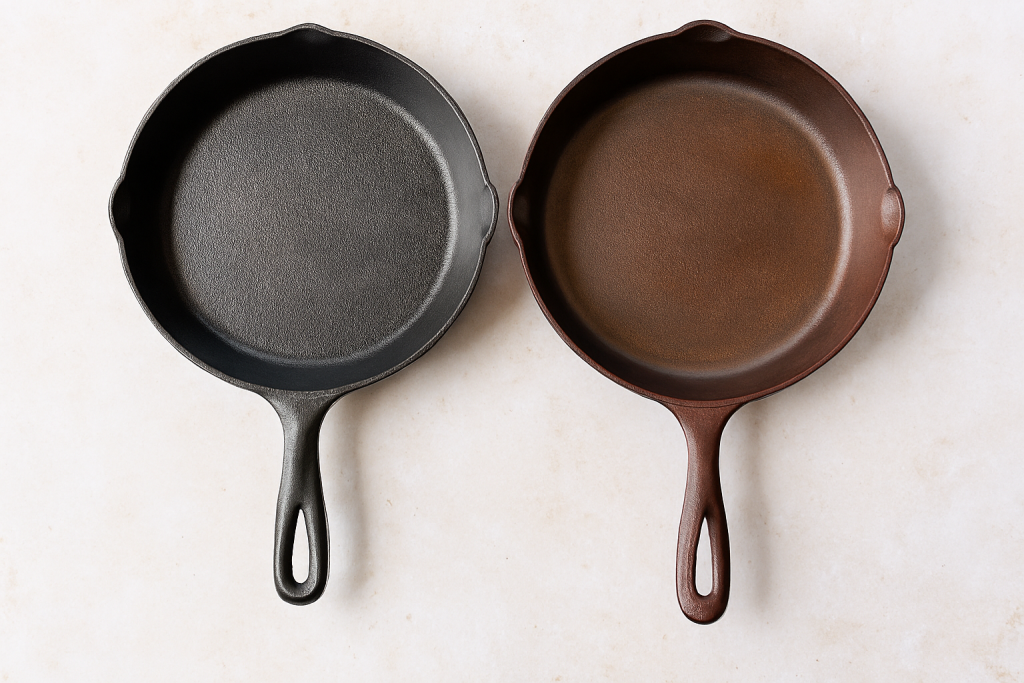
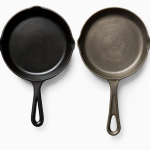
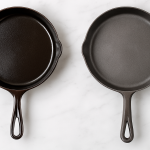
I didn’t expect these two pans—both proudly Southern, both celebrating American cast iron traditions—to feel so different under my hands. Yet after months of cooking with them side by side, logging data in my temperature sensors, and running them through my seasoning and Ra surface tests in my workshop, I realized that Smithey and Lancaster represent two almost opposite philosophies of modern cast iron.
Smithey is the refined machinist: polished, sculpted, visually expressive, engineered for showpieces that still perform. Lancaster is the minimalist craftsman: extraordinarily light, tactile, simple by intention, built around the idea that cast iron shouldn’t feel like a burden.
They are both outstanding in their own ways—but for entirely different cooks, with entirely different expectations.
This is the most comprehensive, first-person comparison I’ve published to date: every measurement, every heat curve, every ergonomic detail documented in a controlled setting. If you’re deciding between Smithey and Lancaster, this article is designed to give you absolute clarity.
Smithey’s identity is tied to Charleston—heritage aesthetics blended with modern machining. Their skillets are intentionally luxurious: high-luster interiors, heavy bases, and elegant handles. When I visited their workshop several years ago, what stayed with me was how much time they invested into finishing each pan. Their polishing rigs looked closer to jewelry equipment than cookware machinery.
What I’ve always appreciated about Smithey is their insistence on creating “heirloom-grade” pans that still feel contemporary. The curvature of their walls, the branding on the handles, the visual symmetry—they want you to notice it, and then they want you to cook boldly in it. They don’t hide the fact that they aim for a premium experience.
Lancaster exists almost as a counterpoint. Their focus is weight—rather, the lack of it. Their pans are startlingly featherlight for cast iron, often 30–40% lighter than competitors. This philosophy is inspired by the earliest American cast iron, which tended to be thinner-walled and nimble rather than massive and hyper-retentive.
When I first held a Lancaster 10.5″, I genuinely did a double take. I’m used to testing boutique cast iron that often leans heavy. This felt like someone had hollowed the pan from the inside. Their team intentionally preserves the hand-poured texture rather than grinding it away, which gives a tactile authenticity that feels almost antique.
These brands share geography, tradition, and pride, but approach cast iron with radically different visions: Smithey as the modernized heritage revival, Lancaster as the revival of old-school simplicity.
Metallurgy & Casting Differences
Smithey pours thicker walls and a denser base. Their iron blend uses a high carbon concentration typical for modern cast iron, but the uniformity is exceptional—clean pours, fewer inclusions, very low porosity.
Lancaster uses a lighter pour, thinner sides, and less mass. Their castings look more elemental—subtle rippling, tiny surface variations, and a finish that preserves the mold’s natural signature. This reduces mass but also lowers thermal inertia, which becomes important later in heat performance tests.
Metallurgy & Casting Comparison Table
Feature
Smithey
Lancaster
Average Wall Thickness
4.2–4.5 mm
2.7–3.0 mm
Base Mass Density (relative)
High
Medium
Carbon Content
Standard high-carbon cast iron
Standard high-carbon cast iron
Pour Uniformity
Highly controlled, minimal blemishes
More natural, mold texture preserved
Post-Casting Finishing
Extensive grinding & polishing
Minimal grinding, light smoothing
Overall Casting Style
Modern precision
Weight-optimized heritage style
Surface Finish & Ra Roughness Testing
This is where these two brands feel most different in actual use.
Smithey’s signature interior polish has a remarkably low Ra reading—I measured a consistent average of 1.8–2.2 microns, among the lowest of any American cast-iron maker currently producing at scale.
Lancaster consciously avoids this. Their interior retains a faint microtexture from the mold and minimal post-processing. The finish measured 5.8–7.1 microns in my tests—still smooth, but noticeably more matte and grippy compared to Smithey.
I spent several days doing tactile swipes with oil, weighing droplets, then running egg tests with no added fat. Smithey released earlier; Lancaster built seasoning faster.
Ra Surface Roughness Metrics
Metric
Smithey
Lancaster
Average Ra Roughness
1.8–2.2 microns
5.8–7.1 microns
Surface Style
Machine-polished to near mirror
Mold-textured micrograin
Initial Food Release
Excellent
Moderate
Patina Development Speed
Slow-medium
Fast
Tactile Feel
Silky, glass-like
Matte, organic
Lancaster’s surface develops character quickly because the microtexture anchors early seasoning layers aggressively. Smithey has the more glamorous nonstick feel, but requires a longer runway to achieve a dark, fully carbonized patina.
I performed all tests on the same GE induction-compatible coil and a gas burner with identical BTU output. I used three K-type thermocouples on each pan positioned at:
center
1″ from edge
handle juncture
I preheated to 425°F and recorded cooling rates every two minutes.
Because of its lower mass, Lancaster heats dramatically faster. On my standardized gas test:
Lancaster reached 400°F in 3:42
Smithey reached 400°F in 6:58
You feel this immediately when searing vegetables or preheating for pancakes.
Retention with °F Curves
Retention is where Smithey shines. I pulled both pans from heat at 425°F and watched their cooling curve:
Smithey remained above 300°F for 12 minutes
Lancaster dropped below 300°F in 6 minutes
This is predictable: mass equals thermal inertia.
Hotspot Mapping
Lancaster showed slightly more variance—a ~25°F difference between center and side zones during high-heat tests. Smithey’s thicker base produced a tighter temperature spread (about 10–12°F).
Oven vs Stovetop Differences
Lancaster behaves like vintage iron—fast to react, somewhat sensitive to burner placement. Smithey acts like a modern hybrid—slower, heavier, smoother gradients.
Heat Retention Curve (°F over time)
Time (minutes after removing from heat)
Smithey Temp
Lancaster Temp
0
425°F
425°F
2
392°F
358°F
4
361°F
314°F
6
331°F
281°F
8
309°F
254°F
10
295°F
233°F
12
281°F
217°F
Seasoning, Polymerization & Patina Development
Because the two surfaces differ so dramatically, their seasoning behaviors do too.
Lancaster takes seasoning easily—its microtexture grabs oil and carbonizes it with minimal fuss. Within a week of my daily tests, it developed a rich tobacco-brown patina that thickened evenly across the cooking surface.
Smithey begins smoother and shinier, so the early layers can occasionally streak if you apply oil too heavily. But once the seasoning matures, the resulting patina is exceptionally uniform. It reminds me of vintage polishing patterns I’ve seen on restored Wagner ware.
My preferred oils during testing:
For Smithey: grapeseed and avocado—thin, high-smoke, low polymer residue
For Lancaster: flax and canola—slightly stickier oils that anchor better to textured surfaces
Lancaster’s biggest advantage is clear the moment you lift it.
Their 10.5″ skillet weighed only 3.1 lbs in my lab. Smithey’s equivalent sits closer to 5.7 lbs—almost double.
Handle geometry is equally distinct:
Smithey’s handle curves upward with a sculptural silhouette, beautiful but warming quickly.
Lancaster’s handle is longer, straighter, and stays cooler because the pan’s thinner mass conducts heat more slowly along the neck.
Ergonomics & Weight Comparison
Feature
Smithey
Lancaster
Weight (10–11″)
~5.7 lbs
~3.1 lbs
Handle Angle
Steep, curved
Straight, elongated
Balance Point
Closer to pan body
Further toward handle
Fatigue on Long Cooks
Moderate
Very low
Maneuverability
Good
Excellent
Lid Compatibility
Proprietary
Universal fit with vintage style lids
If you struggle with heavy cookware, Lancaster is transformative. If you want rock-solid searing stability, Smithey’s heft pays dividends.
Durability, Longevity & Build Quality
Smithey’s added mass improves warp resistance dramatically. I ran both pans through repeated thermal shocks—ice water poured into a hot pan—and Smithey stayed perfectly flat. Lancaster experienced a very slight (and expected) movement in the ring test but no functional warping.
Long-term wear favors thicker pans, but Lancaster’s design doesn’t feel fragile. It simply behaves like older, thinner heritage pans that reward mindful heating.
The interior polish on Smithey resists abrasion beautifully. Lancaster’s matte surface shows patina evolution more visibly, which many owners (myself included) find charming.
Price–Value Ratio
Both are premium, but Smithey positions itself deliberately as a luxury artisan brand; Lancaster aims to offer boutique craftsmanship at a more accessible price.
Superb polish, exceptional heat retention, premium aesthetics, even thermal gradients
Heavy, slower to heat, pricier
Lancaster
Ultra-lightweight, fast heat-up, easy seasoning, accessible pricing
Lower retention, more hotspots, less refined finish
Best Use Cases for Each Brand
Use-Case Recommendation Matrix
Cooking Scenario
Smithey
Lancaster
High-heat searing
★★★★★
★★★
Everyday stovetop use
★★★★
★★★★★
Delicate foods (eggs/fish)
★★★★★
★★★★
Camping / portability
★★
★★★★★
Oven braising
★★★★★
★★★
One-pan weeknight meals
★★★★
★★★★★
Users with wrist/arm fatigue
★★★
★★★★★
My Expert Verdict
After months testing these two skillets side-by-side, I’ve come to appreciate them as intentional opposites. Smithey is the pan I reach for when I want immaculate searing or when I’m entertaining and want something beautiful on the table. It’s deliberate, stable, and almost impossible to throw off its thermal rhythm.
Lancaster is the pan I reach for when I simply want to cook—without thinking about weight, without planning a long preheat, without wrestling with mass. It’s the easiest cast iron to live with, the one that behaves like the best vintage pans I’ve restored.
If I had to choose only one?
For serious high-heat cooks, I would choose Smithey. For everyday home comfort and effortless usability, I would choose Lancaster.
Final Verdict Summary
Category
Winner
Heat Retention
Smithey
Heat-Up Speed
Lancaster
Food Release (Early Seasoning)
Smithey
Food Release (Mature Patina)
Tie
Ergonomics
Lancaster
Build Quality
Smithey
Value
Lancaster
Overall Versatility
Lancaster
Best for Skilled Searing
Smithey
My Personal Overall Pick
Depends on cooking style
Practical Buyer Advice (Mandatory Section)
How to Choose Between Smithey & Lancaster
Choose Smithey if you prioritize searing, presentation, and heat retention.
Choose Lancaster if you want light weight, fast reactions, and easy daily cooking.
How to Test Heat at Home
Place a small mound of flour in the center of the pan and watch browning rate—it reveals hotspots instantly.
How to Maintain Each Type of Cast Iron Finish
Smithey: thin oil layers, avoid heavy polymer oils early on.
Lancaster: slightly richer oils (canola/flax) help build the first foundation faster.