✍️ By a 10-year All-Clad daily user🔄 Updated April 2026
From daily soap-and-water to full burnt-pan recovery — what actually works, why it works, and the three mistakes that silently destroy expensive cookware.
I burned a chicken thigh to the bottom of my All-Clad d5 skillet two weeks into owning it. The kind of burn where you wonder if you’ve just destroyed a $150 pan. I scrubbed with the wrong pad, made it worse, then spent an hour on forums reading advice that ranged from “soak in bleach” to “it’s ruined.”
None of it was right. A baking soda boil and five minutes of Bar Keepers Friend later, the pan looked new. That was eleven years ago. I’ve cooked on All-Clad stainless almost every single day since — seared duck breast, reduced aggressive wine sauces, forgotten pans on high heat more times than I want to admit.
Here’s what I actually know about cleaning them.
⚡ Featured Answer — 60-Second Version
How to Clean All-Clad Stainless Steel Pans
Cool first — never shock a hot pan with cold water; warping risk is real
Deglaze while warm — splash of water + wooden spoon while pan is still 130–150°F lifts 70% of residue instantly
Soap + non-scratch pad — standard Dawn handles daily cooking; no exotic products needed
Burnt residue? Boil 2 tbsp baking soda in water for 5–10 min, scrape, follow with Bar Keepers Friend
Rainbow stains? White vinegar, 3 minutes, wipe clean — done
Restore shine? Bar Keepers Friend paste, scrub with the grain, rinse completely, dry immediately
Stainless steel looks inert. It isn’t. The surface has microscopic pores that open under heat. Knowing what type of contamination you’re dealing with tells you exactly which cleaning approach to use — and saves you from making things worse.
Protein Adhesion
Egg white, chicken skin, fish — when these hit a pan that’s not hot enough, or wasn’t properly oiled, they bond chemically with the steel surface. Not “stuck” in the loose sense. Actual protein-metal adhesion. Cold water does nothing. You need heat or alkaline chemistry to break it.
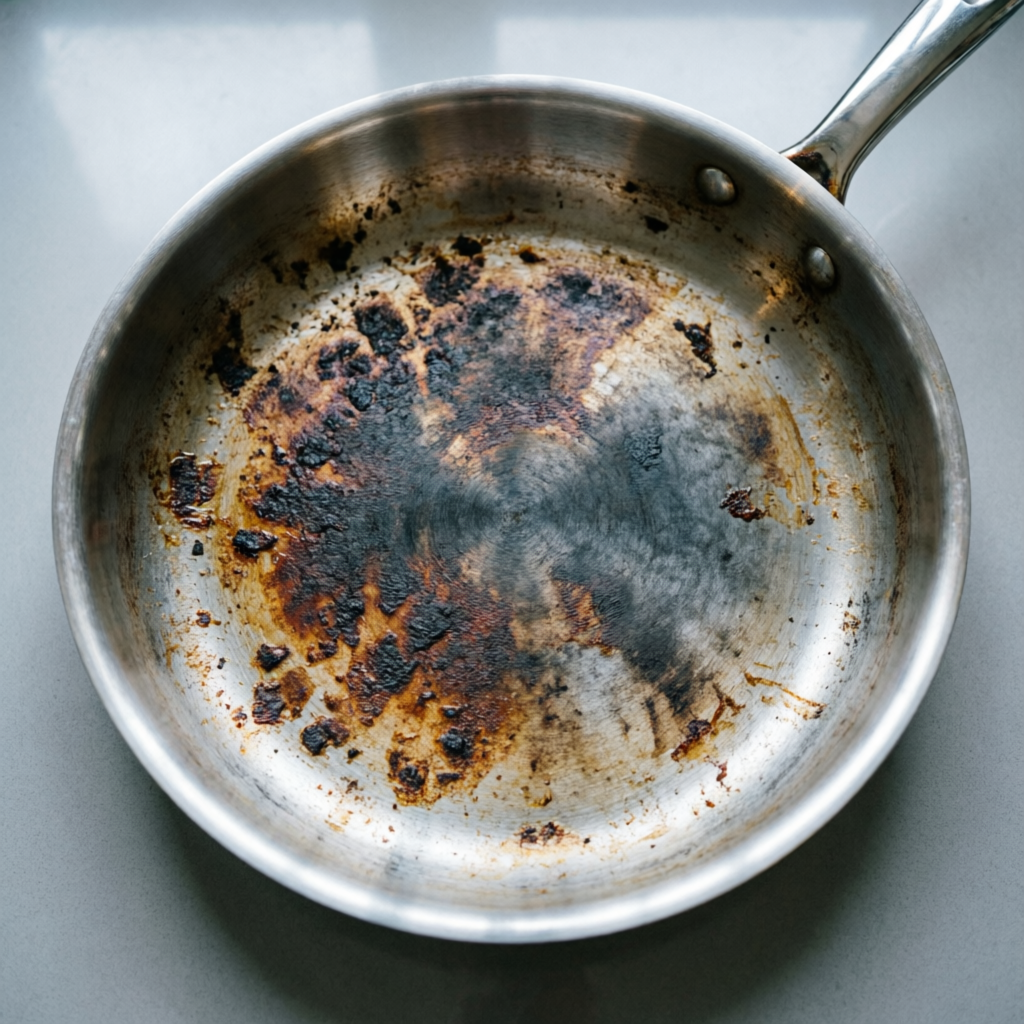
Oil overheated past its smoke point stops being oil. It cross-links into a hard polymer — essentially a plastic layer baked onto the cooking surface. That dark ring inside your pan? That’s it. Soap doesn’t dissolve polymers. You need mechanical abrasion or an oxidizing agent like oxalic acid (Bar Keepers Friend).
Mineral Deposits
Calcium and magnesium in tap water leave white residue when water evaporates. It’s inert, harmless, purely cosmetic. Builds up invisibly until one day you notice a chalky film. An acid dissolves it in minutes.
All-Clad’s 18/10 stainless gets its corrosion resistance from a chromium oxide layer on the surface. High heat — especially an empty dry pan — thickens that layer unevenly. Light refracts through layers of different thickness: you see blue, gold, purple. It looks like heat damage. It’s actually the steel protecting itself. The pan is fine.
Type of Stain
Cause
Best Fix
Cosmetic or Functional?
Brown/black residue
Polymerized oil, carbonized food
Baking soda boil + BKF
Cosmetic (affects appearance)
White haze / spots
Hard water minerals
White vinegar simmer
Purely cosmetic
Rainbow iridescence
Chromium oxidation
White vinegar wipe
Purely cosmetic
Stuck food (fresh)
Protein adhesion, insufficient heat/oil
Deglaze while warm
Functional if ignored long-term
Pitting or dark spots
Chlorine exposure or salt in cold water
No fix — prevention only
Functional damage
How to Clean All-Clad After Everyday Cooking
Ninety percent of cleaning problems come from waiting too long. Thirty-minute-old residue and twelve-hour-old residue require completely different amounts of effort. The gap is enormous.
Thermal shock warps pans. The bonded layers in tri-ply construction expand and contract at slightly different rates. A cold-water plunge on a 400°F pan stresses those bonds. Five to ten minutes on the cooling burner is enough. If you’re impatient, add warm water — not cold.
2
Deglaze while the pan is still warm
This is the habit that changes everything. Add a splash of water while the pan is 130–150°F — still warm to the touch but not spitting. The thermal gradient loosens residue from the surface without any scrubbing. A wooden spoon or silicone spatula finishes the job. Twenty seconds. Eliminates the need for soaking in most cases.
The “no soap on stainless” myth is for cast iron. Stainless steel has no seasoning to strip. A drop of Dawn and a Scotch-Brite Non-Scratch pad handles daily cooking residue completely. If you cooked something fatty — duck, bacon — a second pass with a tiny bit more soap.
4
Rinse and dry immediately
Air-drying causes water spots. Just wipe it down with a clean microfiber cloth right after rinsing. Thirty seconds. The pan stays looking like it did the day you bought it.
If you deglaze consistently while the pan is warm, you almost never need to soak. Soaking stainless steel is harmless — but it’s a workaround for not deglazing, not a cleaning strategy. And it doesn’t work as well.
How to Remove Stuck-On Food from All-Clad
Stubborn adhesion — egg that welded itself on, caramelized sugars, anything that the deglaze didn’t fully lift — needs a specific approach depending on what you’re dealing with.
Add water, put the pan on medium heat, let it come to a simmer. The thermally loosened water works under the stuck material and releases it. Scrape with a wooden spoon. This isn’t just cleaning — it’s the same technique used to make pan sauces. Works on about 70% of stuck situations without any special products.
Baking Soda Paste
Mix baking soda with just enough water to make a thick paste. Apply it to the stuck area. Let it sit 10–15 minutes. Then scrub with a non-scratch pad. Baking soda’s alkalinity (pH around 9) breaks down protein bonds, and its mild abrasive quality — much softer than steel wool — scours the loosened material away without scratching the surface.
Dry scrubbing baked-on residue accomplishes two things: scratching the surface and spreading the residue around. Always work with a liquid medium — water, vinegar, or baking soda paste — before applying any mechanical force. The liquid breaks the bond. The scrubbing removes what’s already loose.
⚠️ Do Not Use Steel Wool
Steel wool scratches stainless permanently. Those gouges collect food and discolor faster — and there’s no reversing it without professional polishing. The green Scotch-Brite pad is also too aggressive. Use the white or blue non-scratch version only.
A genuinely burnt pan looks bad. The first time it happened to me I thought the pan was finished. It wasn’t. Stainless steel is almost always recoverable — the key is matching the cleaning method to how severe the burn actually is.
Level 1 Light
Scorched fond, light browning on the cooking surface
You cooked something over too-high heat and got a dark layer of residue. Not catastrophic — just needs chemical help.
Level 2 Moderate
Dark polymerized layer, carbonized oil, significant discoloration
The CO₂ bubbles created by the acid-base reaction mechanically work material off the surface. It’s not dramatic chemistry — just useful agitation.
3
Apply Bar Keepers Friend paste, scrub along the grain
BKF’s oxalic acid dissolves iron oxide residue while its feldspar abrasive polishes the surface. Scrub parallel to the steel’s brush pattern — always. Cross-grain scrubbing creates visible swirl marks that are permanent.
BKF is acidic — leaving it on the surface longer than 60 seconds can affect the finish on softer stainless grades.
Level 3 — Full Recovery Protocol
Smoke-alarm-triggering burn. Black interior. The recovery takes 45–60 minutes but it works.
Baking soda boil for 10–15 minutes (not 5)
Cool completely — don’t rush this step — scrape with a wooden or silicone tool
White vinegar soak for 10 minutes on the remaining residue
Apply heavy Bar Keepers Friend paste, wait 45 seconds, scrub along grain with non-scratch pad
Rinse, assess, repeat BKF pass if needed — usually takes 2–3 rounds
Final wash with warm water + small vinegar splash, dry with microfiber immediately
✅ What Actually Works vs. Myths
Myth: “You need specialty cookware cleaner.” Reality: baking soda + water and Bar Keepers Friend handle 95% of everything. The only burnt pans I’ve seen that couldn’t be recovered were ones that someone attacked with steel wool first — the surface was too scratched to clean properly after that.
How to Remove Rainbow Discoloration from All-Clad
That iridescent blue-gold-purple swirl. First time I saw it I was convinced I’d overheated the pan past some point of no return. Went back to the store. The guy at the cookware counter just said “vinegar.” He was right.
What’s Actually Happening (The Short Version)
Chromium in 18/10 stainless forms a protective oxide layer — this is literally what makes stainless steel stainless. High heat causes that layer to grow thicker in certain spots. Light refracts through varying layer thicknesses and splits into visible wavelengths: blue, gold, purple. It’s physics, not pan failure. The chromium oxide layer actually makes the steel more corrosion-resistant after this happens, not less.
The Fix
1
Pour undiluted white vinegar into the cool pan
Tilt it to cover the stained area fully. You don’t need much.
2
Wait 2–3 minutes
Acetic acid dissolves the excess oxide layer. You might see the color starting to shift as it works.
3
Wipe with a soft cloth, rinse, dry immediately
The stain is gone. No scrubbing needed. If a faint tint remains, repeat once.
To prevent recurrence: don’t preheat an empty pan on high heat for more than 30–45 seconds. All-Clad’s tri-ply construction distributes heat so efficiently that medium heat is genuinely all you need for most tasks — including searing.
How to Remove White Spots (Calcium and Mineral Buildup)
Hard water leaves calcium carbonate deposits — they look like dried water drips, a chalky haze, or small white circles. Not mold. Not etching. Not the coating failing (there is no coating on stainless). Just minerals.
The Fix
White vinegar — same bottle. Combine 1 part white vinegar with 3 parts water in the pan. Bring to a gentle simmer for 5 minutes. The acetic acid dissolves calcium carbonate cleanly. Pour it out, wipe the surface, rinse, dry. That’s the whole process.
Prevention Habits
Dry the pan immediately after washing — don’t let tap water pool and evaporate inside
If you blanch vegetables or cook pasta in it, pour out the water promptly after
Boiling water for other purposes? Use a dedicated stockpot — the repeated mineral deposits accumulate faster in a pan with a smaller surface area
A monthly vinegar wipe-down as part of regular maintenance prevents buildup from becoming a problem
🔬 Why Vinegar Works
Calcium carbonate (CaCO₃) reacts with acetic acid to form calcium acetate, water, and carbon dioxide. The calcium acetate is water-soluble and rinses away completely. Same chemistry as descaling a kettle — just at lower concentration.
How to Restore Shine to All-Clad Pans
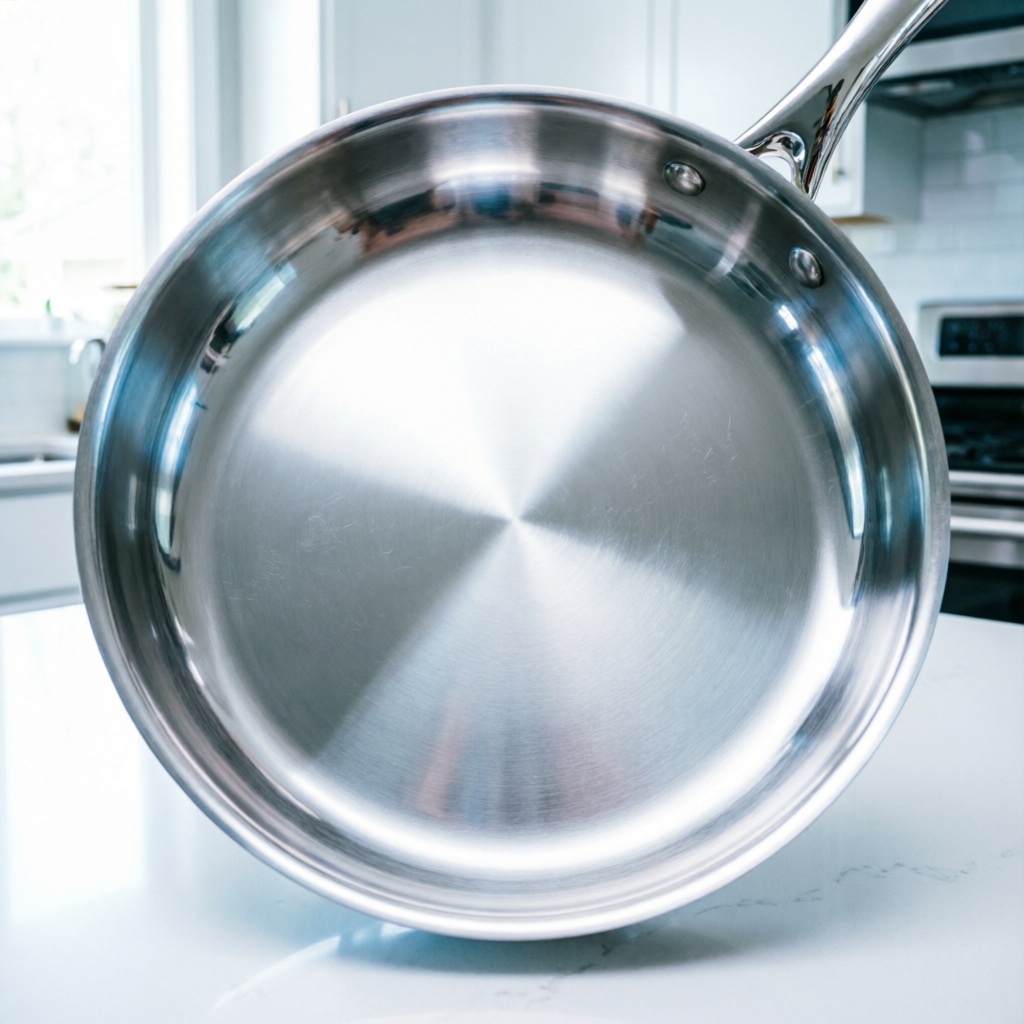
A pan that’s seen six months of daily cooking looks different from a new one. Duller. Greyer. Not damaged — just accumulated micro-abrasions and light surface oxidation. Getting it back to looking new takes about ten minutes.
Bar Keepers Friend: The Actual Answer
1
Wet the pan surface lightly
Just enough moisture to work the powder into a paste. Too much water dilutes the product and reduces effectiveness.
2
Sprinkle Bar Keepers Friend, spread into a paste
BKF contains oxalic acid — dissolves iron oxide, rust tints, and oxidation discoloration — and fine feldspar particles as a polish abrasive. It’s mild enough to use on stainless but effective enough to work where soap fails entirely.
3
Find the grain and scrub parallel to it
Hold the pan under good light. You’ll see a faint linear brush pattern in the steel — this is the “grain.” Always scrub in the same direction as this pattern, not across it. Cross-grain scrubbing creates visible swirls that dull the pan permanently.
4
Don’t exceed 60 seconds contact time
Oxalic acid works quickly. Longer isn’t better — extended contact can micro-etch the surface on softer stainless alloys.
5
Rinse thoroughly, dry with microfiber, buff lightly
The difference is immediate. The surface should be noticeably brighter. If one pass wasn’t enough, do a second — but rinse completely between passes.
💡 How Often?
Monthly on daily-use pans. Weekly if you cook a lot of protein (steaks, chicken thighs) which leaves more residue. Daily BKF is overkill — the mild abrasion adds up and you’ll dull the finish faster than the cooking would.
What NOT to Do When Cleaning All-Clad
The specific mistakes that actually damage these pans are narrower than most guides suggest. Most warnings are overcautious. A few are genuinely critical. Here’s the honest split.
✅ Do These Things
Deglaze immediately after cooking
Use Bar Keepers Friend for deep clean
Dry the pan right after washing
Scrub with the grain of the steel
Cook on medium to medium-high heat
Use non-scratch pads only
Preheat properly before adding oil
❌ Never Do These
Plunge hot pan into cold water
Use steel wool or abrasive green pads
Apply bleach or chlorine cleaners
Daily dishwasher use
Preheat empty pan on max heat
Leave acidic food (tomato, wine) overnight
Scrub across the grain
The Dishwasher Reality
All-Clad markets these pans as dishwasher-safe. That’s technically accurate. Practically speaking, modern dishwasher detergents are high-alkaline and often chlorine-based. Repeated cycles dull the finish and gradually degrade the adhesive bonding between the steel layers. An occasional dishwasher run — you’re sick, exhausted, whatever — won’t harm a pan. Making it a daily habit will visibly affect appearance within a year.
Bleach and Chlorine
Chlorine ions attack chromium oxide — the protective layer that makes stainless steel stainless. The result is pitting: small dark craters in the surface that are permanent. Never use chlorine bleach on All-Clad. Be careful with certain dishwasher pods that have high chlorine content — another reason to hand wash when possible.
The High Heat Misunderstanding
People assume more heat equals better searing. On a cast iron pan with poor heat distribution, maybe — you compensate with extra BTUs. All-Clad tri-ply distributes heat so efficiently that medium-high is genuinely high enough for almost everything. Sustained maximum heat scorches oil before it has a chance to do anything useful, creates polymerized residue, and stresses the laminate bonding. Not a cleaning issue — a cooking technique issue that creates cleaning problems.
Tools and Products That Actually Work
Product
Use Case
Why It Works
Watch Out For
Bar Keepers Friend (powder)
Deep clean, shine restoration, burnt residue, black rings
Oxalic acid dissolves iron oxide; feldspar polishes without deep scratching
Don’t leave on more than 60 sec; rinse completely
White vinegar
Rainbow stains, mineral deposits, water spots
Acetic acid dissolves chromium oxide buildup and calcium carbonate
Don’t use on cast iron or carbon steel — stainless only
Mild alkaline (pH ~9) breaks protein bonds; safe, gentle abrasive
Won’t handle heavy polymerized oil alone — combine with BKF for that
Scotch-Brite Non-Scratch Pad (blue/white)
Daily scrubbing, BKF application
Soft enough not to scratch stainless, firm enough to scrub effectively
Green Scotch-Brite pads are too abrasive — avoid those
Microfiber cloth
Drying, post-BKF buffing
Pulls water off completely without leaving lint or streaks
Wash regularly — a microfiber with grease embedded in it streaks
Dawn dish soap
Daily cleaning
Degreasing surfactants cut through cooking oil effectively
Generic dish soap works fine too — Dawn’s degreasing formula is marginally better on cooking fats
Wooden or silicone spatula
Deglazing, scraping warm residue
Safe on heated stainless; won’t scratch the cooking surface
Metal utensils over time leave small scratches that accumulate
💬 What’s Actually Under My Sink
One container of Bar Keepers Friend powder, a bottle of white vinegar, a box of baking soda, and two blue non-scratch Scotch-Brite pads. Total cost around $12. That’s everything needed to maintain All-Clad for the next decade.
Maintenance Tips to Keep All-Clad Clean Longer
The cleanest pans aren’t cleaned better — they’re used better. Small technique adjustments upstream prevent most of the serious cleaning work downstream.
The Water Test (Most Useful Habit)
Before adding oil, flick a few drops of water into the preheating pan. If they evaporate instantly — the pan is too hot. If they form balls that skitter across the surface (Leidenfrost effect) — perfect temperature. Add oil at this point. It spreads in a thin, even layer across pores that are just open enough to distribute it. Food releases cleanly. Far less residue after cooking.
Medium Heat Is Actually Enough
This took me a while to internalize. All-Clad’s tri-ply design — stainless, aluminum core, stainless — conducts and distributes heat so well that medium heat on most home burners equals what you’d get from high heat on a cheap thin pan. Once I stopped reaching for the max dial, the polymerized oil buildup dropped significantly. Fewer deep cleaning sessions per month.
Deglaze Within Two Minutes
The habit that eliminates most cleaning problems. Two minutes after you plate the food, splash of water in the still-warm pan, wooden spoon across the surface. The residue is soft, the pan is warm enough to loosen it, and the whole thing wipes out with one pass of a sponge. Eleven years of this habit means I rarely spend more than three minutes cleaning any pan.
Storage (The Overlooked Part)
Stacking pans directly? The rim of the pan above scratches the cooking surface of the pan below. Over months this creates a network of fine scratches that food catches in. Use pan protectors or a folded dish towel between stacked pans. Or hang them. Either works.
Common Mistakes People Make Cleaning All-Clad
Waiting Too Long
The single most impactful mistake. Thirty-minute-old stuck food versus twelve-hour-old stuck food require completely different effort levels. The same residue that a warm deglaze removes in twenty seconds requires a baking soda boil and BKF scrub after sitting overnight. Don’t let it sit.
Confusing Cosmetic Stains with Structural Damage
Rainbow stains look like heat damage. Mineral deposits look like etching or coating failure. White haze looks alarming. None of these are functional problems — stainless steel doesn’t have a coating that fails, the cooking surface is the metal itself. If a pan cooks evenly and doesn’t leak, it’s not damaged. Stains are stains.
Using the Wrong Abrasive
Steel wool removes stains. It also creates microscopic gouges that collect food, accelerate future staining, and can’t be reversed. Bar Keepers Friend with a non-scratch pad removes the same stains with no surface damage. There’s no scenario where steel wool is the right choice on stainless steel cookware.
Treating Maximum Heat as a Default
Most home cooks preheat on high out of habit. On All-Clad specifically, this causes oil to smoke and polymerize before food even enters the pan — and creates a dark ring of carbonized oil that requires BKF and actual effort to remove. Medium to medium-high preheating, water test to check temperature, then oil. Problem mostly disappears.
Forgetting the Exterior
The cooking surface gets all the attention. The exterior bottom — where the pan contacts the burner — collects just as much polymerized oil and mineral deposits. Same cleaning methods apply: BKF paste along whatever directional grain exists on the outside. A monthly pass keeps it from building up into a thick, difficult layer.
FAQ: Cleaning All-Clad Stainless Steel Pans
How do you clean a burnt All-Clad pan?
Fill the pan with water to cover the burnt area, add 2 tablespoons of baking soda, and bring it to a boil. Simmer for 5–10 minutes — the alkaline solution at boiling temperature breaks down carbonized proteins and polymerized oil. After cooling, scrape gently and follow with a Bar Keepers Friend paste scrub along the grain of the steel. For severe burns, this may take two or three passes. Works on 95% of burnt All-Clad situations.
Is Bar Keepers Friend safe for All-Clad pans?
Yes — and it’s the best cleaning product available for stainless steel cookware. Bar Keepers Friend contains oxalic acid, which dissolves iron oxide and discoloration without damaging the steel, and a fine feldspar abrasive that polishes rather than gouges. All-Clad’s care documentation specifically recommends it. The only rule: don’t leave it in contact with the surface for more than a minute, and rinse completely after use.
Why does my All-Clad pan turn rainbow colors?
Rainbow discoloration is chromium oxidation — the chromium in 18/10 stainless forms a thicker protective oxide layer when exposed to high heat. Light refracts through different thicknesses of this layer and produces visible spectrum colors: blue, gold, purple. It is not damage. It’s the steel’s protective mechanism activating. Fix it with undiluted white vinegar (sit 2–3 minutes, wipe, rinse) and it disappears completely. To prevent it, don’t preheat an empty pan on high for more than 30–45 seconds.
Can you put All-Clad in the dishwasher?
All-Clad labels their pans as dishwasher-safe, and an occasional run won’t cause harm. Regular dishwasher use is a different story — high-alkaline, often chlorine-based detergents dull the finish over time, and the repeated thermal cycling stresses the bonding between the steel layers. The pans don’t fail catastrophically, but their appearance degrades meaningfully over a year of daily dishwasher use compared to hand washing. Hand washing is the right long-term choice.
How do you make All-Clad shiny again?
Bar Keepers Friend. Wet the surface, sprinkle the powder, work it into a paste, scrub with a non-scratch pad parallel to the grain of the steel (not across it — that creates swirl marks). Rinse completely within 60 seconds of application. Dry immediately with a microfiber cloth and buff lightly as you dry. One pass restores most of the shine; two passes handles pans with more buildup. Do this monthly on pans you use daily.
How do you remove black residue from All-Clad?
Black residue is polymerized oil — overheated cooking fat that cross-linked into a hard layer. Boil water and 2 tablespoons of baking soda in the pan for 5–10 minutes to chemically soften the layer. Cool, scrape gently, then apply Bar Keepers Friend paste and scrub along the grain with a non-scratch pad. Do not use steel wool — it scratches the surface while only partially removing the residue, making the problem worse and permanent.
Why do white spots appear on All-Clad pans?
White spots and chalky haze are calcium and magnesium deposits from hard water — they form when tap water evaporates and leaves minerals behind. No safety concern, no functional impact on cooking. Remove them by simmering equal parts white vinegar and water in the pan for 5 minutes. The acetic acid reacts with calcium carbonate and dissolves it completely. Prevent recurrence by drying the pan immediately after washing.
Can I use baking soda and vinegar together on All-Clad?
Yes — and the combination is useful for moderate burns. The acid-base reaction between acetic acid and baking soda produces CO₂ bubbles that mechanically agitate loosened residue. The reaction itself isn’t chemically aggressive to stainless steel. That said, don’t use them simultaneously as a primary cleaning strategy — the reaction neutralizes both agents quickly. More effective to use vinegar to pre-soak, then baking soda paste to scrub, as sequential steps rather than simultaneously.
⬇️ Bottom Line
The Simplest Way to Keep All-Clad Clean Long-Term
Three habits cover 90% of it. Not products. Habits.
Deglaze while warm — water + wooden spoon, twenty seconds, immediately after plating. Eliminates most stuck food before it becomes a problem.
Hand wash, dry right away — dish soap, non-scratch pad, microfiber cloth. Three minutes total.
Bar Keepers Friend once a month — five minutes, along the grain, rinse completely. Handles any buildup before it becomes permanent.
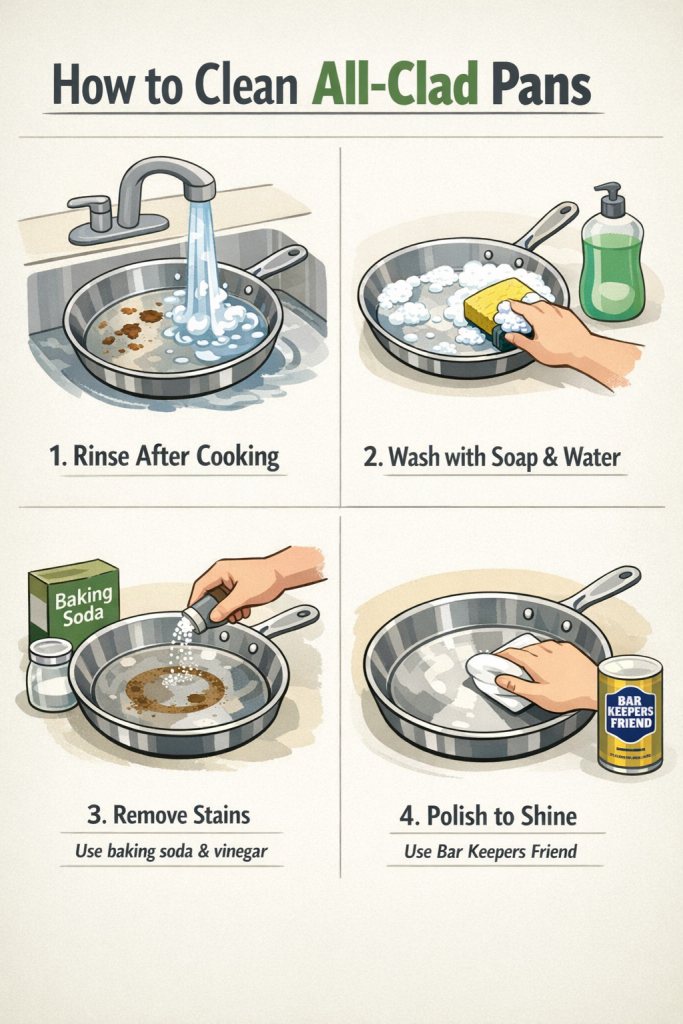
When things go wrong — and they will — the toolkit is simple: baking soda boil for burns, white vinegar for rainbow stains and mineral spots, Bar Keepers Friend for restoration. No specialty products. No complicated procedures.
These pans are built to cook for decades. The only things that shorten that are steel wool, chlorine cleaners, and letting residue harden over time. Avoid those three and clean consistently — honestly, eleven years in, my original All-Clad d5 looks better than most pans I’ve seen at five years. That’s what proper maintenance actually does.
✨ See the Transformation
Drag the slider to reveal the magic of proper All-Clad cleaning
BeforeAfter
🍳 What's on Your Pan?
Tap your mess type to get the perfect cleaning method
🔥Stuck-On Food
🌈Rainbow Stains
⚪White Film
💀Severe Burnt
🍖 Removing Stuck-On Food Easy
1Fill the pan with warm water and a drop of dish soap. Let it sit for 15 minutes.
2Gently scrub the surface with a nylon pad or non-abrasive sponge.
3For stubborn spots, use Bar Keeper's Friend with a soft cloth.
4Rinse thoroughly with warm water and dry immediately with a soft towel.
🌈 Removing Rainbow Stains Easy
1Rainbow stains are harmless mineral deposits from cooking heat.
2Pour a small amount of white vinegar into the pan.
3Wipe with a soft cloth until the rainbow disappears completely.
4Rinse with water and dry. No scrubbing needed!
⚪ Removing White Film (Hard Water) Easy
1This is calcium from hard water — completely normal and safe.
2Mix equal parts white vinegar and water in the pan.
3Bring to a gentle boil, then let it cool for 10 minutes.
4Discard the solution, wash with soap, rinse, and dry.
💀 Removing Severe Burnt Residue Advanced
1Fill the pan with water and 2 tbsp baking soda. Bring to a boil.
2Reduce heat and simmer for 15-20 minutes. The burnt food will loosen.
3Let the pan cool until safe to handle, then gently scrub with a nylon pad.
4For extreme cases: apply Bar Keeper's Friend paste, wait 5 min, then scrub and rinse.
🧠 Test Your Knowledge
Do you really know how to care for All-Clad? Take the quiz!
Question 1 of 6
Is it safe to use steel wool on All-Clad stainless steel pans?
✅ Correct! Never use steel wool! It scratches and dulls the polished surface permanently. Use nylon pads or Bar Keeper's Friend instead.
❌ Not quite! Never use steel wool! It scratches and dulls the polished surface permanently. Use nylon pads or Bar Keeper's Friend instead.
Question 2 of 6
Can you put All-Clad pans in the dishwasher?
✅ Correct! All-Clad stainless steel is dishwasher safe, though hand washing helps maintain the shine longer.
❌ Not quite! All-Clad stainless steel is dishwasher safe, though hand washing helps maintain the shine longer.
Question 3 of 6
Should you let your pan cool completely before washing?
✅ Correct! It's best to let it cool to warm before washing. Extreme temperature changes can cause warping.
❌ Not quite! It's best to let it cool to warm before washing. Extreme temperature changes can cause warping.
Question 4 of 6
Does All-Clad recommend Bar Keeper's Friend for cleaning?
✅ Correct! All-Clad officially recommends Bar Keeper's Friend for removing stubborn stains and restoring shine.
❌ Not quite! All-Clad officially recommends Bar Keeper's Friend for removing stubborn stains and restoring shine.
Question 5 of 6
Should you use cooking spray on All-Clad pans?
✅ Correct! Cooking sprays contain additives that build up a gummy film that's very hard to remove. Use regular oil or butter instead.
❌ Not quite! Cooking sprays contain additives that build up a gummy film that's very hard to remove. Use regular oil or butter instead.
Question 6 of 6
Can you use bleach on All-Clad pans to remove stains?
✅ Correct! Never use bleach! It can corrode the stainless steel. Stick to vinegar, baking soda, or Bar Keeper's Friend.
❌ Not quite! Never use bleach! It can corrode the stainless steel. Stick to vinegar, baking soda, or Bar Keeper's Friend.
0/6
🏆 All-Clad Expert!
You scored 100% on All-Clad care knowledge
🃏 Safe or Unsafe for All-Clad?
Tap to decide — is each item safe to use on your pan?