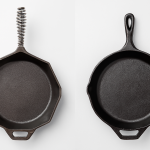
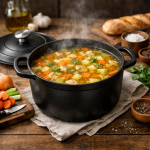
The legs were touching the walls and I put the lid on anyway. Figured the margin would be fine.
One side of that chicken roasted. The other side looked like it had been steaming in a Tupperware. Same bird, same recipe, same oven — just a 4.5-pound chicken in a 5-quart Lodge with nowhere to go.
That was three years ago. I’ve cooked maybe thirty-five whole birds in Dutch ovens since, in five different pots, keeping notes in a Google doc my wife treats as evidence of a problem. Some of those cooks were great. A few were bad in instructive ways. Here’s what I actually learned, including the parts that don’t fit a clean narrative.
The Answer
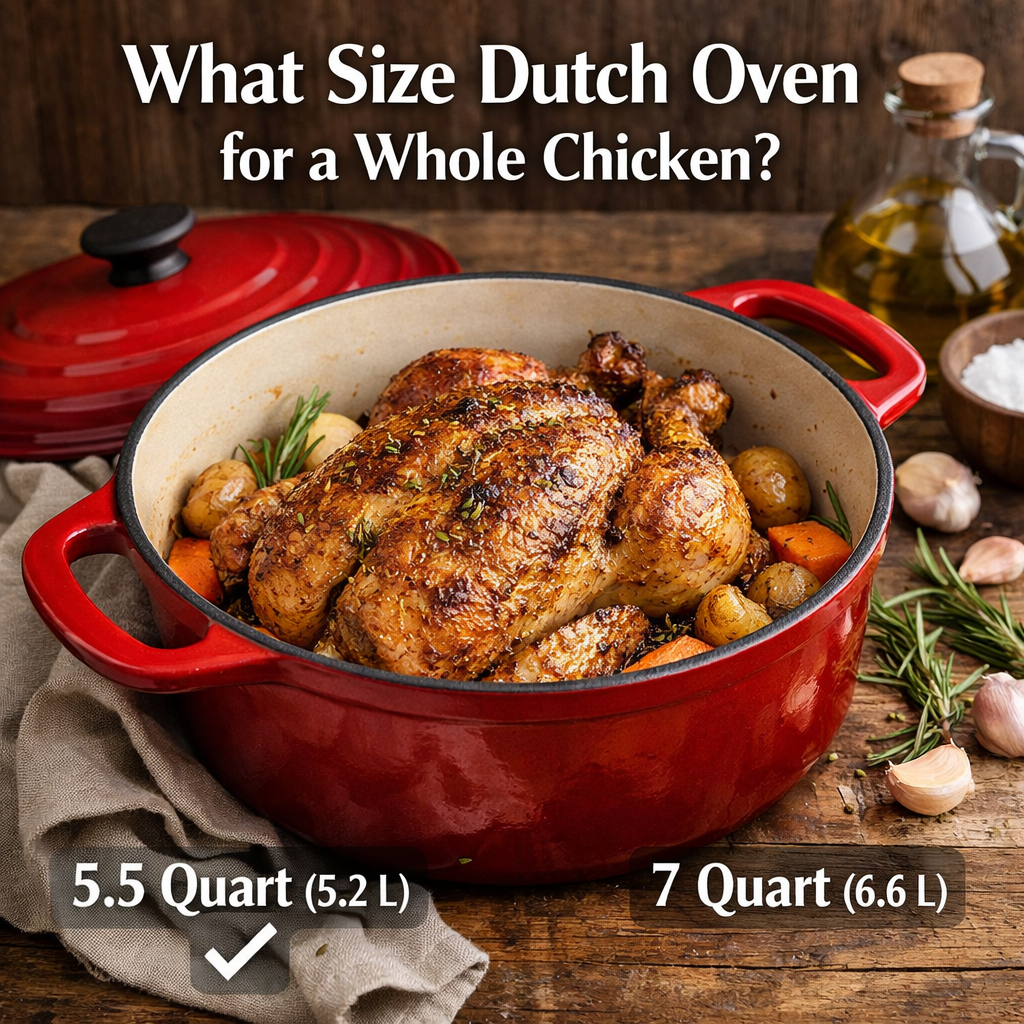
6-quart round Dutch oven.
Fits the 4 to 5-pound bird your grocery store stocks with about an inch of clearance on each side. Room for vegetables. Works on the stovetop for searing. That’s the recommendation and most people can stop reading here.
Chicken Weight
Lid Closes
Cooks Properly
With Vegetables
3–3.5 lb
4 qt
5 qt
5.5 qt
4–4.5 lb
5 qt
6 qt
6–7 qt
4.5–5.5 lb
5.5 qt
6–7 qt
7 qt
5.5–6.5 lb
6.5 qt
7 qt oval
7.5–8 qt oval
6.5 lb+
7 qt
8 qt oval
9 qt oval
“Lid closes” and “cooks properly” are two different columns. Every other article on this topic collapses them into one. That’s the whole error.
The Quart Number Doesn’t Tell You What You Need
Volume is width times depth. A tall narrow 6-quart and a short wide 6-quart have identical volume on the label and completely different floor space inside.
For chicken, floor space is the only measurement that matters. Interior base diameter. A trussed 4-pound bird has a footprint of roughly 9 to 10 inches — you need 10.5 to 11 inches of interior base to fit it without wall contact. Standard 5-quart: about 9.5 inches. Standard 6-quart: about 11.
One inch. That’s the whole argument.
Lodge’s official size guide says 5 or 6-quart handles “up to 4 pounds,” 7 or 7.5-quart handles “up to 6 pounds.” Useful starting framework. But Lodge is measuring lid-closes, not cooks-properly. Not the same question and they’re not pretending it is — they’re just not making the distinction explicit.
5-Quart: When It Works and When It Doesn’t
Under 4 pounds — genuinely fine. Bird sits in with a real gap on each side, steam circulates, skin gets colour when you pull the lid for the final stretch. No complaints.
At 4.5 pounds the legs press outward against the walls. Contact happens. And during the 45-minute covered phase — the part that’s supposed to create a warm humid envelope around the bird — the skin at those contact points is instead sitting wet against cast iron.
Wet skin doesn’t crisp. It comes out grey, slightly tacky, like something that surrendered. The top of the bird browns fine when the lid comes off. The sides don’t recover. 20 minutes of open roasting at 450°F can’t fully undo what happened in the first 45.
You could argue bird shape matters too — some chickens are wider, some taller, and lid fit varies by brand. Fair. But across my testing, 4.5 lbs is reliably where the 5-quart starts producing a bird that’s visibly uneven on the plate.
If you already own a 5-quart, use it for smaller birds. If you’re buying today, the gap between Lodge’s 5-quart and 6-quart is about twenty dollars.
What Changes at 6 Quarts
The extra inch isn’t comfort room. It changes the physics.
Steam with nowhere to go just sits against the skin. Steam with an inch of clearance actually moves — up the sides, across the breast, back down, around the whole bird. That circulation is what creates even heat distribution during the covered phase. The covered phase isn’t about cooking the bird through; it’s about building a humid environment that protects the breast from drying out while the thighs catch up. Size determines whether that environment forms or not.
Drippings land differently too. In a tight pot, fat dripping off the bird hits the hot vertical walls and scorches there — bitter deposits instead of usable fond. In a properly sized pot everything falls clean to the base. That dark concentrated layer at the bottom of the pot is where the flavour lives, the stuff you deglaze with wine at the end. Scorching it against the walls is a real loss, not a minor one.
And — this sounds trivial until it happens to you — getting the bird out. I have a small scar on my left forearm from working tongs into 1.5 inches of clearance at 450°F with steam rising. In a 6-quart with a 4.5-pound bird, you get a large fork in each end and lift cleanly. Uneventful. That’s the goal.
What Happens When the Pot Is Too Big
My neighbour has a 9-quart. I borrowed it once out of curiosity.
Same 4-pound bird, same recipe, same temperature. Breast came out noticeably drier. The steam the chicken generates during the covered phase has to fill the entire interior volume before it creates any kind of meaningful humid environment — in a 9-quart with a 4-pound bird, it just dissipates. Disappears into empty space. The chicken was essentially in a regular oven with a lid on.
Vegetables spread thin across a wide base charred on the outer edges while the center stayed pale. Drippings evaporated. The whole logic of one-pot cooking — everything concentrated in one space, flavours building together — stops working when the pot is disproportionate to the bird.
Bigger is not more forgiving. Fit is the variable.
Round vs. Oval
Chickens aren’t round. An oval pot follows the bird’s actual shape, wastes less interior space, gives you more usable floor area at the same quart number.
But ovals sit across two burners. On most home ranges — gas especially — one end runs hotter than the other. If you sear skin-side down on the stovetop before the oven, that uneven heat makes uneven browning on the breast. Not a disaster, just mildly annoying and visible when you’re carving.
On induction it’s worse. The heating element is round and an oval pot hanging over the edges heats unevenly enough to matter.
I reach for my round 6-quart more because I always sear first and the even stovetop heat matters to me. For straight-to-oven cooking or birds over 5 pounds, the oval 7-quart is genuinely the better vessel. If you’re buying one Dutch oven and you know you’ll sear on the stovetop: round. If you mostly go straight into the oven: oval.
By Situation
Two people, birds under 4 lbs: 5-quart is fine. Seriously, don’t buy anything.
Family of four, regular weeknight bird: 6-quart round. This covers most people and most situations.
Six-plus people, or meal prep with larger birds: 7-quart oval. A 5.5-pound bird in a 6-quart round works but you feel the compromise in the result — the skin on the thigh sides is always slightly less good.
One pot that handles everything: 6-quart round. Chicken, bread, braises, stew, pasta sauce. The size that just disappears into cooking without being the problem.
Brands — The Unsentimental Version
Cooking results between Lodge and Le Creuset for whole chicken are not meaningfully different. Same technique, same timing, same temperature — the chicken tastes the same coming out of both.
What actually differs:
Lodge Enameled 6-quart. Interior base runs slightly small — closer to 9.5 inches than 11. Enamel chips with rough use. Mine has chips after four years of daily cooking. Still makes excellent chicken. Around $60 on sale, sometimes less.
Tramontina 6.5-quart. Wider interior than Lodge at comparable quart sizes. Lid fits well. Around $50 at Costco sometimes. If I were starting from scratch today this is what I’d buy.
Staub 7-quart oval. Dark matte interior creates more fond — the rougher surface texture gives browning reactions more to grab onto and you can taste the difference in the drippings. Self-basting lid spikes redistribute condensation during the covered phase more evenly than a flat lid. The dark interior makes it harder to monitor fond development compared to Le Creuset’s light sand interior, which is a real practical difference if you cook on the stovetop frequently. Best single vessel for whole chicken if budget is flexible.
Le Creuset 6.75-quart round. Wider base than most competitors at this quart size — among the roomier interiors in the 6-ish-quart category. Light interior makes fond monitoring easy. Lid fit is excellent. Enamel holds up over a decade of hard use in a way Lodge doesn’t. Hard to justify $350 on cooking performance alone. Buy it if you want to purchase cookware once and genuinely never think about it again — it’s a different object in daily use even if the chicken tastes the same.
For most people: Tramontina 6.5-quart. Honest answer.
Technique That Actually Changes the Result
Dry the skin overnight. Season the bird, put it uncovered on a rack in the fridge, leave it eight hours minimum. Skin that’s been air-drying overnight is already partially dehydrated before it hits the pot — it crisps faster, more completely, and more evenly than anything you do at cook time. Wet skin steams. This is honestly a bigger variable than pot size for skin quality. I do it maybe half the time on weeknights. The nights I don’t, I notice.
Truss the bird. Untrussed legs splay outward and expand the footprint by an inch and a half. Two minutes of kitchen twine. A comfortable 6-quart stays comfortable.
Preheat the empty pot. 450°F, ten minutes, nothing in it. Cold chicken hitting screaming hot cast iron gets immediate contact browning on the underside — the start of real fond. Skip this step and the bottom just sits in rendering fat.
Elevate the bird. Rack, or halved onions and carrots flat on the base. Keeps bottom skin out of pooling drippings. Also means every drop of fat the chicken releases goes directly onto the vegetables for the entire cook — which is why Dutch oven vegetables are actually worth eating rather than just decorative.
45-50 minutes covered, 20-25 uncovered. Don’t change this ratio trying to chase more colour. Want more browning? Raise the temperature to 475°F for the uncovered phase. Don’t extend the time — the breast dries out.
FAQ
Is a 5-quart Dutch oven big enough for a whole chicken? Under 4 pounds, yes. Standard 4 to 4.5-pound grocery store bird — uneven skin, uneven doneness. Own a 5-quart already? Use it for smaller birds. Shopping now? Get the 6.
Can you roast a chicken in a 4-quart Dutch oven? Cornish hen, very small broiler, maybe a 3-pounder. Standard whole chicken won’t fit cleanly — lid doesn’t close properly, cooking environment breaks down.
Is oval better than round for chicken? Better fit for the bird’s shape, worse stovetop performance. Oven-only cooking: oval wins. Stovetop sear then oven: round is more practical. One pot for both: round 6-quart.
How much clearance do you need around the chicken? At least 1 inch between bird and wall. Less and you’re steaming skin against cast iron. More than 2.5 inches and you lose the steam environment that keeps the breast moist.
Best single Dutch oven if you only ever buy one? 6-quart round. Handles almost everything a home cook does. Fits any burner and any oven. Never the problem.
Bottom Line
6-quart round Dutch oven.
Tramontina 6.5-quart if cost matters — around $50 to $60, genuinely excellent. Le Creuset 6.75-quart if you want to buy once and never revisit the question. Lodge 6-quart if it’s on sale and the enamel situation over the years doesn’t bother you.
Cook a 4 to 4.5-pound bird. Dry the skin overnight if you can manage it. Truss it. Preheat the empty pot ten minutes at 450°F. Halved onion and two carrots on the bottom, chicken on top. Lid on 45 minutes, lid off 25 minutes.
The pot size is doing more work than most people give it credit for.