✍️ 12+ years cooking on cast iron daily🔄 Updated April 2026
Cast iron skillet, baking soda (sodium bicarbonate), polymerized oil seasoning, rust removal, re-seasoning — this guide covers all of it. When baking soda is the right tool, when it damages your seasoning, and exactly what to do after every use so your pan keeps improving for years.
I ruined a patch of seasoning on my Lodge skillet doing this wrong. Not catastrophically — but I could see exactly where I’d over-scrubbed with baking soda paste and didn’t oil the pan fast enough afterward. Gray, matte, slightly rough. Stuck on my next cook right in that spot.
Took three uses to recover it. That mistake was useful. I now know exactly how baking soda behaves on cast iron — what it actually does to the seasoning, how long is too long, when salt scrub is the better call, and why the re-season step people skip is the only part that really matters.
⚡ Quick Answer — How to Clean Cast Iron Skillet with Baking Soda
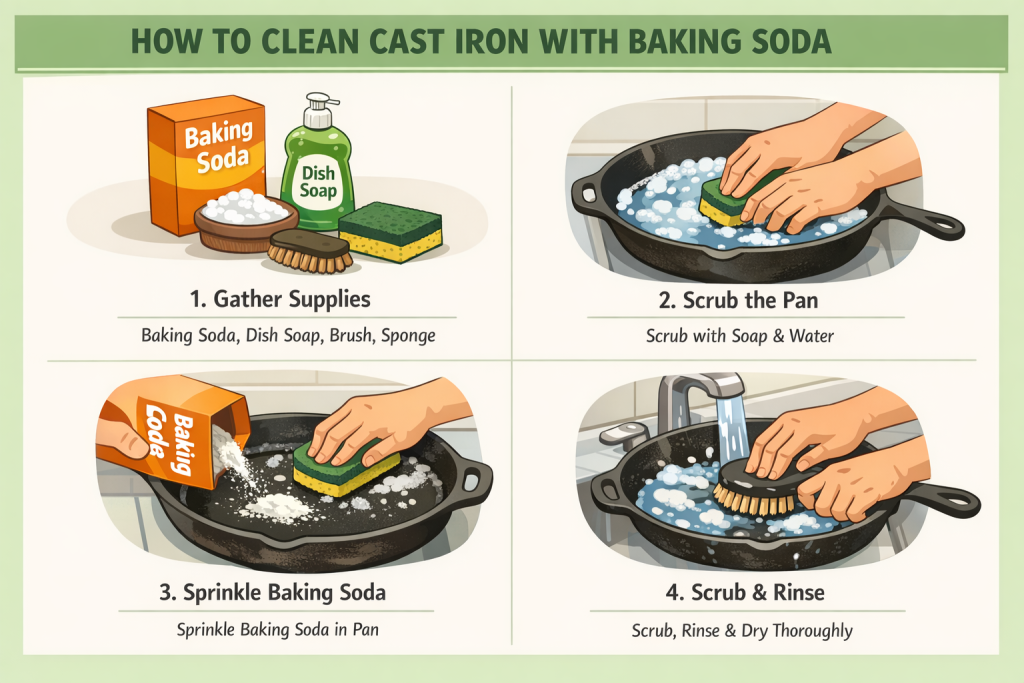
Step-by-Step: Baking Soda on Cast Iron
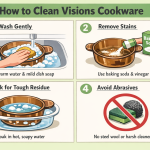
Make a thick paste — 1 tbsp baking soda + a few drops of water; consistency of wet sand, not runny
Apply only to the problem area — stuck food, rust spot, carbon buildup; don’t paste the whole pan unnecessarily
Scrub 30–60 seconds — stiff brush or chain mail scrubber, firm circular motion; stop when residue lifts
Rinse immediately and completely — every extra minute of alkaline contact = more seasoning exposure
Dry on the stove — low heat, 2–3 minutes; never air-dry cast iron, ever
Oil the surface while still warm — thin coat of vegetable oil, Crisco, or flaxseed; buff until barely shiny; this step is non-negotiable
What Baking Soda Actually Does to Cast Iron Seasoning
Cast iron seasoning isn’t a factory coating. It’s polymerized oil — layers of fat and cooking grease that bonded to the iron surface under heat and transformed into a hard, semi-nonstick polymer layer. Every time you cook with oil, you add to it. That’s what makes a well-used skillet cook better than a new one.
Baking soda — sodium bicarbonate, pH 8–9 — is mildly alkaline and mildly abrasive. Those two properties make it useful for breaking down stuck food residue. They’re also what makes it risky on seasoning. The alkalinity attacks the polymerized oil layer gradually. The abrasive particles scour it.
The pH Problem Explained Simply
The lye baths that collectors use to strip cast iron entirely run at pH 13. Baking soda at pH 9 is mild by comparison — but the pH scale is logarithmic. pH 9 is ten times more alkaline than neutral water. Used briefly and rinsed fast, the damage to seasoning is minimal. Left on for 30 minutes, or scrubbed repeatedly across the whole pan, it strips measurable amounts of the polymerized layer.
That’s why the method matters as much as the ingredient. Targeted use, brief contact, immediate rinsing — fine. Full-pan paste left while you do dishes — real damage.
The Abrasion Problem
Baking soda’s abrasive particles are softer than steel wool — they won’t gouge the iron. But seasoning is also softer than iron. Heavy scrubbing with baking soda paste on a lightly seasoned pan removes the polymer layer mechanically, separate from any chemical effect. America’s Test Kitchen found that vigorous scrubbing with any abrasive on cast iron removes more seasoning than gentle scrubbing — the chemistry matters less than the pressure.
Cleaning Agent
pH
Abrasive?
Seasoning Risk
Best Use
Hot water + brush
7 (neutral)
No
None
Daily cleaning — always try first
Coarse kosher salt
Neutral
Yes (mild)
Minimal with light pressure
Stuck food — best low-risk option
Baking soda paste
8–9
Yes (mild)
Low–moderate with immediate rinse
Stuck food, rust spots, carbon buildup
Dish soap (small amount)
8–9
No
Minimal with brief contact
Occasional deep clean — myth-busted
White vinegar (diluted)
2.5
No
High — strips fast, causes rust
Heavy rust only, under 1 min, immediate re-season
Chain mail scrubber + water
Neutral
Yes (moderate)
Low on well-seasoned pans
Stuck food when salt/baking soda won’t budge it
Steel wool
Neutral
Yes (aggressive)
Removes all seasoning
Full strip + re-season only — nuclear option
Bleach / harsh chemicals
12+
No
Destroys seasoning, pits iron
Never
When to Use Baking Soda on a Cast Iron Skillet — and When Not To
Most guides get this backwards. They either treat baking soda like a miracle cleaner for cast iron (too casual) or warn you away from it entirely (too cautious). The honest answer is situational.
✅ Use it
Stuck-on food that hot water and brushing won’t shift
Thick paste, targeted to the stuck area, 30–60 seconds of scrubbing, immediate rinse, oil coat. This is the best use case — effective without much seasoning risk if done correctly.
✅ Use it
Light surface rust spots (early rust, not deep pitting)
Baking soda paste is abrasive enough to lift early-stage iron oxide without the aggression of steel wool. Good for small spots. Full oven re-season required after.
✅ Use it
Odor neutralization after strong-smelling food
Baking soda has mild antibacterial properties and neutralizes odors from fish, garlic, or other pungent ingredients. Rinse immediately, dry on stove, thin oil wipe — quick and effective.
⚠️ Use carefully
Carbon buildup on the cooking surface (boil method)
The baking soda boil method works on baked-on carbon deposits but removes seasoning alongside the buildup. Full oven re-season after — not just an oil wipe.
❌ Skip it
Daily or routine cleaning after normal cooking
Hot water and a stiff brush — or kosher salt — handle normal cooking residue without touching the seasoning. Baking soda for daily cleaning slowly degrades what you’ve built. Not worth it.
❌ Skip it
New pans or lightly seasoned skillets (under 6 months of regular use)
A pan with 2–4 thin seasoning layers has almost nothing to spare. Salt scrub or plain hot water only. Baking soda on a barely-seasoned Lodge sets back weeks of careful cooking.
❌ Skip it
Enameled cast iron (Le Creuset, Staub, Lodge Enameled)
Completely different surface. The enamel is a glass-like coating — baking soda’s abrasive can scratch it with repeated use, leading to chipping. Use soft sponge and mild soap on enameled cast iron.
How to Clean Cast Iron with Baking Soda: Full Step-by-Step Method
This is the complete process — from making the paste to re-seasoning after. Every step matters. The ones people skip (the immediate rinse, the stove drying, the oil coat) are exactly the ones that cause the problems they’re trying to avoid.
1
Let the pan cool to warm — not cold, not hot
Around 5 minutes off the heat. A warm pan opens the pores slightly and responds better to cleaning. A cold pan makes residue harder and stickier. A hot pan makes baking soda paste cook into the surface. Warm is the target.
2
Try hot water and a stiff brush first — always
A Lodge Scrub Brush or stiff-bristled brush with hot running water solves most stuck-food situations without touching the seasoning. If this works, stop here. Baking soda is a step two, not step one.
3
Make a thick baking soda paste — drier than you think
One tablespoon baking soda, a few drops of water. The consistency should be like wet sand or thick toothpaste — spreadable but not runny. Runny paste stays wet longer in the pores, extending alkaline contact with the iron. Thick paste does the work and rinses out faster.
4
Apply only to the problem area — targeted, not total coverage
Use a spoon or your finger to place the paste directly on the stuck spot, rust patch, or carbon buildup. Don’t spread it across the whole cooking surface if only 20% of the pan needs help. Proportional application = proportional seasoning risk.
5
Scrub in firm circular motion — 30 to 60 seconds maximum
Use a stiff brush, a Lodge chain mail scrubber, or the rough side of a non-scratch pad. Firm but not violent pressure. You’ll see residue lifting — stop when it looks clean. Extended scrubbing after the food has released just removes seasoning.
6
Rinse immediately under hot running water — completely
The moment you stop scrubbing, rinse. Every extra minute of baking soda contact is unnecessary alkaline exposure to the seasoning. Rinse until water runs clear and you feel no grit. Check the edges and handle — paste collects there.
7
Towel dry, then 2–3 minutes on low heat on the stove
Towel first, then burner. Cast iron has microscopic pores that trap water a towel can’t reach. Two minutes on low heat drives off every trace of moisture. Skip this and you’ll find rust spots within 24 hours, especially in humid climates.
8
Oil immediately while the pan is still warm — thin coat, buffed off
Half a teaspoon of vegetable oil, Crisco, flaxseed oil, or any neutral cooking fat. Wipe it across the cooking surface with a paper towel. Then buff it off until the pan looks barely shiny — not wet, not greasy. If you can see oil traces on a finger swiped across the surface, there’s too much. Buff again. This step rebuilds what the cleaning removed and protects against rust overnight.
💡 The Overnight Baking Soda Method
One legitimate variation: apply a thick paste to heavily burnt residue and leave it overnight without scrubbing. The alkalinity slowly weakens the bond between carbon and iron over hours. In the morning, the residue often wipes off with minimal pressure — less scrubbing means less seasoning damage. Don’t add vinegar. Dry the pan completely on the stove and oil it the moment it’s clean.
How to Remove Stuck-On Food from a Cast Iron Skillet
Stuck food happens when a pan wasn’t hot enough before adding food, wasn’t properly oiled, or when sugar-heavy ingredients caramelized harder than expected. There’s a hierarchy of approaches — start gentle, escalate only if needed.
Step 1: The Simmer Method (Gentlest — Try First)
Add water to the warm pan and put it on medium heat. Let it simmer for 3–5 minutes. The steam works under the stuck material and releases it from below. Scrape gently with a wooden spatula or Lodge pan scraper. This is Lodge’s own recommended first approach — and it works on probably 60% of stuck situations with zero impact on seasoning.
Step 2: Coarse Salt Scrub (Low Risk)
Two tablespoons of coarse kosher salt, a folded paper towel or stiff brush, firm circular scrubbing. Salt is pH-neutral and abrasive — it lifts residue mechanically without any chemical attack on the seasoning. The Kitchn’s direct comparison testing found the kosher salt method outperformed soap and water on stuck food while leaving seasoning intact. If simmer method didn’t fully work, salt is step two.
Step 3: Baking Soda Paste (When Salt Isn’t Enough)
The thick paste method described in the full step-by-step above. Targeted, brief, immediately rinsed. Use this for food that’s genuinely welded on — egg whites that seized, deeply caramelized sugars, thick protein adhesion. Works. Just oil after.
✅ Which Method Won? Real Comparison
Salt + stiff brush: handles 70% of stuck food with no seasoning risk. Baking soda paste: handles nearly all of the remaining 30%, with minimal risk if rinsed fast and followed by oil. The simmer method with water handles a huge range before either abrasive is needed. Use them in that order.
How to Remove Rust from Cast Iron with Baking Soda
Surface rust — the orange spots that appear when you left the pan slightly wet, or stored it in a humid spot — responds well to baking soda. It’s a gentler first approach than steel wool, appropriate for early-stage rust that hasn’t pitted the iron.
Light Rust Removal: Baking Soda Method
1
Mix a slightly drier paste than usual
For rust removal you want more abrasive action than chemical action. Less water in the paste concentrates the scrubbing particles against the iron oxide.
2
Apply directly to rust spots and scrub in circles
Stiff brush or the rough side of a non-scratch pad. You’ll see orange residue — iron oxide — coming off. Keep going until the spot looks gray, not orange.
3
Rinse, inspect, repeat once if needed
Rinse completely between passes to see what’s actually happening. If a faint orange tint remains, apply paste and scrub once more.
4
Stove-dry, then full oven re-season — not just a wipe
Rust spots have no seasoning left over them. A surface oil coat won’t rebuild it adequately. Oven season at 450°F for one hour after rust removal.
Heavy Rust: When Baking Soda Isn’t Enough
Pitting, flaking, orange covering most of the cooking surface — baking soda won’t cut it. Steel wool down to bare metal, full wash, complete re-season from scratch. That sounds like a lot of work but the pan comes out essentially new. Not a reason to panic, just a longer afternoon.
⚠️ Vinegar and Cast Iron — Be Very Careful
Diluted white vinegar (1:1 with water) does dissolve rust — but it also strips seasoning in under a minute and can begin leaching iron from the surface if left too long, which produces a metallic taste in subsequent cooking. If you use it: no more than 30 minutes of soak time, rinse thoroughly, immediate full oven re-season. Most people find baking soda paste and a stiff brush more forgiving.
Removing Burnt-On Carbon Buildup from Cast Iron
This is different from stuck food. Carbon buildup is the dark, rough, sometimes flaking crust that develops over months and years of high-heat cooking — layers of overcooked oil and carbonized food residue beyond the point of being useful seasoning. Too much of it makes the surface uneven and actually reduces nonstick performance.
Is It Buildup or Seasoning? How to Tell
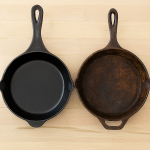
Good seasoning is smooth, dark, even, slightly matte or shiny. Carbon buildup is rough, bumpy, flaking, or has a raised crust you can feel with your fingertip. Run your finger across the surface — smooth and even is seasoning, leave it alone. Rough and gritty is buildup, needs to go.
The Baking Soda Boil Method for Carbon Removal
1
Fill pan with water to cover the buildup, add 2–3 tbsp baking soda
Bring to a boil on the stove. The alkaline boiling solution chemically softens the carbon layer from below.
2
Boil 5 minutes, scrape with wooden spatula mid-boil
You’ll see chunks and flakes of dark material lifting. This is the carbon layer releasing. Let the boil do the work — don’t scrub while it’s hot.
3
Cool slightly, scrub with stiff brush, rinse completely
The loosened material rinses away easily. If buildup remains in spots, repeat the boil once — two passes handle almost everything short of years of completely ignored buildup.
4
Stove-dry completely, then full oven re-season
The boil method removes seasoning along with the carbon. A wipe of oil isn’t enough — do the full oven season at 450°F for one hour. The pan will emerge clean, slightly gray, and ready to rebuild.
How to Re-Season Cast Iron After Cleaning with Baking Soda
Every baking soda cleaning session — no exceptions — ends with a re-season. This is the single most skipped step and the cause of 80% of the “my cast iron rusts and sticks after cleaning” complaints online. The cleaning removes some seasoning. The oil coat replaces it. Skip the oil coat and you have a clean but vulnerable pan.
Quick Re-Season: Stovetop Oil Coat (After Light Baking Soda Use)
Pan is dry and warm from the stove. Add half a teaspoon of oil — vegetable, Crisco, flaxseed, canola. Any neutral high-smoke-point fat works. Wipe it over the cooking surface with a paper towel. Then buff it off until the surface looks barely shiny, not wet. America’s Test Kitchen recommends this exact approach: “you never want the surface to be glossy and oily.” If you can see your oil, you’ve put on too much. Buff again. Heat on medium for 2 minutes. Done.
Full Oven Re-Season (After Rust Removal, Carbon Boil, or Heavy Cleaning)
1
Preheat oven to 450–500°F (230–260°C)
Lodge recommends 450–500°F. Higher temperature polymerizes the oil faster and creates a more durable bond to the iron surface.
2
Apply a very thin coat of oil to the entire pan — inside, outside, handle
Rub oil everywhere, then wipe almost all of it off with a clean paper towel. The layer should be barely visible. Thin coats polymerize into hard seasoning. Thick coats pool and cure into a sticky, gummy mess that collects debris and doesn’t provide nonstick properties.
3
Place upside-down in the oven, bake 1 hour
Upside-down prevents oil pooling in the cooking surface. Put foil on the rack below to catch any drips. The pan will smoke slightly — normal. Good ventilation or your range hood on.
4
Cool in the oven with the door closed
Slow cooling lets the polymerized layer set and bond fully. An hour is usually enough. The pan should emerge dark, smooth, and slightly matte — not shiny, not sticky.
🍳 Best Oils for Cast Iron Seasoning
Crisco / vegetable shortening — what Lodge uses from the factory; reliable, widely available, cheap. Flaxseed oil — polymerizes hardest due to high polyunsaturated fat content (68%); builds durable layers fast but expensive. Grapeseed or canola oil — good middle ground, available everywhere, high smoke point. Avoid olive oil (too low a smoke point for oven seasoning), butter (burns unevenly), and coconut oil (goes rancid in the pores over time).
Daily Cast Iron Skillet Cleaning Routine (Without Baking Soda)
Baking soda is a problem-solver, not a daily routine. For 90% of normal cooking — eggs, vegetables, seared chicken thighs — hot water and a brush is everything needed. The less intervention in the seasoning, the better it gets over time.
1
While still warm, scrub with hot water and a stiff brush
A Lodge Scrub Brush, bamboo brush, or chain mail scrubber. No soap required for daily cleaning after normal cooking — Lodge says soap is fine occasionally, but hot water and mechanical action handle residue without it when the pan is warm.
2
For anything stuck: salt scrub first
Coarse kosher salt + a paper towel or brush. pH-neutral, abrasive, zero impact on seasoning when used with moderate pressure. This solves most stuck-food situations before baking soda is ever needed.
3
Dry thoroughly — towel then stove
Every time. Low heat, 2 minutes. Cast iron’s porous surface traps moisture that causes rust faster than you’d expect. This habit eliminates 90% of rust issues.
4
Thin oil coat while warm
Half a teaspoon, buff off almost entirely, store. For a well-used pan this is maintaining, not rebuilding. Cooking itself builds the seasoning — you’re just protecting overnight.
💡 The Dish Soap Myth — Busted
The rule against soap on cast iron came from when household soap was made with lye — sodium hydroxide, pH 13 — which genuinely strips seasoning aggressively. Modern dish soap runs pH 8–9, similar to baking soda. A small amount with brief contact doesn’t damage a well-seasoned pan. Lodge’s own cleaning guide now includes soap as acceptable. That said, hot water and brush is faster and has zero risk — so why bother with soap for daily use?
Baking Soda vs. Salt vs. Soap vs. Chain Mail: Which Method Wins?
The internet is full of passionate arguments about cast iron cleaning methods. Here’s a direct comparison based on actual behavior — not manufacturer claims, not forum anecdotes.
Method
Effectiveness on Stuck Food
Seasoning Risk
Re-Season Needed?
Best For
Hot water + stiff brush
Good for fresh, light residue
None
Just oil wipe
Daily cleaning after every cook
Simmer water in pan
Very good — lifts most stuck food
None
Just oil wipe
First move for stuck food
Coarse kosher salt
Very good on most stuck food
Minimal
Oil wipe
Stuck food without seasoning risk
Baking soda paste
Excellent on stubborn stuck food, rust, carbon
Low–moderate
Yes — always
Tough messes, rust spots, odor
Dish soap (small amount)
Good on greasy residue
Minimal
Oil wipe
Occasional deep clean
Chain mail + water
Excellent — physically aggressive
Low on seasoned pans
Oil wipe
Stubborn stuck food on well-seasoned pan
Steel wool
Complete removal of everything
Removes all seasoning
Full oven season
Full strip before re-season only
The hierarchy for stuck food: simmer → salt → baking soda → chain mail → steel wool (full strip). Each escalation is more effective and more damaging to seasoning. Use the minimum that works.
What NOT to Do When Cleaning a Cast Iron Pan
✅ Do These
Hot water + brush for daily cleaning
Dry on stove every single time
Re-season after any baking soda use
Salt scrub for stuck food first
Store uncovered in a dry place
Cook fatty foods — they build seasoning
Preheat before adding oil or food
❌ Never Do These
Soak in water — even 10 minutes
Put in the dishwasher — ever
Leave wet after washing
Use bleach or harsh chemical cleaners
Leave baking soda paste on for hours without intent
Soaking in Water — The Fastest Way to Rust Cast Iron
Even 10 minutes of soaking produces surface oxidation on poorly seasoned spots. An hour produces visible rust on a well-seasoned pan in most tap water. The iron’s porous surface absorbs water differently from stainless steel — it holds moisture at the microscopic level where a towel can’t reach. Hot water for 30 seconds while scrubbing: yes. Soaking while you do other things: no.
The Dishwasher: Why It Destroys Cast Iron
One dishwasher cycle combines everything cast iron can’t handle: extended water exposure, high heat, high-alkaline detergent, and forced drying with residual steam. It strips all seasoning and produces visible rust before the cycle even finishes. No cast iron is “dishwasher-safe” in any practical sense — that claim on some pans refers to the iron not warping, not the seasoning surviving.
Extended Cooking with Acidic Foods
Tomato sauce simmered for 45 minutes, lemon-butter sauce reduced in cast iron, wine braises at high acid — these slowly dissolve seasoning and can leach iron into food, producing a metallic taste. Short contact (5 minutes max) is fine. Lodge’s beginner guide specifically says to avoid acidic foods until you’ve built solid seasoning. Use enameled cast iron or stainless for long acidic cooks.
Best Tools for Cleaning Cast Iron Skillets
Tool / Product
Use Case
Why It Works
Watch Out For
Baking soda (sodium bicarbonate)
Stuck food, rust spots, carbon buildup, odor
Mildly alkaline (pH 8–9) + mild abrasive; breaks protein bonds and loosens residue
Always re-season after; don’t use as daily cleaner
Coarse kosher salt
Stuck food (first choice before baking soda)
pH-neutral abrasive; lifts residue with minimal seasoning risk
Won’t handle rust or carbon buildup
Lodge Scrub Brush
Daily cleaning
Stiff enough to clean, won’t damage seasoning; designed for cast iron specifically
Replace when bristles flatten — worn brush doesn’t clean effectively
Chain mail scrubber (e.g. The Ringer)
Stubborn stuck food on well-seasoned pans
More aggressive than brush; still won’t strip seasoning on a well-built surface
Too aggressive for new pans (under 6 months use)
Lodge pan scraper (polycarbonate)
Scraping stuck bits before washing
Safe on seasoning, more effective than a wooden spatula for thick residue
Use edge not corner — corner digs into seasoning
Crisco / vegetable shortening
Re-seasoning after cleaning
High polyunsaturated fat content polymerizes reliably; what Lodge uses from the factory
Apply thin — pooled Crisco goes gummy
Flaxseed oil
Building up new seasoning layers
Highest polyunsaturated fat percentage of common oils; creates hardest polymer layer
Can flake with heavy use; expensive
Paper towels
Oil application, drying, buffing
Disposable — cast iron oil residue permanently stains cloth towels
Cheap single-ply shreds and leaves lint in the pores; use quality paper towels
Steel wool
Full rust removal only — before complete re-season
Removes all rust and all seasoning down to bare iron
Never for casual cleaning; a one-way trip to a complete re-season
🛒 Honest Shopping List
Lodge Scrub Brush ($8), coarse kosher salt (pantry staple), baking soda (pantry staple), one can of Crisco ($5), a pack of quality paper towels. That’s under $15 and covers every cast iron cleaning and seasoning situation for years. Chain mail scrubber is worth adding ($25) if you cook proteins daily — it’s the most effective tool for stuck food with the least seasoning impact on a well-seasoned pan.
Common Mistakes That Damage Cast Iron Seasoning
Using Baking Soda and Then Skipping the Oil
The most common mistake I see, and the one that causes the most confusion. The cleaning works. The pan looks clean. People put it away. Then it sticks on the next cook and they blame the cleaning method. The baking soda was fine — the missing oil coat was the problem. Every baking soda session ends with oil. No exceptions.
Applying Too Much Oil When Re-Seasoning
Instinct says more oil equals better protection. The opposite is true for cast iron. Oil that doesn’t polymerize cleanly stays liquid or semi-liquid, pooling into a sticky layer that collects debris and provides zero nonstick benefit. A pan with too-thick seasoning actually sticks more than a lightly seasoned one. Buff off more than you think you need to — the pan should look barely shiny, not oiled.
Cleaning Too Infrequently — Then Overcorrecting
Pan builds up visible carbon and residue over weeks of heavy use. Owner panics, scrubs hard with baking soda across the whole surface. Removes most of the seasoning alongside the buildup. Rust appears. More panic. The cycle continues. Monthly visual checks and mild maintenance cleaning prevent the heavy-handed recovery sessions that cause the most damage.
Using Baking Soda on a New or Lightly Seasoned Cast Iron
A new Lodge comes with one thin layer of factory seasoning. Two months of cooking adds two or three more. That’s still a fragile surface. Baking soda on a pan this new removes meaningful amounts of what’s there. Salt scrub and hot water only until the pan has a solid, dark, even surface — minimum four to six months of regular use.
Confusing Bad Seasoning with Dirty Pan
A pan with worn, uneven, or damaged seasoning looks like a dirty pan — patchy, gray in spots, rough texture. Cleaning harder doesn’t fix bad seasoning. Re-seasoning does. Before reaching for the baking soda, run your finger across the surface. Smooth and even but dull? Season it. Rough or sticky? Clean and then season it. Different problems, different solutions.
FAQ: How to Clean Cast Iron with Baking Soda
Is baking soda safe to use on a cast iron skillet?
Yes — with conditions. Baking soda (sodium bicarbonate, pH 8–9) is mildly alkaline and mildly abrasive. Used targeted and briefly — 30 to 60 seconds of scrubbing, immediate thorough rinse — it cleans stuck food and light rust with minimal damage to seasoning. The risks are overuse, leaving the paste on too long, and skipping the re-season after. Arm & Hammer specifically recommends it for cast iron cleaning when used as a thick paste, not a loose solution. Rinse immediately after scrubbing and always apply a thin oil coat before storing.
Does baking soda remove seasoning from cast iron?
It can, but probably less than you think if used correctly. The alkalinity (pH 8–9) does attack polymerized oil — the same chemistry, much weaker, as the lye baths used to fully strip cast iron at pH 13. One targeted scrub on a problem area, rinsed within 60 seconds, causes minimal damage to a well-seasoned pan. Repeated full-pan applications, extended contact time, or use on a new/lightly seasoned skillet causes measurable seasoning loss. The oil coat after cleaning is what prevents this from becoming a problem — it replaces what was removed.
How do you clean a cast iron skillet with baking soda and water?
Mix one tablespoon of baking soda with a few drops of water to form a thick paste — the consistency of wet sand. Apply it directly to the stuck food, rust spot, or dirty area. Scrub with a stiff brush or chain mail scrubber for 30–60 seconds in circular motions. Rinse immediately under hot running water until completely clean. Dry the pan on the stove over low heat for 2–3 minutes, then apply a very thin coat of oil while the pan is still warm and buff it off with a paper towel until barely shiny. This is the complete, correct method.
What is the best way to clean a cast iron skillet?
For daily cleaning: hot water and a stiff brush while the pan is still warm, dry on the stove, thin oil wipe. For stuck food: try simmering water in the pan first (3–5 minutes), then coarse salt scrub if needed, then baking soda paste as the third option. For rust: baking soda paste targeted to the rust spot, full oven re-season after. The Kitchn’s direct comparison testing found the kosher salt + brush method outperformed all other daily cleaning methods while leaving seasoning intact. Lodge recommends water and a brush as the standard approach. Use baking soda as a problem-solver, not a routine.
How do you remove rust from cast iron with baking soda?
Make a slightly drier paste than for food removal — more baking soda, fewer drops of water. Apply directly to the rust spots. Scrub in firm circular motions with a stiff brush or non-scratch pad until the orange color is gone and the area looks gray. Rinse completely, dry on the stove for 2–3 minutes, then do a full oven re-season at 450°F for one hour. This handles early-stage rust effectively. For heavy rust covering most of the pan, steel wool down to bare metal followed by a complete re-season works faster and more completely.
Do you need to re-season cast iron after using baking soda?
Yes — every time, without exception. Baking soda’s alkalinity and mild abrasion remove some of the polymerized oil seasoning during cleaning. An oil coat afterward replaces it and protects against rust overnight. For light baking soda use on a small area, a stovetop oil coat is sufficient: half a teaspoon of oil, wiped over the warm surface, buffed off until barely shiny. For heavier use — rust removal, carbon boil, full-pan scrubbing — a full oven re-season at 450°F for one hour is the right call.
Can you use baking soda and vinegar together to clean cast iron?
Not recommended. The acid-base reaction between white vinegar (pH 2.5) and baking soda neutralizes both within seconds, eliminating the useful properties of each. More critically, vinegar is aggressive enough to strip seasoning and begin leaching surface iron in under a minute on unprotected spots. Chowhound and multiple cookware sources specifically warn against combining them on cast iron. Use them separately if at all: baking soda paste for stuck food and rust, diluted vinegar only for heavy rust when nothing else works — never both together.
Can you put a cast iron skillet in the dishwasher?
No. The dishwasher combines everything cast iron can’t withstand — extended water exposure, high-alkaline detergent, high heat, and forced steam drying. Lodge explicitly states their cast iron should never go in the dishwasher. One cycle typically strips all seasoning and produces visible rust before the cycle ends. No amount of subsequent re-seasoning fully compensates for repeated dishwasher cycles — the iron surface degrades over time with that treatment. Hand wash only, dry on the stove, thin oil wipe.
How do you get burnt food off a cast iron skillet without removing the seasoning?
Start with the gentlest method: add water to the warm pan and simmer for 3–5 minutes — the steam releases stuck food from below without touching the seasoning at all. If that doesn’t fully work, try coarse kosher salt and a stiff brush (pH-neutral, minimal seasoning risk). If baking soda is needed, use a thick paste targeted only to the stuck area, scrub for 30–60 seconds maximum, rinse immediately, dry on the stove, and apply a thin oil coat. Each escalation removes slightly more seasoning — use the minimum that gets the job done.
⬇️ Bottom Line
How to Clean Cast Iron with Baking Soda — The Short Version
Baking soda belongs in your cast iron cleaning kit. Not as the main tool, and not for daily use — as a targeted solution for problems that hot water and salt can’t solve: stubborn stuck food, surface rust spots, carbon buildup, lingering odors.
Always try simmer method and salt scrub first — they solve most problems with zero seasoning risk
When you use baking soda: thick paste, targeted area, 60 seconds max, immediate rinse
Re-season every single time — stovetop oil wipe minimum, full oven season after rust removal or heavy cleaning
Dry on the stove after every wash — the habit that prevents rust more than any other single practice
Never soak, never dishwasher, never leave wet — these cause more cast iron damage than all other mistakes combined
The Lodge skillet I mentioned at the start — the one I damaged with baking soda twelve years ago — cooks better today than it did then. That patch recovered in three uses. Good cast iron is resilient. The cleaning methods are forgiving if you follow through with the oil coat. The pans that fail are the ones where people clean aggressively and then put the pan away dry.