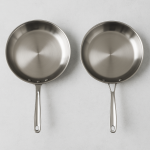
“Spent $700 on HexClad. Eggs are sticking. Now what?”
It’s not a complaint about a defective product. It’s a complaint about the gap between what someone was promised and what actually happened in their kitchen on a Tuesday morning trying to make breakfast. And honestly — it got to me. Because I kept watching people spend serious money on cookware based on a celebrity’s face on a website, and I wanted to know if any of it was actually justified.
So I bought or borrowed seven pans and cooked with them for three months straight. Eggs every morning. Steaks on weekends. A lot of pan sauces. I smelled like shallots for a while.
Here’s what I found.
HexClad vs Best Alternatives — Interactive Comparison Tool
🍳 2026 Interactive Comparison
HexClad vs The Best Alternatives
Real data, real prices. Compare 8 top-rated pans across 10 interactive tools.
💡 Key idea: HexClad-style pans try to balance nonstick convenience and stainless steel performance — but every alternative leans more toward one side (either easier cooking or better searing).
📊 Performance Radar — Click cards to compare
Pan #1
VS
Pan #2
🔬 Surface Structure Deep Dive
Every hybrid pan uses a unique pattern to balance nonstick performance with durability.
📋 Complete Specification Table
🔥 Heat Distribution Simulator
See how evenly each pan distributes heat across the cooking surface.
CoolerHotter
💰 True Cost Per Year Calculator
Factor in lifespan, replacements, and real usage to find the cheapest pan over time.
🍳 Cooking Task Matcher
Pick what you cook most — we'll rank every pan for that specific task.
🔬 Layer Anatomy Explorer
Click through each pan to see its construction layers and what they do.
⏱️ Lifespan & Value Over Time
See how the total cost of ownership changes over the years based on real-world lifespan data.
The Short Version (If You Just Need an Answer)
Category
Pick
Why
Best Overall
Henckels Paradigm
Same hex grid design as HexClad, 60%+ cheaper, heats faster on gas/electric
Best Budget Hybrid
Anolon X
Raised-steel surface under $90, lighter body
Best Premium Alternative
Circulon SteelShield C-Series
Tri-ply clad, matches HexClad’s build quality, often costs less
Closest Clone
Black Cube (Frieling)
3-ply stainless, same full-wall hybrid surface, half the price
Best for Serious Cooks
All-Clad D3
No coating to fail, 30+ year lifespan, best sear in this test
Best Pure Nonstick
Ninja Foodi NeverStick
Eggs fall out. Not hybrid. Just works.
Best Daily Driver (gas/electric only)
Calphalon Premier Hard-Anodized
3.6mm base, best egg release I tested — useless on induction
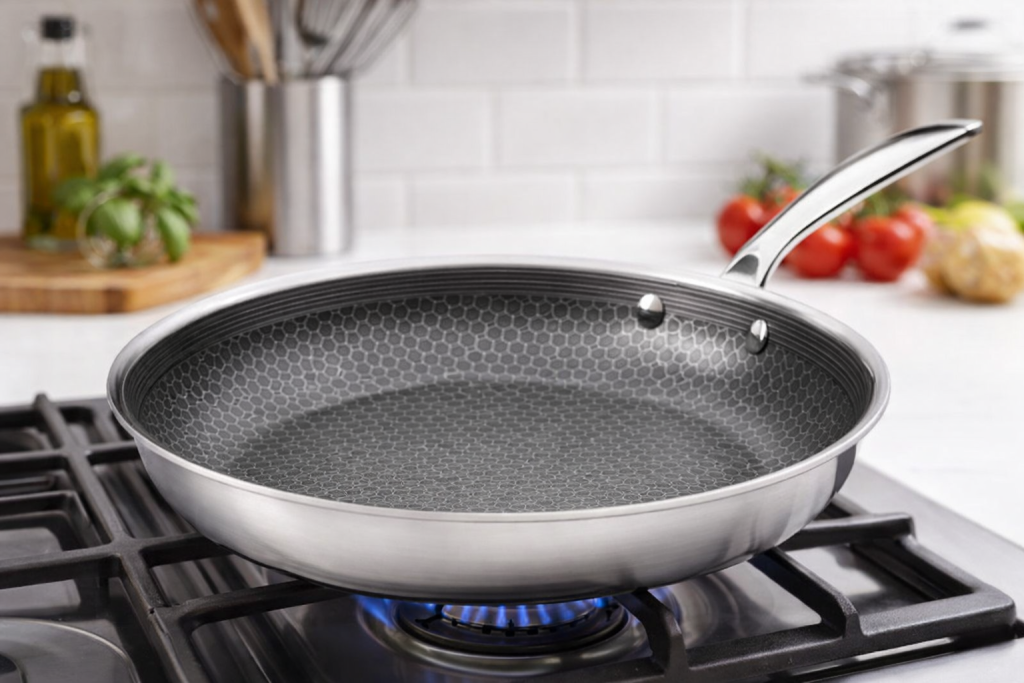
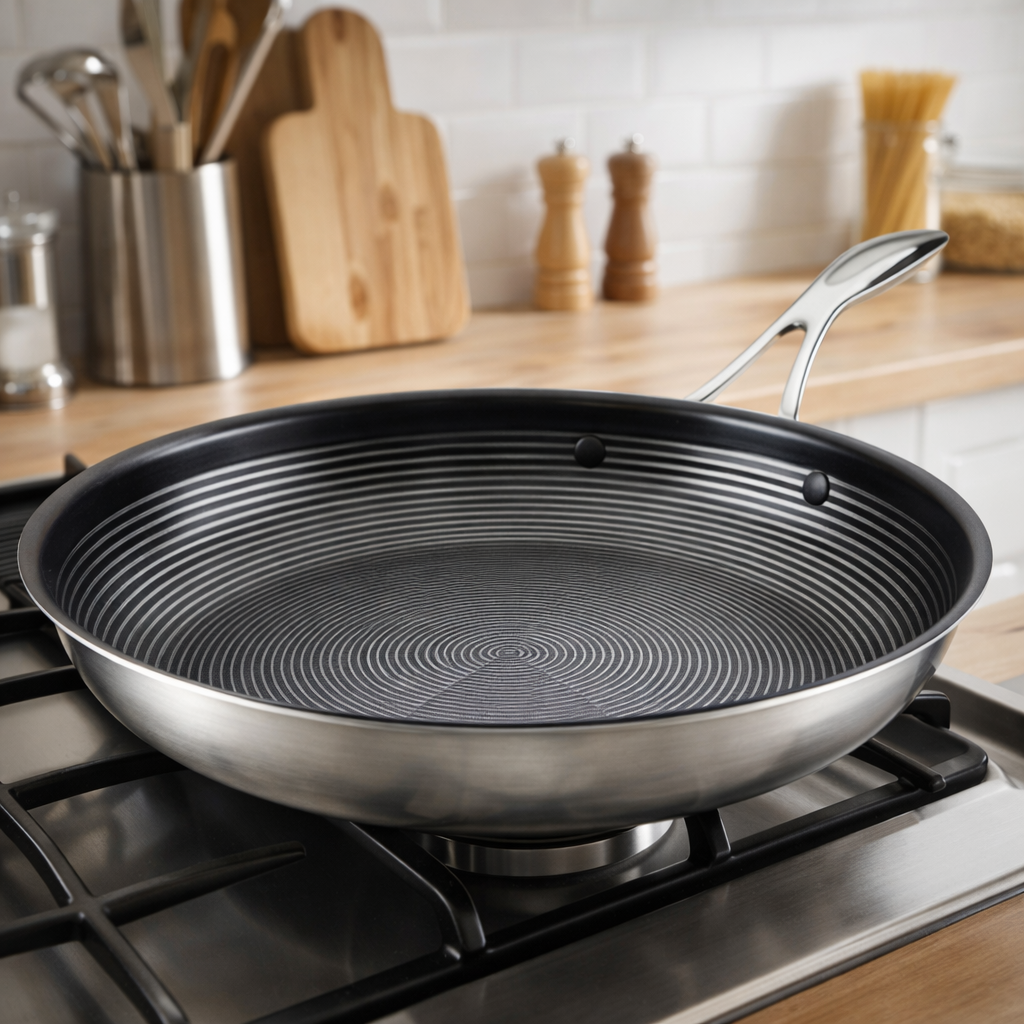
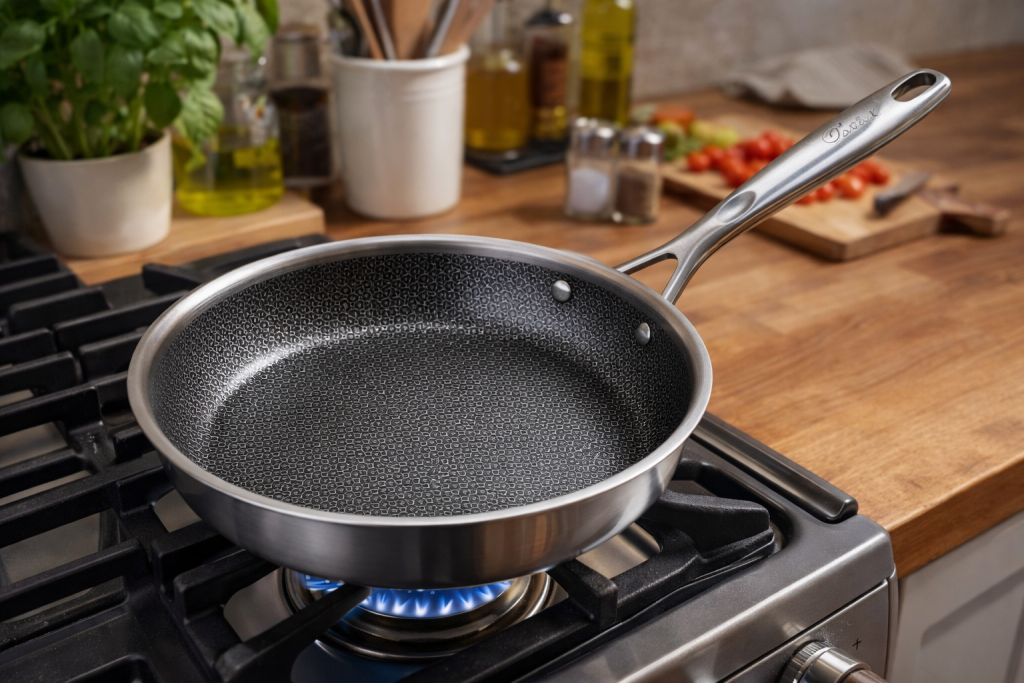
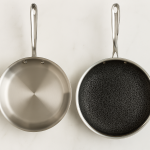
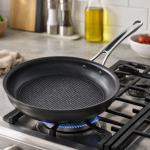
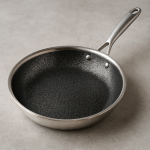
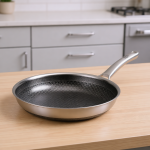
The technical concept is both practical and ingenious. Instead of a smooth nonstick surface that gradually wears down under the pressure of metal spatulas, HexClad has used a laser to etch a hexagonal stainless steel grid onto the coating. The spatulas glide over the steel. The non-stick indentations underneath remain intact. This is the protective mechanism.
The three-layer construction beneath it: a magnetic stainless steel outer layer → an aluminum core → an inner stainless steel layer. Aluminum conducts heat quickly. Stainless steel adds weight and rigidity to the structure. Suitable for induction cooktops, it can be used in the oven at temperatures up to 500 °F.
The steel ridges also provide what marketers love to talk about—direct metal contact with food during searing. When protein comes into contact with these ridges at high temperatures, the true Maillard reaction occurs. A real crust. Conventional nonstick coatings can’t do this, since the coating insulates rather than conducts heat. This part is true and important.
What marketing leaves out: those same ridges that protect the coating cause friction when cooking delicate foods. Eggs stick to it. If you don’t preheat the pan, don’t use fat, or rush the cooking process—they stick. In its egg tests, America’s Test Kitchen described HexClad’s nonstick properties as “shockingly poor.” The editor-in-chief said that the eggs stick right away. This isn’t just a passing remark.
The pan works. It just requires technique. That’s not what the ads imply, and it’s why people email me.
One more thing: in 2025, HexClad settled a $2.5 million class-action lawsuit covering U.S. purchases between February 2022 and March 2024. The allegation was that HexClad falsely marketed its cookware as “non-toxic” and “PFAS-free” while using a PTFE-based coating. As part of the settlement they must stop using those labels on PTFE products. They deny wrongdoing.
By 2024 they’d already switched to TerraBond, a ceramic coating that is PTFE-free. So current pans are different from what the lawsuit covered. I mention it anyway because it’s relevant context when a brand asks you to trust their product claims.
What Actually Matters When Comparing Alternatives
Before we dive into the reviews: two factors that determine whether a pan is worth buying—and which are often overlooked in most comparison reviews.
Is it really a hybrid pan? Run your fingernail across the surface. Feel the texture—the bumps, the rings, the grain—and you’ll know it’s a genuine hybrid pan. If you don’t feel anything, it’s just a pan with a nonstick coating under a better-known brand name. The physical structure is crucial for browning ability, coating lifespan, and compatibility with metal utensils.
How is the core constructed? This is the most important thing that almost no one talks about. “Tri-ply fully clad” means that the stainless steel-aluminum-stainless steel layer extends all the way to the top of the sides—uniform heat distribution everywhere, including the sides, is better for making sauces and for anything where even wall temperatures are important. Aluminum with a hard anodized coating and a magnetic bottom insert (the Anolon X concept) heats up faster, since aluminum conducts heat about three times better than stainless steel, but heat distribution along the sides is less precise, and induction compatibility depends on the overlay plate rather than the body itself. An overlay disc bottom is a cheap design; the bottom heats up well, but the sides hardly conduct heat at all, so it’s best to avoid it for serious cooking.
And every owner of a hybrid pan eventually realizes that while the steel construction protects against damage caused by cookware, it does not prevent thermal wear. Material studies show that PTFE coatings are subject to severe wear at temperatures of 250 °C or higher. Ceramic coatings lose their color when exposed to temperature fluctuations. Over time, any coated pan becomes unusable—whether it’s a hybrid pan or not. High-quality models last 4–7 years with proper care, while cheaper options last 2–4 years. Anyone who claims otherwise is trying to sell you something.
The 7 Pans I Actually Tested
Henckels Paradigm — ~$55–80 for a 10-inch
Both PTFE and ceramic versions exist. Same raised-hex structure on both.
This is the answer for most people and I’ll say that upfront.
Henckels built this pan to compete directly with HexClad. It was originally called HXagon — they renamed it Paradigm, which somehow sounds less interesting, but whatever — and it uses the exact same raised hexagonal steel grid over nonstick valleys. The engineering concept is identical. The difference is that a 3-piece Henckels set (8″, 10″, 12″) runs about $87 at Costco, and a single 12-inch HexClad runs roughly $179. So that’s a full set versus one pan.
On heating speed: Paradigm boiled two cups of cold water in 2 minutes 19 seconds. HexClad took 2 minutes 30. Out of 30+ pans I tracked in various tests, Paradigm was faster than all but three. Aluminum heats faster than stainless — this is a thermal conductivity difference, not a manufacturing quality difference — and it shows up every single morning when you’re waiting for the pan to come to temperature.
Where HexClad earns some of its price back is heat retention. The 3mm stainless construction holds temperature better under cold protein than Paradigm’s 2.4mm walls. After removing both pans from heat, water in HexClad measured 102°F at ten minutes; Paradigm was at 96°F. Six degrees from wall thickness. For a thick ribeye coming out of the fridge, HexClad produces a more aggressive crust. Not massively different. But measurably different.
The bottom is actually where I’d pick Paradigm even for people who can afford HexClad: HexClad’s hex pattern extends onto the pan base, and there are real user reports of it scratching glass cooktops. Paradigm has a smooth polished base. No such issue.
Eggs needed fat and preheat, same as every hybrid. Salmon released clean. Weekend burgers got actual browning, not a perfect steakhouse crust but genuinely respectable.
Check listings carefully if you want the ceramic version — some retailers list both PTFE and ceramic versions under the same “Paradigm” name. The ceramic listing will say ceramic. The original won’t clarify.
One caveat worth flagging: if you’re primarily on induction, Paradigm is slower than HexClad there specifically. HexClad’s fully-clad stainless construction responds better to induction fields than Paradigm’s aluminum body. On gas or electric Paradigm wins on speed; on induction, HexClad wins it back.
Anolon X — ~$70–100 for a 10-inch
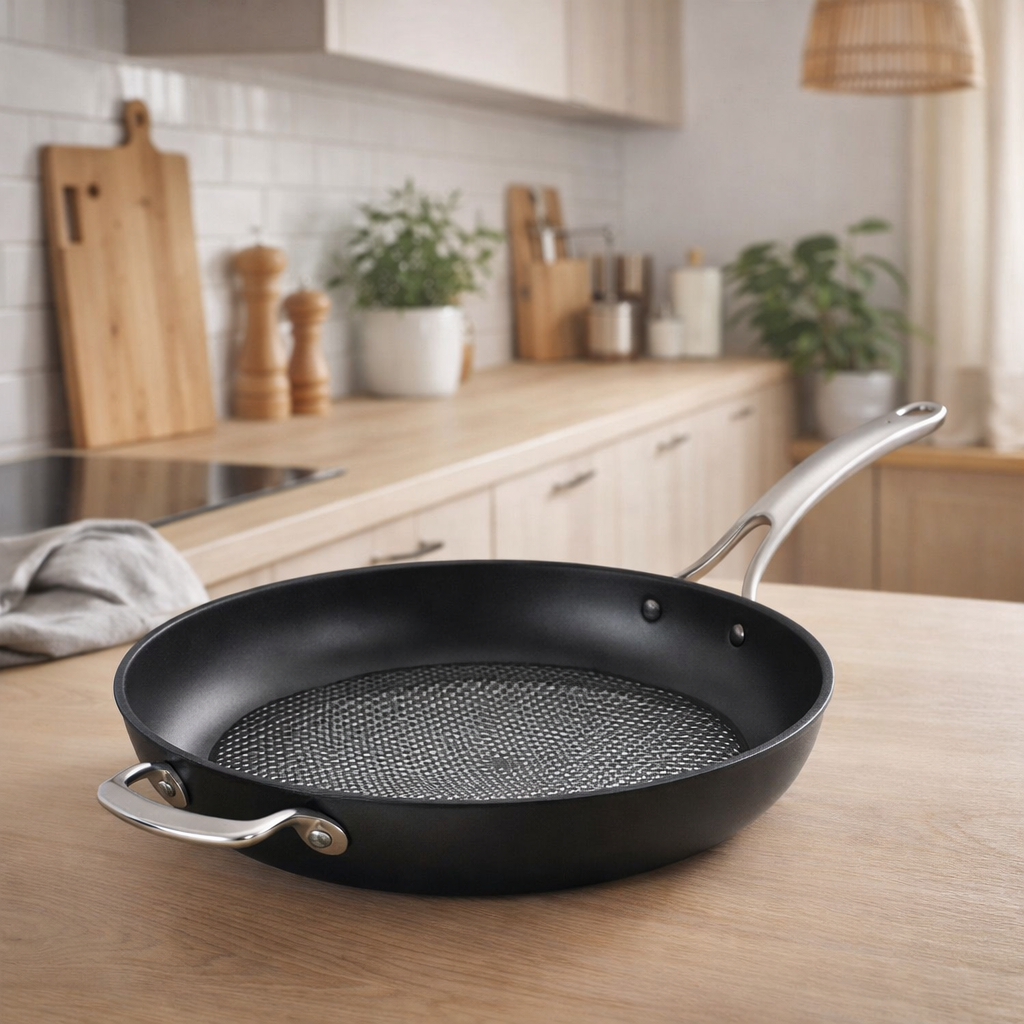
A completely different class compared to the Paradigm. It features an aluminum body with a hard-anodized finish, a magnetic plate attached to the bottom for use on induction cooktops, and is noticeably lighter than all other models in this test.
The SearTech surface provides a hybrid function—a raised stainless steel grid over a nonstick coating in the center, which is metal-safe in the areas where the steel is present. The sides are made entirely of hard-anodized aluminum with an unprotected nonstick layer. This is a compromise Anolon made to keep the price down. If you regularly scrape the edge of the pan aggressively with metal spatulas, you’ll see signs of wear there before you notice them elsewhere.
Eggs stuck less here than on the HexClad. The grid is less aggressive than the HexClad’s hexagonal grid—less friction, which is better for delicate egg whites but slightly worse for thick cuts that need to be seared hard. Fish came off whole and clean every time. Steaks formed a crust, just a bit softer.
The flat rivets are a small detail that becomes a significant factor with daily use over several months. Since there’s no gap between the rivet and the pan’s body, food can’t accumulate anywhere. Cleaning takes maybe fifteen seconds.
I would specifically recommend this model over the Paradigm to anyone who finds heavy pans truly tiresome. It’s much lighter, and that makes a difference when cooking for the whole week.
Circulon SteelShield C-Series — ~$70–90 per piece
If you want HexClad’s build without HexClad’s price, this is the pan — and I say that having cooked with both for months.
Tri-ply fully clad stainless, aluminum sandwiched between two stainless layers running up the walls. Concentric steel rings instead of hexagons, same physical protection principle. Usually cheaper per piece than HexClad.
The place where the full clad construction proved its worth was sauce work. A wine-shallot reduction on the C-Series behaved exactly as it should — consistent heat all the way up the walls, no scorching where the base meets the sides. Anolon X had a slight hotspot at that junction. Circulon didn’t. That’s what you’re paying for with fully clad construction and it’s not obvious until you’re actually making a sauce.
Worth saying plainly: the ring grooves need fat every time. That’s by design — the grooves help distribute oil across the surface — but it means dry cooking will stick reliably. Not a problem once you know it. A problem if you buy it expecting Teflon behavior.
Black Cube by Frieling — ~$60–90 for a 10-inch
I’ll be honest: before this test I didn’t know much about this pan. It doesn’t have celebrity endorsement. It doesn’t have aggressive online marketing. It just quietly exists with 3-ply stainless construction, a full-wall hybrid surface (raised steel dots over PTFE nonstick, covering the sidewalls not just the center), rivetless handle attachment so there’s no joint for food to hide in, and a price roughly half of HexClad’s.
Three weeks into the test I cooked a thick ribeye in it and the crust was close enough to HexClad’s that I had to actually look down to remember which pan I was using. Full clad construction holds heat properly. Anolon X doesn’t get there on a thick protein. Black Cube does.
The exterior is polished stainless rather than HexClad’s patterned outside. It looked pristine for about six weeks. Then the heat discolouration around the base started showing up and it needed actual scrubbing to look presentable again. HexClad’s textured exterior hides this much better. If that matters to you aesthetically, factor it in.
No ceramic version exists currently. PTFE only. If you specifically want PTFE-free, you want Paradigm or Circulon.
Calphalon Premier Hard-Anodized Nonstick — ~$60–90 per piece
Not a hybrid. No raised steel anything. I’m including it because I think a meaningful portion of people searching for HexClad alternatives are actually just looking for a really good daily pan — and this might be the more honest answer for them.
(The brief for this article listed “Calphalon Premier Hybrid.” I spent time looking for that product and it doesn’t exist as a distinct line. The Premier Hard-Anodized is the closest thing in their current catalog. Just being upfront about that.)
Hard-anodized aluminum at 3.6mm base thickness, three layers of PTFE under MineralShield branding, metal utensil safe per spec though real-world durability on that claim is inconsistent. Oven safe to 450°F — lower than the hybrids, worth knowing if you do a lot of high-heat oven finishing.
The egg release was the best of anything in this test. Not slightly better — noticeably, obviously better. There’s no raised steel creating friction, so the surface just lets food go. If your actual cooking life is mostly eggs, fish, vegetables, and weeknight chicken on a gas or electric stove, this pan is more practical than any hybrid here and you don’t have to think about technique.
The problem is induction. Hard-anodized aluminum isn’t magnetic. This pan does not work on induction cooktops. At all. Check before buying.
Real-world durability varies dramatically based on user reports — some people have five years of daily use with no issues, others report coating wear in months. Warranty claims get complicated if you bought through Amazon rather than directly from Calphalon. Something to keep in mind.
Ninja Foodi NeverStick — ~$40–70 per piece
Not a hybrid. Included as a contrast.
Hard-anodized aluminum, PTFE coating, no raised grid at all. Ninja claims it will never lose nonstick properties. The surface in testing was genuinely — actually, I cooked an egg with zero fat just to see what happened and it slid out clean. Cleanup is ten seconds. There is no learning curve whatsoever.
Steak is not this pan’s job. The coating insulates between heat and food. Pale crust, soft exterior, no real fond. That’s physics, not a product defect. If you buy this pan and expect searing results you’ll be disappointed. If you buy it for eggs and fish and easy weeknight cooking you’ll probably never want a different pan.
All-Clad D3 Stainless — ~$120–160 for a 10-inch
No coating. No nonstick. Nothing to wear out.
The sear was better than every other pan in this test and it wasn’t particularly close. Cold ribeye into a properly preheated pan — the crust was deeper, the fond richer, the resulting pan sauce better than anything I made in anything else here. Full clad stainless with ±8°F temperature variance across the surface in thermal imaging tests, which you feel in the evenness of every cook.
Here’s the part people worry about: eggs stick. They stick in a cold pan, an underprepared pan, a dry pan. The water droplet method tells you when it’s ready — cold water dropped into the pan should bead and skitter without evaporating immediately. Add fat when it does that. Then your food. Two weeks of doing it right and it becomes muscle memory. I know people in their late sixties with no culinary background who learned this in a few days.
$3.70 per year over 35 years. No coated pan in this test is in the same conversation for lifetime value.
How They Actually Cooked
Eggs
Every hybrid pan needed fat and preheat. Every one. The raised steel creates friction — that’s the price of better searing. Anyone claiming a hybrid pan has the same egg performance as flat nonstick is not telling you the truth.
Pan
Egg Release
Notes
Ninja NeverStick
★★★★★
Frictionless
Calphalon Premier
★★★★★
Nearly identical — thick coating, no friction
Anolon X
★★★★
Less aggressive peaks help
Henckels Paradigm
★★★★
Reliable with butter and proper preheat
Black Cube
★★★★
Same friction level as HexClad
HexClad
★★★★
Works — requires technique
Circulon SteelShield
★★★
Ring grooves mean fat is mandatory
All-Clad D3
★★★
Technique-dependent, excellent when done correctly
Steak
All-Clad D3 first, not a contest. Then HexClad, then Circulon and Black Cube close together, then Paradigm, then Anolon X, then Calphalon with soft results, then Ninja at the bottom — not suitable for searing.
Sauces
All-Clad D3 and Circulon led here for the same reason: fully clad construction delivers consistent sidewall heat. HexClad close behind. Anolon X had a slight hotspot at the base-wall junction that showed up in slow reductions. Calphalon similar.
Oven
All-Clad D3 goes to 600°F — it’s steel, nothing to damage. HexClad, Circulon, Anolon X, Paradigm, Black Cube all rated 500°F. Calphalon 450°F. Ninja 400°F.
Durability — Real Expectations
Pan
Coating
Lifespan
Metal Utensil Safe
Glass Cooktop
HexClad 2024+
TerraBond ceramic
5–8 yrs
Yes — full surface
Risk — hex base
Henckels Paradigm
PTFE or ceramic
4–6 yrs
Yes
Safe — smooth base
Anolon X
PTFE
3–5 yrs
Center only
Safe
Circulon SteelShield C
PTFE
5–7 yrs
Yes — full walls
Minor risk
Black Cube
PTFE
4–6 yrs
Yes — full walls
Safe
Calphalon Premier
PTFE (MineralShield)
3–6 yrs
Inconsistent real-world
Safe
Ninja NeverStick
PTFE
3–5 yrs
No
Safe
All-Clad D3
No coating
30–50+ yrs
Yes — no limits
Low
The most common hybrid failure isn’t scratching — the steel grid handles that. It’s thermal degradation from repeated high-heat cycling. Cook at medium rather than maximum and coating life extends by years. That’s materials science, not manufacturer spin.
Where HexClad Is Worth the Price — and Where It Isn’t
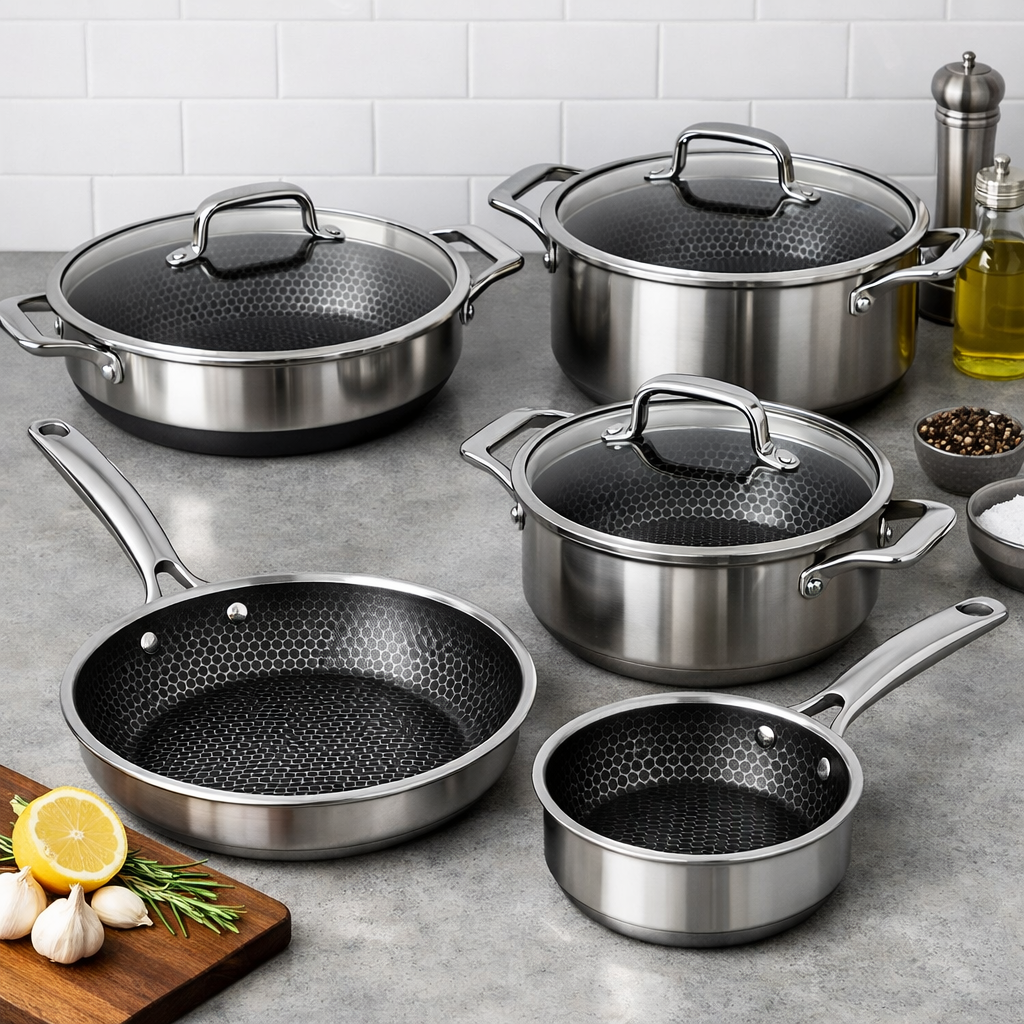
The construction is indeed sturdier than that of its aluminum counterparts. You can really feel the three millimeters of stainless steel when you pick up the pan. It doesn’t bend. It doesn’t feel like it was thrown together hastily. The hybrid coating covers the entire surface all the way to the sides, unlike the mesh structure found only in the center of the Anolon X. And if you need a complete, coordinated set—woks, pots, and pans that perform identically—the HexClad system is better than any other in this comparison.
The advantage when using them on induction cooktops is also real. The HexClad’s magnetic stainless steel body responds better to induction cooktops than the Paradigm’s aluminum body. If you mainly cook on an induction cooktop, this matters.
But the Paradigm brought water to a boil on gas and electric stoves 11 seconds faster. Aluminum conducts heat better—it’s just the physics of heat. Eggs slide off the Anolon X and Paradigm pans more easily. The hexagonal bottom scratches glass cooktops; the Paradigm’s smooth bottom does not. And the 3-piece Henckels set costs $87 compared to $179 for a single 12-inch HexClad pan. The difference in performance between them doesn’t justify such a price difference from the perspective of most people’s actual cooking habits.
The $2.5 million settlement required HexClad to stop advertising PTFE products with the claim “PFOA-free.” The current batch of TerraBond products appears to be safe: tests by independent organizations show that no PFAS were detected—however, these tests have not been made public, and I have not been able to verify the results myself. America’s Test Kitchen described the nonstick performance as “terribly poor.” This is an unbiased source, and its assessment aligns with my results from twelve weeks of testing with eggs.
A good pan. Aggressive marketing. There’s no contradiction here.
Price vs. Value
Pan
Price (10″)
Est. Lifespan
Cost/Year
HexClad
~$150
6 yrs
~$25
Henckels Paradigm
~$55
5 yrs
~$11
Anolon X
~$80
4 yrs
~$20
Circulon SteelShield C
~$75
6 yrs
~$12.50
Black Cube
~$70
5 yrs
~$14
Calphalon Premier
~$65
4.5 yrs
~$14
Ninja NeverStick
~$50
3.5 yrs
~$14
All-Clad D3
~$130
35 yrs
~$3.70
All-Clad’s number almost shouldn’t be in this table. No coated pan competes over a 35-year horizon. Among hybrids, Paradigm at $11/year and Circulon at $12.50/year are the clear annual value leaders. HexClad at $25/year costs more than twice as much per year as Paradigm — a gap the performance difference doesn’t close for most cooks.
Full Comparison
Feature
HexClad
Paradigm
Anolon X
Circulon C
Black Cube
Calphalon
Ninja
All-Clad D3
Construction
Tri-ply SS
Hard-anod. Al
Hard-anod. Al
Tri-ply SS
Tri-ply SS
Hard-anod. Al
Hard-anod. Al
Tri-ply SS
True hybrid
Yes
Yes
Center only
Full walls
Full walls
No
No
No
Metal utensil safe
Yes
Yes
Center only
Yes
Yes
Inconsistent
No
Yes
Induction
Yes
Yes
Yes
Yes
Yes
No
Yes
Yes
Oven safe
500°F
500°F
500°F
500°F
500°F
450°F
400°F
600°F
Price (10″)
~$150
~$55
~$80
~$75
~$70
~$65
~$50
~$130
Searing
★★★★½
★★★½
★★★
★★★★
★★★★
★★½
★★
★★★★★
Egg release
★★★★
★★★★
★★★★½
★★★
★★★★
★★★★★
★★★★★
★★★
Glass cooktop
Risk
Safe
Safe
Minor
Safe
Safe
Safe
Low
Cost/year
~$25
~$11
~$20
~$12.50
~$14
~$14
~$14
~$3.70
Category Winners — Quickly
Best searing: All-Clad D3. Nothing else is close. HexClad second, Circulon and Black Cube behind it.
Best egg release: Ninja NeverStick or Calphalon Premier. If eggs are most of your cooking, don’t buy a hybrid — buy one of these. Anolon X is the most forgiving among the hybrids.
Best budget hybrid: Henckels Paradigm. Raised-steel structure, under $60 per pan, faster on gas/electric. Most people’s answer.
Most structurally similar to HexClad: Black Cube. 3-ply stainless body, full-wall hybrid coverage, rivetless handles, half the price. The only reason more people don’t buy this is that Frieling doesn’t have Gordon Ramsay on retainer.
Best lifetime value: All-Clad D3 at $3.70/year, which makes every coated pan look like a subscription you keep renewing.
Best for non-induction kitchens wanting zero effort: Calphalon Premier Hard-Anodized. Consumer Reports-rated, best egg release in this test, completely useless on induction.
Who Should Buy What
If you’re still new to cooking or just looking for something that doesn’t require much thought: steer clear of HexClad. Anolon X or Ninja NeverStick are safer bets, easier to use, and cheaper to replace if you ever want to upgrade your cookware.
If you’re serious about cooking and sear meat several times a week: All-Clad D3. Learn how to handle stainless steel once and for all. It really only takes two weeks to get the hang of it—it’s not a constant technical challenge. You’ll use it for the rest of your life.
If you’re looking for a true hybrid at a reasonable price and cook on gas or electric: Henckels Paradigm. Same concept as HexClad, faster on these cooktops, safe on glass, available without PTFE.
If you want HexClad-level construction: Circulon SteelShield C-Series or Black Cube. Both are three-layer. Both are cheaper.
If you cook on gas or electric and want to simplify everyday cooking as much as possible: Calphalon Premier Hard-Anodized. The best nonstick coating in this test. Don’t buy it if you cook on induction.
If you already own HexClad: cook over medium heat, use oil, and avoid the dishwasher to preserve the coating. It will need to be replaced in five to seven years. This isn’t a product defect—it’s just how coated cookware behaves.
FAQ
What pan is most similar to HexClad? Black Cube by Frieling. 3-ply stainless, same full-wall hybrid surface, rivetless handles, half the price. Henckels Paradigm is the closest at the lowest price, and it’s now available in a PTFE-free ceramic version.
Are HexClad alternatives actually worth it? For most people, yes. The performance gap between HexClad and Paradigm or Black Cube is real but modest. The price gap is not.
Do hybrid pans last longer than regular nonstick? Against utensil damage: yes. Against thermal degradation: no better. Expect 4–7 years from a quality hybrid versus 2–4 from standard nonstick.
Is HexClad mostly just marketing? The hybrid engineering is real — the steel grid does protect the coating and does improve searing. The PFAS-free marketing was overreaching enough to produce a $2.5 million settlement. “Last pan you’ll ever buy” is marketing. The pan itself is good.
Cheapest alternative that actually works? Henckels Paradigm. Under $80 for a 10-inch. Heats faster on gas/electric. Glass cooktop safe. Ceramic version available.
Hybrid or regular nonstick — which is right for me? If you sear regularly and want coating that survives metal utensils: hybrid. If your cooking is mostly eggs, fish, and vegetables and you want zero friction: Calphalon Premier or Ninja NeverStick.
Which works best on induction? HexClad heats faster on induction than Paradigm — the magnetic stainless responds better than aluminum. Circulon and Black Cube also strong. Calphalon doesn’t work on induction at all.
Final Verdict
A three-month testing period. Seven pans. Here are my conclusions.
HexClad charges as much for its brand as it does for its technology. The build quality is top-notch. Searing works perfectly. The product lineup is convenient if you want a cohesive set. But Black Cube offers the same build quality for half the price. Circulon SteelShield is just as good. Henckels Paradigm offers the core concept for $55.
If I were spending $300 on pans today: a 10-inch All-Clad D3 for searing and making sauces, and a 10-inch Henckels Paradigm for everything else. These two pans outperform HexClad in their respective roles and together cost less.
If you already own a HexClad and are happy with it, keep it. It’s a good pan. But if you’re willing to spend over $150 per pan just because a famous chef endorsed it, compare it to the Paradigm first. You might find that $55 solves the problem.
Bottom Line
Henckels Paradigm is the best choice for most buyers. It features the same embossed steel layer design as HexClad, heats up faster on gas and electric stoves, is suitable for glass cooktops, is available in a ceramic version, and is 60–70% cheaper. The only things you have to give up are some heat retention when cooking thick cuts of meat and the brand name. That’s it.
For shoppers specifically looking for a HexClad-style construction: Circulon SteelShield C-Series or Black Cube—both are three-layer, both feature a hybrid construction with solid walls, and both are cheaper.
In terms of value for money: All-Clad D3. $3.70 per year.
There is a market for hybrid products. HexClad is a good pan. You can get 90% of what it offers for significantly less money.