I’ve had my cast-iron skillet for eleven years—it’s still in perfect condition. I use my carbon steel wok at least three times a week. I had two Teflon pans until I got tired of constantly replacing them. A $140 stainless steel pan that took me six months to finally stop ruining food in.
Tramontina Ceramic kept popping up in my searches. “The best nonstick coating under $50.” On websites that make money from affiliate commissions. So I bought them myself—a 10-inch skillet, an 11-inch sauté pan with a lid, a 5-piece set—and cooked with them every day for eight weeks.
Eggs every morning. Chicken thighs. Caramelized onions, which destroy weak coatings within a month. Tomato-based sauces. Pancakes. I deliberately subjected one pan to rough treatment—daily over high heat, with a metal spatula, twice a week in the dishwasher—just to see how quickly it would fail.
When brand new, the nonstick performance is truly excellent. Eggs glide effortlessly across the surface. Fish comes off without a trace. Pancakes flip over with ease. And yes, it’s free of PFAS, lead, and cadmium—it’s the real deal, not just a marketing gimmick.
But there’s one caveat: ceramic coatings wear out faster than PTFE. Not suddenly, but gradually. High temperatures break down the silicone compounds in the coating matrix. Dishwashers accelerate this process. Metal utensils leave microscopic scratches on the surface. None of these factors is a major concern on its own. But all three together—and the pan will start sticking within eight months at the latest.
At a price of $25–35 for a 10-inch pan, replacing it annually is quite affordable. But you need to know this from the very beginning. This is a highly effective consumable, not a lifetime investment.
What Is Tramontina Ceramic Cookware? Product Lines Explained
Tramontina is a Brazilian manufacturer founded in 1911. In the U.S., the brand’s products are available at Walmart, Costco, and Amazon. The “Keramik” series is the company’s PFOA-free line, developed in response to demand from consumers who prefer non-stick coatings without fluoropolymer components.
There are two main ceramic series—and the difference between them is significant:
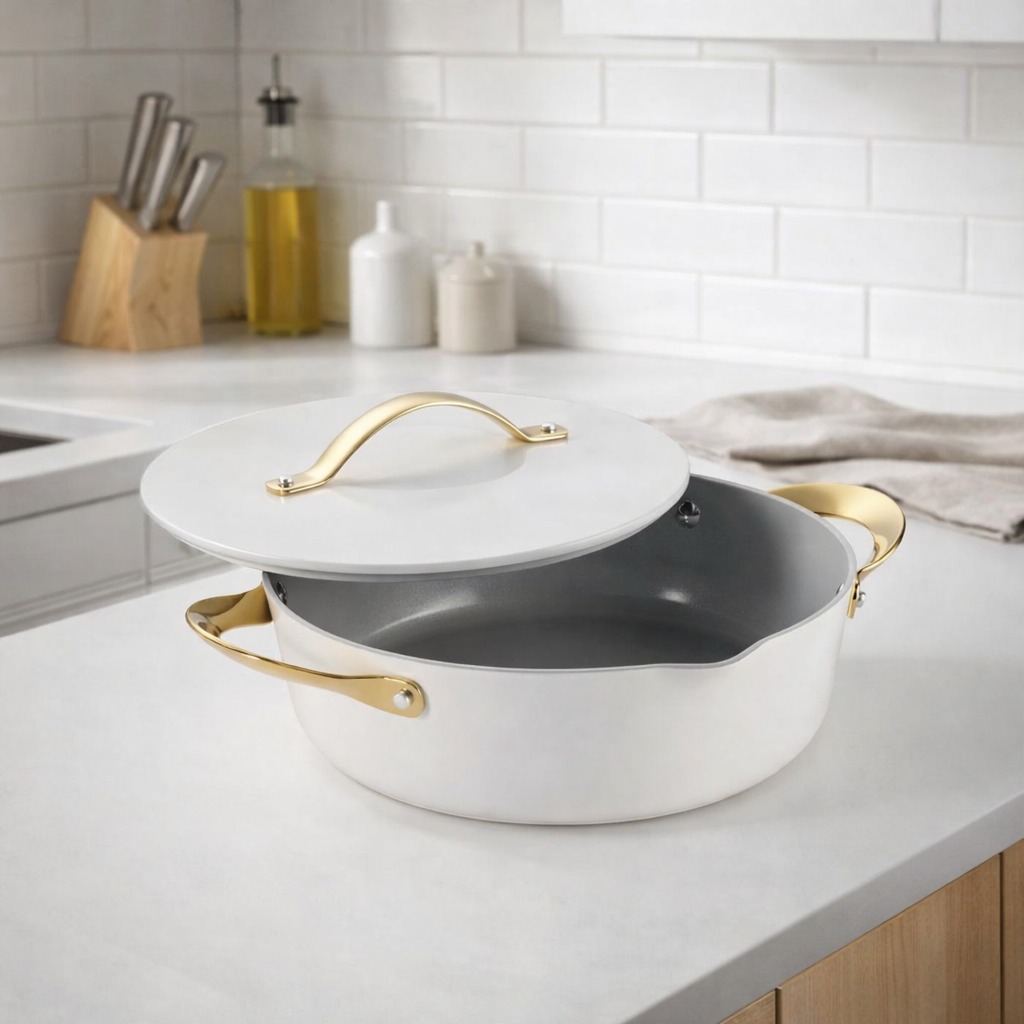
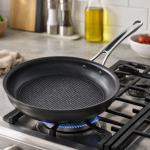
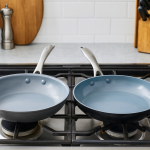
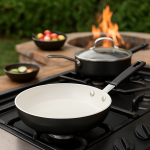
Gourmet Ceramica Deluxe is the higher-quality option. It features a thick-walled aluminum base, an exterior porcelain enamel coating, and a cream-colored ceramic coating on the inside. Manufactured in Italy, assembled in the U.S. Stainless steel handles with Soft-Grip inserts. Tempered glass lid on models with lids. This series is worth buying.
Tramontina Classic Ceramic is a more budget-friendly option. It has thinner aluminum, a less durable coating, and a shorter lifespan. Several reviews from actual users report food sticking to the surface after just a few months. At the same price, Ceramica Deluxe is the smarter choice.
Not premium. Not pretending to be. This is everyday cookware at a price most people can afford without overthinking it.
Materials & Construction: What’s Actually Inside
The Base
Thick-walled aluminum—in the Ceramica Deluxe series with a hard-anodized finish, and in the more affordable Classic series—is made of standard aluminum. Aluminum with a hard-anodized finish truly outperforms other materials: it distributes heat more evenly, doesn’t warp as easily, and withstands thermal stress better. I warped a standard aluminum product by rinsing it with hot water under cold water—a classic mistake caused by thermal shock. The versions with a hard anodized coating passed all tests.
The Ceramic Coating — Not What You Think
Here are the chemical details that most reviews fail to mention.
“Ceramic” does not mean fired clay. The coating is a sol-gel composite—a silicon dioxide (SiO₂) matrix that is applied in liquid form and hardens when exposed to high temperatures. Interestingly, AkzoNobel and Tramontina were among the pioneers in developing this commercial formula as early as 2007. The non-stick properties are provided by silicone compounds that are incorporated into this sol-gel matrix during production.
Practical significance: these compounds are not infinite. Each heating cycle—especially at high temperatures—gradually depletes them. When they disappear, pure silicon dioxide is exposed on the surface. Food sticks to it. It starts to stick. This is not a defect—this is how the coating works.
The coating is harder than PTFE (polytetrafluoroethylene). This is good for scratch resistance—better than Teflon. But harder also means more brittle. Scratches on PTFE are usually only cosmetic. Scratches on ceramic create adhesion points that become stronger. Another type of damage, not necessarily better.
One more point not mentioned in the advertising: the ceramic coating begins to break down at a temperature of about 370 °C (700 °F). At this temperature, the coating can decompose and lose its structure.
Build Details
The porcelain enamel exterior of the Ceramica Deluxe model ensures a clean cooking experience by preventing liquids from splashing onto the outer surface and is more resistant to staining than bare aluminum. The tempered glass lid features vents for steam release when the pots are covered. Stainless steel handles secured with V-shaped rivets to prevent overheating at the joint. Soft-Grip inserts for greater comfort. No gaps around the rivets on the inside where food residue could accumulate.
Compatibility
Feature
Classic Ceramic
Ceramica Deluxe
Induction compatible
No
No (Cold-Forged line: yes)
Oven safe
350°F / 175°C
350°F / 175°C (lid: 350°F)
Broiler safe
No
No
Ceramic glass cooktop
Yes
Yes
Dishwasher safe
Labeled yes — not recommended
Labeled yes — not recommended
Lead and cadmium free
Yes
Yes
Tramontina Ceramic Nonstick Performance: Real Testing
Eggs on the Tramontina Ceramic Fry Pan
Over low or medium heat—it works perfectly. Sunny-side-up eggs glide easily across the surface. Scrambled eggs stick completely and leave only minimal residue. You need very little oil—not cooking spray, which over time forms a sticky film that damages the coating, but regular oil or a small pat of butter.
When using a ceramic pan, you must follow the temperature recommendations. If you heat it to medium or high heat, the surface dries out quickly. Eggs start to stick. A good PTFE-coated pan can handle a burner that’s too hot. With ceramic, you need to turn down the heat. It’s not difficult—it’s just different from what most users of nonstick pans expect.
Pancakes
The sugar in the dough caramelizes on delicate surfaces and sticks firmly. Fresh ceramic handles this with ease—the dough comes off easily without tearing. After two months: still in good condition. After six months: noticeably more grease is needed. The wear occurs so gradually that you might not even notice it. Until you make a direct comparison with the first month.
Chicken, Fish, Proteins
Boneless chicken breasts, salmon fillets, delicate fish, tofu—simply delicious. Food releases evenly throughout almost the entire life of the pan. These are the tasks where ceramic really shines.
Chicken skin that needs to be seared properly? Steak? Anything that requires sustained high heat? Wrong pan. Carbon steel or stainless steel is better suited for that. Use your ceramic pan only for what it does best, and it will last longer.
The Aerosol Spray and Oil-Free Myths
Advertisements suggest you can cook without oil. The reality: Technically speaking, this is possible once or twice on a brand-new pan. As a habit, however, this is the quickest way to ruin the coating. Cooking oil forms a micro-layer between the food and the surface, slowing down the breakdown of the sol-gel matrix. Oil-free cooking accelerates this breakdown faster than almost anything else.
Worse than no oil: cooking spray from a can. The propellants and additives in aerosol cans form a sticky, polymerized film on the ceramic surface that is extremely difficult to remove. Use only liquid oil.
Nonstick Performance Over Time
Period
Nonstick Quality
Oil Required
Months 1–3
Excellent — slides freely
Minimal
Months 4–6
Good with correct technique
Light coat
Months 7–9
Decline at higher heat
More fat needed
Months 10–12
Moderate — spotty sticking
Consistent fat
12+ months heavy use
Significant degradation
Time to replace
Heat Distribution & Cooking Behavior
Heats up quickly. For this material, the heat distribution is quite even—better than stainless steel, but not as good as copper or high-quality clad materials. On a gas stove, the center gets hotter than the edges. For eggs, fish, and vegetables: irrelevant. For four scallops that require uniform browning: you’ll notice the difference.
Responsiveness is aluminum’s true strength. Turn down the heat, and the pan reacts immediately. Cast iron retains heat for minutes after you’ve turned off the flame. Ceramic-aluminum gives you control—which is especially important for delicate proteins and temperature-sensitive preparations.
Thermal shock damages aluminum faster than anything else. Do not hold a hot pan under cold water. Let it cool naturally before washing. The hard-anodized Ceramica Deluxe series withstands heat stress better than the standard Aluminum Classic series—another reason to choose the higher-quality option.
Tramontina offers a lifetime warranty on materials and craftsmanship. The main reason it gets voided: metal utensils damaging the ceramic interior. The warranty explicitly does not cover normal wear and tear, which conveniently includes the gradual nonstick decline that every ceramic pan experiences.
Honest lifespan by use pattern:
Careful use — low-medium heat, silicone or wooden tools, hand wash, no aerosol spray, don’t stack pans without protection: 2–3 years
Normal daily cooking — medium heat, occasional dishwasher, occasional metal spatula: 12–18 months
Heavy daily use — high heat, metal tools, regular dishwasher: 6–12 months
A quality PTFE pan under identical conditions lasts 3–5 years. Some experts suggest ceramic coatings have as little as one-sixth the lifespan of their PTFE counterparts under equal conditions. That’s a real gap.
Stacking and Storage
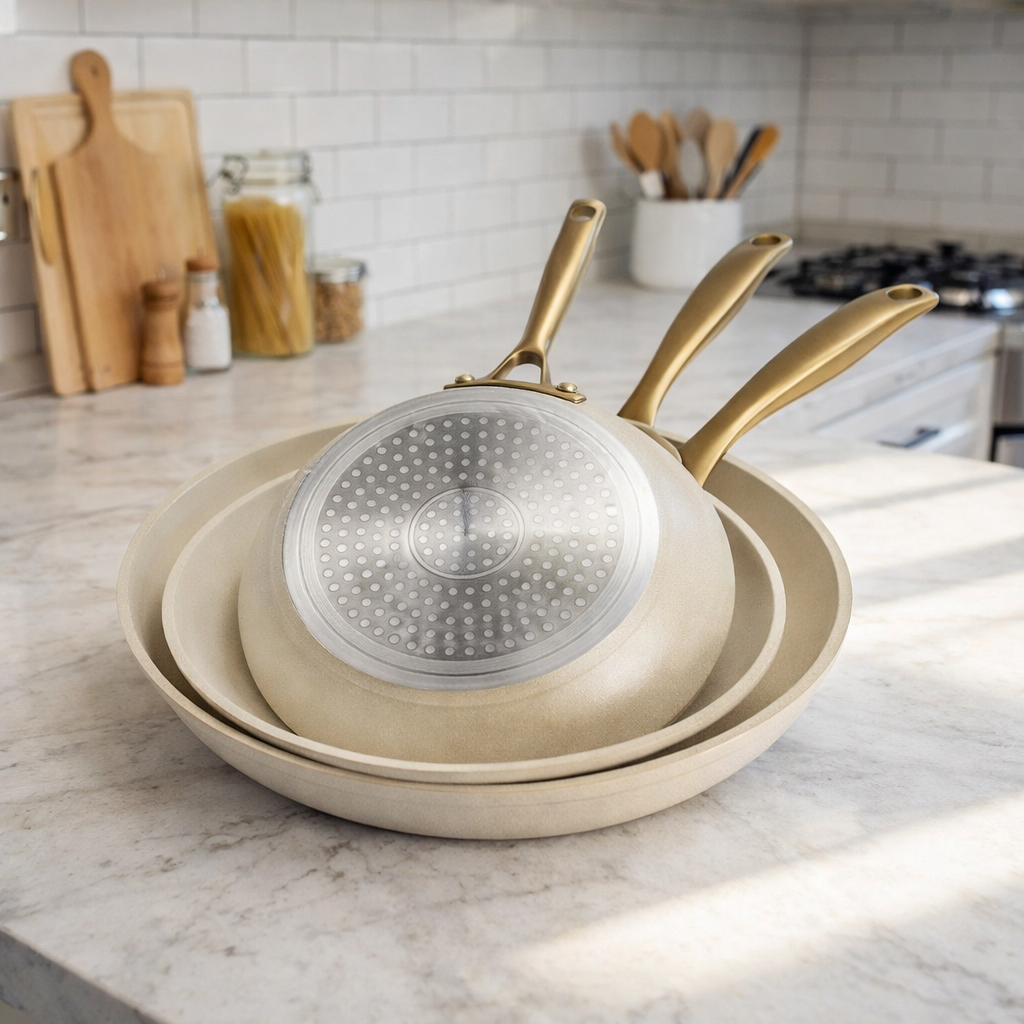
Something every competitor mentions: don’t stack ceramic pans directly on each other. The coating chips — sometimes even on the rim or exterior — which can then scratch a ceramic glass cooktop. Use a pot rack, store in single layers, or place paper towels between pieces when stacking is unavoidable.
Dishwasher Reality
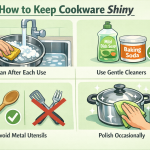
Alkaline detergent plus high-temperature drying cycles — every cycle strips sol-gel matrix compounds that don’t come back. One cycle: negligible. Fifty cycles: months of coating life gone. The manufacturer technically calls it dishwasher-safe. Real-world owner feedback is consistent: hand washing extends coating life significantly.
Is Tramontina Ceramic Cookware Safe? Full Analysis
PFAS-Free, Lead-Free, Cadmium-Free — What This Means
Tramontina Ceramica Deluxe is PTFE-free, PFOA-free, lead-free, and cadmium-free. The sol-gel silicate coating contains no fluoropolymers whatsoever. PFAS (per- and polyfluoroalkyl substances) are a group of fluorocarbon compounds—PTFE (polytetrafluoroethylene) is the most commonly used in cookware. None of these chemicals are present in Ceramica. Verified, not just marketing rhetoric.
Important note: Tramontina also manufactures a separate product line called Starflon—a PTFE-based nonstick coating that is not PFAS-free. Be sure to specifically purchase the ceramic product line. Different product, different chemical composition.
Ceramic vs PTFE Safety — Honest Comparison
Modern PTFE cookware is also considered safe for normal cooking use. PFOA—the manufacturing chemical linked to health problems—was phased out of the U.S. cookware industry around 2013. What remains is the PTFE itself, which is inert at normal cooking temperatures. Both modern PTFE and ceramic are safe when used properly.
In one specific scenario, ceramic clearly has the edge: overheating. PTFE begins to release vapors at temperatures above 260 °C (500 °F)—not dangerous for adults in a well-ventilated kitchen under typical exposure, but potentially lethal for pet birds, whose respiratory systems are extremely sensitive. Ceramic merely loses its non-stick properties at overheating temperatures (up to 370 °C)—no harmful fumes are released. For households with birds, this is a real and significant difference.
When Coating Degrades
Worn ceramic releases silicon dioxide particles — microscopic, inert. Essentially fine sand. No known health hazard. But visible coating damage signals the pan isn’t functioning. Replace it. Not because it’s toxic. Because it’s just not a working pan anymore.
Tramontina Ceramic vs Nonstick (PTFE) — Complete Comparison
Factor
Tramontina Ceramic
PTFE Nonstick
Initial nonstick
Excellent
Excellent
Coating longevity
12–24 months careful use
3–5 years careful use
Overheating safety
Better — no harmful fumes to 370°C
Risk above 260°C
Scratch resistance
Higher — harder sol-gel surface
Lower — softer, gouges more easily
Dishwasher tolerance
Poor — degrades sol-gel matrix
Poor — also degrades
Induction compatible
Usually no
Varies by brand
Price (10″ pan)
$25–45
$20–60
Realistic daily lifespan
1–2 years
2–4 years
PFAS-free
Yes
Modern versions: yes
Lead and cadmium free
Yes
Most brands: yes
Safe around birds
Yes
No
Ceramic wins on overheating safety and zero-fluoropolymer chemistry. PTFE wins on longevity and tolerance of imperfect technique. Day-to-day cooking performance when both are new: essentially identical. The gap shows up at month eight, not month one.
The dominant complaint everywhere, across every retail platform. Pan is incredible at month one. Noticeably more oil needed by month four. Genuinely sticky at month eight to ten. Every single person describing this is experiencing normal ceramic coating chemistry — sol-gel matrix depletion under repeated heat cycles — that the marketing language never prepares them for.
No fix. Only honest expectations. Buy knowing it’s a 12–18 month performer: satisfied. Buy expecting Teflon longevity: three-star review, “stopped working.”
Staining
Light cream interior — on the Ceramica Deluxe — stains visibly. Tomato sauce, wine, high-sugar glazes leave marks. Discoloration, not structural damage. Bar Keepers Friend removes most of it without harming the coating. The porcelain enamel exterior handles exterior staining much better than bare aluminum.
Center Wears Before Edges
Over time the center of the cooking surface degrades faster — that’s where heat concentrates most consistently. Eventually you have a pan where the outer edge releases cleanly and the center sticks. Clear replacement signal.
The “Made in China” Confusion
Some buyers who purchased the Classic line found “Made in China” on the bottom after marketing implied otherwise. The Ceramica Deluxe line is manufactured in Italy and assembled in the US — different product. Verify which line you’re buying.
Price vs Value: Tramontina Ceramic Cookware Worth It?
The Ceramica Deluxe actually makes better economic sense than the Classic line — longer lifespan per dollar. Both are outperformed by cast iron and carbon steel on pure cost-per-year economics. But those require learning technique. Ceramic is the low-maintenance option, and for that category the Tramontina price is honest.
Best Tramontina Ceramic Products: What to Actually Buy
Tramontina Ceramica Deluxe Fry Pan Review — Best Single Buy
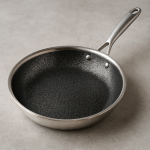
The 10-inch Ceramica Deluxe. Heavy-gauge aluminum, porcelain enamel exterior, cream ceramic interior. Made in Italy. Right size for one or two people daily. Buy this one, not the Classic.
Tramontina Ceramic Cookware Set Review
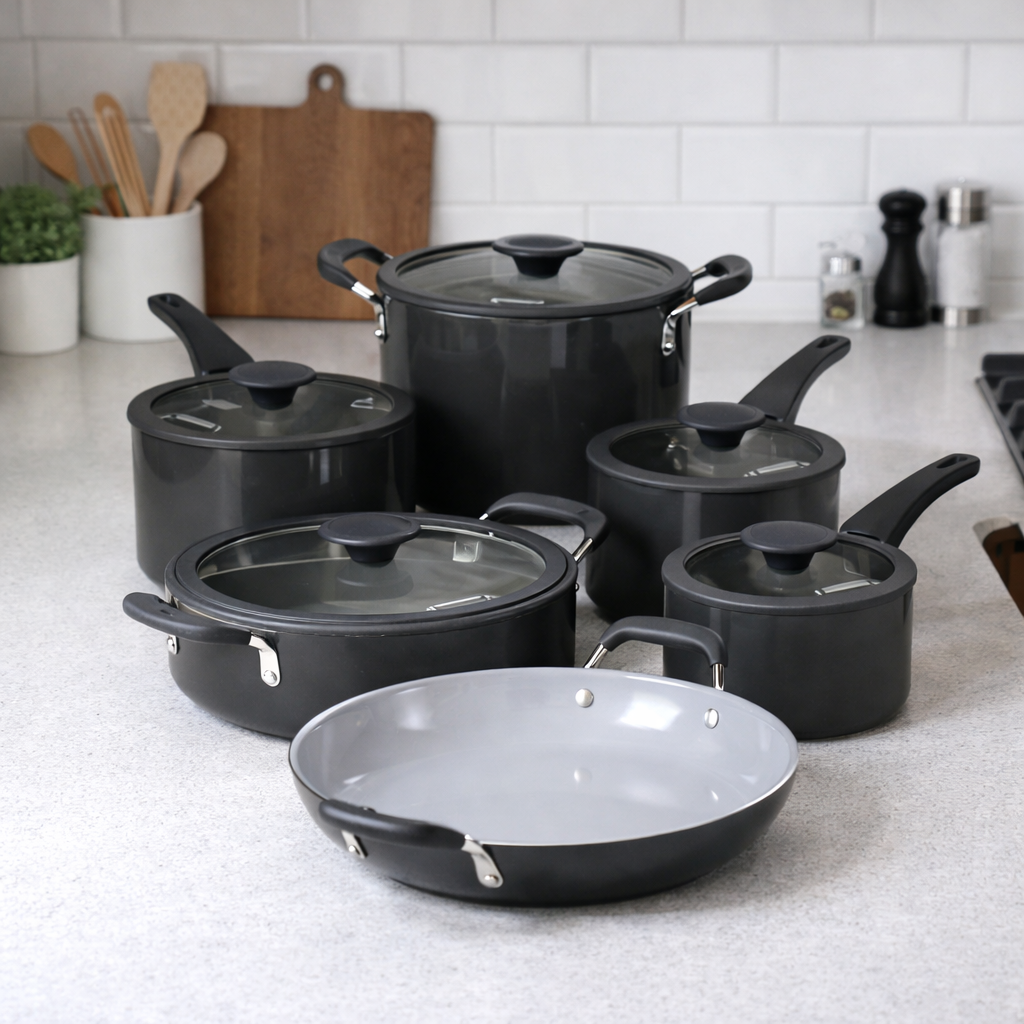
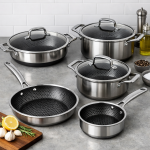
The 8-piece or 10-piece Ceramica Deluxe set. Includes 8-inch and 10-inch fry pans, 11-inch covered deep skillet, 1.5-quart and 3-quart covered saucepans, 5-quart Dutch oven. Tempered glass lids throughout. At $100–150 on sale it’s a complete kitchen in one purchase. All pieces age together — know that going in.
Tramontina Ceramic Covered Sauté Pan
The surprise winner in my testing. The lid traps moisture, moderates temperature swings, reduces the thermal stress cycles the sol-gel coating undergoes each use. This piece held up noticeably better than the open fry pan across eight weeks of testing. For braising, one-pan meals, covered cooking — the best piece in the lineup.
Product
Best For
Ceramica Deluxe 10″ fry pan
Daily eggs, fish, vegetables
Covered deep skillet / sauté pan
One-pan meals, braised dishes
8 or 10-piece set
Full kitchen setup, first apartment
Who Should Buy Tramontina Ceramic Cookware
You’re specifically avoiding PFAS, PTFE, lead, or cadmium — for health, environmental, or personal reasons. The Ceramica Deluxe delivers on all of those claims.
You have pet birds at home. Overheating PTFE around birds is a documented risk. Ceramic eliminates it.
You cook at moderate heat most of the time. Eggs. Fish. Vegetables. Boneless proteins. You’re not running screaming-hot sears every night.
You’re setting up a first kitchen and want to cover everything for under $150 without thinking too hard about it.
You’re fine replacing cookware every one to two years. Some people genuinely don’t mind. If that’s you, this category works well.
Who Should Avoid Tramontina Ceramic Cookware
You cook hard every day, push high heat, use metal tools without thinking, and dishwasher everything. The sol-gel coating will fail on you within six to twelve months. You’ll be frustrated.
You want to buy once and not think about it again. Cast iron. Carbon steel. Learn the technique. Never buy another pan.
You have an induction cooktop. Most Tramontina ceramic models are not compatible — the Cold-Forged Induction line is the exception, but that’s a different product.
Your main use is searing — steak, crispy fish skin, anything needing sustained high heat. Wrong tool. Stainless or carbon steel handles searing without coating damage.
The idea of replacing cookware on a regular schedule genuinely irritates you. This category will do exactly that.
Tramontina Ceramic Cookware FAQ
Is Tramontina ceramic cookware safe?
Yes. The Ceramica Deluxe sol-gel silica coating is PTFE-free, PFOA-free, PFAS-free, lead-free, and cadmium-free. Under normal cooking conditions it doesn’t release harmful compounds. Worn particles are inert silicon dioxide. Replace a damaged pan not because it’s toxic but because it isn’t working anymore.
Does Tramontina ceramic contain PFAS?
No — the ceramic line doesn’t. Note: Tramontina also makes Starflon, a PTFE-based nonstick coating that does use fluoropolymers. Verify you’re buying the ceramic line specifically. Different product, different chemistry.
How long does Tramontina ceramic cookware last?
Ceramica Deluxe with careful use: 2–3 years. Normal daily use: 12–18 months. Heavy daily use with dishwasher and high heat: 6–12 months. The Classic ceramic line is shorter across all categories. This timeline is consistent across ceramic-coated cookware as a category.
Can you use metal utensils on Tramontina ceramic?
The sol-gel surface is harder than PTFE and resists visible gouging better. Metal utensils still create microscopic damage that becomes sticking points compounding over time. The lifetime warranty specifically cites metal utensil damage as a voiding cause. Use wood, silicone, or nylon.
Is Tramontina ceramic better than Teflon?
On overheating safety and PFAS-free chemistry: yes. On longevity and tolerance of imperfect technique: no. On day-to-day performance when both are new: essentially the same. Modern PTFE (post-2013) is also safe for normal cooking. This is a priorities question, not an objective winner.
Can Tramontina ceramic go in the dishwasher?
Labeled dishwasher-safe. Repeated alkaline detergent cycles strip the sol-gel matrix faster than hand washing. Occasional cycle: minimal damage. Regular habit: meaningfully shorter coating life. Hand wash with mild soap and a soft sponge.
Why does ceramic cookware lose nonstick over time?
The nonstick behavior comes from silicone compounds embedded in the sol-gel silicon dioxide matrix during manufacturing. Repeated heat — especially high heat — depletes those compounds gradually. Process is essentially irreversible. Proper care (low-medium heat, no aerosol spray, hand wash, silicone tools, no stacking) slows it significantly but cannot stop it. True of every ceramic pan on the market.
Final Verdict
Eight weeks. Cooking every day. That’s my verdict.
The Tramontina Ceramica Deluxe is really good—better than its retail price would suggest. For the first six months, the sol-gel nonstick coating holds its own against pans that cost three times as much. The thick-walled aluminum heats up quickly and responds well. PFAS-free, lead-free, cadmium-free—all tested. The porcelain enamel exterior is a nice touch that most competitors in this price range don’t include. It comes with a lifetime warranty, though wear and tear are excluded.
It’s not a pan that will last forever. The sol-gel coating wears out. Faster than PTFE. Faster than the “ultra-durable” marketing claims suggest. At a price of $35–50 for the Ceramica Deluxe, that’s a reasonable compromise if you’re aware of it. If you’re not aware of this—if you expect the durability of Teflon wrapped in ceramic marketing—you’ll be frustrated after ten months and leave a three-star review.
Buy the Ceramica Deluxe. Not the Classic. The extra $10–15 ensures significantly better craftsmanship and a longer coating lifespan.
Bottom Line: Is Tramontina Ceramic Cookware Worth Buying?
Yes — with clear eyes about what ceramic coating is and how it works.
Buy it if: you’re avoiding PFAS/PTFE, you cook at moderate heat, you use cooking oil not aerosol spray, you hand wash, you don’t stack pans without protection, and you’re genuinely comfortable with a 1.5–2 year replacement cycle on the Ceramica Deluxe.
Don’t buy it if: you want cookware that lasts a decade, you cook hard daily, or dishwasher use is non-negotiable.
Ceramica Deluxe: 7.5/10. Outstanding when new. Sol-gel degrades faster than PTFE — that’s the material, not the brand. Best ceramic option Tramontina makes. Recommended — with realistic expectations firmly attached.