I’ve cooked on both. A lot. And honestly the answer isn’t what most people expect when they start this research.
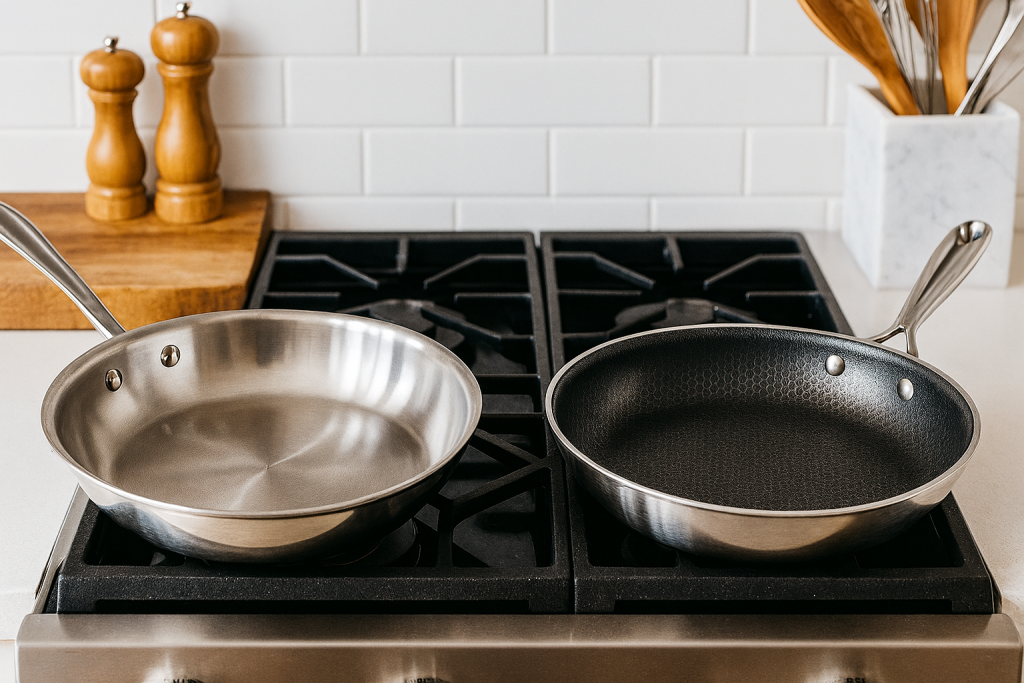
All-Clad is the stainless steel workhorse that’s been living in professional kitchens since 1971 — before most of us were born. HexClad is the hybrid cookware upstart with Gordon Ramsay’s face on the box and a laser-etched hexagonal surface that looks genuinely futuristic sitting on your stove. One of them is built to last your entire cooking life. The other is… more complicated than the marketing lets on.
This comparison covers everything: materials, construction, heat physics, cooking performance, safety, durability, long-term value. No fake lab numbers. No brand cheerleading. Just what you actually need to know before spending $150+ on a single pan.
Brands and Origins
All-Clad started in 1971 in Canonsburg, Pennsylvania. Metallurgist John Ulam founded All-Clad Metalcrafters with one idea — bond dissimilar metals together to make cookware that actually conducts heat properly. The company is now owned by Groupe SEB, the French conglomerate that also owns T-fal and Lagostina, but the core stainless lines are still made in the USA. That matters. Not just for the patriotic bumper sticker value — USA manufacturing means tighter quality control on the cladding process, which is where premium stainless cookware either succeeds or quietly fails.
HexClad launched in 2016. Direct-to-consumer brand, Los Angeles, built on a genuinely novel idea: what if a single pan surface combined the searing power of stainless steel with the food release of nonstick? The laser-etched hexagonal pattern — stainless peaks, PTFE-coated valleys — is the product. Celebrity endorsements (Gordon Ramsay most prominently) drove early awareness. Manufacturing is overseas; HexClad doesn’t publicize where exactly.
All-Clad
HexClad
Founded
1971
2016
Headquarters
Canonsburg, PA
Los Angeles, CA
Manufacturing
Made in USA
Overseas
Parent Company
Groupe SEB
Independent
Core Identity
Professional stainless steel
Hybrid nonstick cookware
Marketing Approach
Chef reputation, word-of-mouth
Celebrity endorsements, DTC
Warranty
Limited lifetime
Lifetime
Where They Sit Among Competitors
The cookware market is genuinely crowded and the price tiers are confusing. Here’s where both brands actually land.
All-Clad competes at the top of the stainless steel segment. Demeyere from Belgium arguably has better heat distribution in some lines. Mauviel makes French copper-core pans that cost more and perform differently. Made In Cookware is a newer American brand doing similar tri-ply stainless at lower prices — worth knowing about. Calphalon, Cuisinart, and Tramontina offer solid stainless options for significantly less money. All-Clad’s advantage has always been brand trust, restaurant pedigree, and the consistency of USA manufacturing.
HexClad basically invented its own category. There’s not much direct competition doing exactly what HexClad does at this price. Indirectly — Le Creuset enameled cast iron, Lodge carbon steel, traditional nonstick from Calphalon or Cuisinart — but none of those are really apples-to-apples. HexClad costs roughly the same as entry All-Clad, which is the core tension of this whole comparison.
Gordon Ramsay is an investor in HexClad and his name is everywhere in their marketing. Does that mean professional chefs cook on hybrid nonstick? Walk into any serious restaurant kitchen and find out. You won’t see HexClad. You’ll see stainless — commercial grade, beat up, often All-Clad or something equivalent.
Kenji López-Alt (Serious Eats, New York Times Cooking) has written more carefully about cookware physics than almost anyone else working in food media. His conclusion: stainless steel is the foundation of serious cooking. Jacques Pépin, maybe the most technically accomplished French chef who ever worked in America, has cooked on stainless his entire career. Culinary schools teach on stainless. Not because it’s easy — it isn’t — but because it forces you to learn proper heat management.
YouTube cookware reviewers have given HexClad a complicated reception. Long-term tests — 12 to 18 months of real daily use — show the hybrid surface degrading faster than the marketing suggests. Nonstick properties fade. Stainless peaks scratch. The pan still works, but it stops being what it was sold as.
Daniel Winer and other independent testers landed on the same basic conclusion: HexClad is interesting. It doesn’t outperform a great stainless pan at high heat, and it doesn’t outperform a great nonstick at delicate release. It splits the difference — which is either a feature or a compromise depending on how you cook.
D3 Stainless is the one. Three layers: magnetic stainless exterior, aluminum core, stainless interior cooking surface. This is what most people mean when they say “All-Clad.” Excellent heat distribution, oven-safe to 600°F, technically dishwasher-safe though hand-washing keeps it looking better longer.
D5 Brushed adds two more layers — five-ply with an extra aluminum and stainless sandwich. Heats more slowly than D3 but holds temperature steadier. Better for sauces, custards, anything where hot spots punish you. The brushed exterior hides scratches.
Copper Core — five layers with actual copper in the center. Copper’s thermal conductivity is exceptional, roughly twice aluminum’s. Most responsive All-Clad line for precise heat control. Most expensive.
HA1 Nonstick — hard-anodized aluminum body with PTFE coating. All-Clad’s answer to “but what about eggs?” Works well. Not what All-Clad built its reputation on, but it’s a solid nonstick.
Essentials Line — disc-bottom construction, not full cladding. Performs fine for casual cooks who aren’t searing steaks or building pan sauces. Hot spots are real.
FusionTec — ceramic coating on stainless. Not widely praised. Skip it.
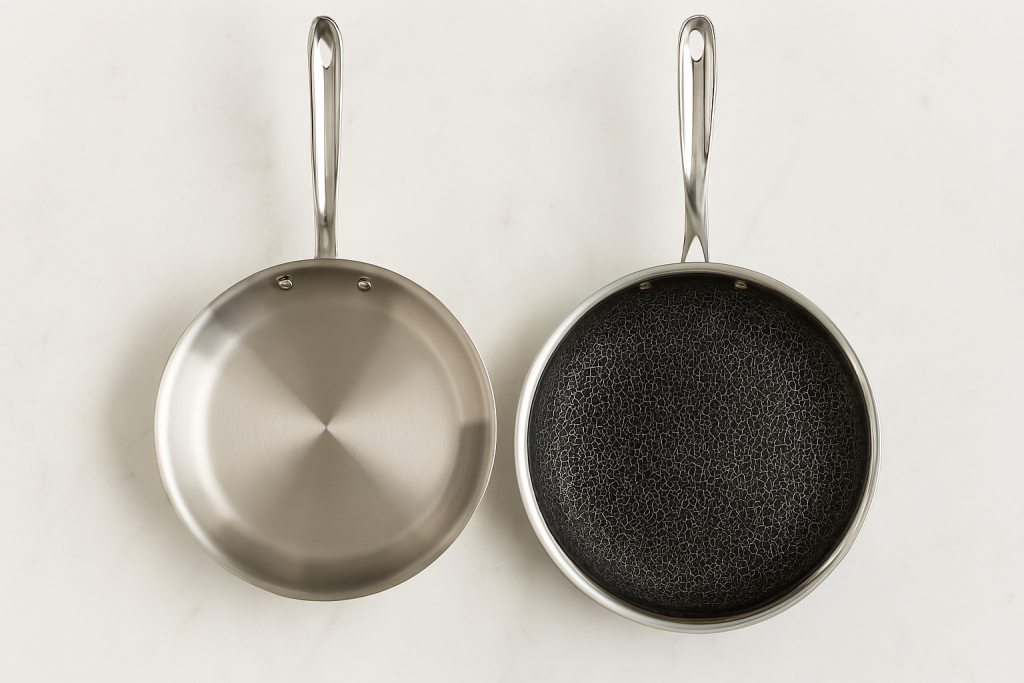
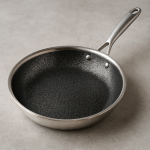
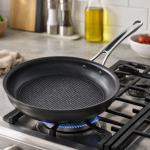
Hybrid Fry Pan is the flagship — 8″, 10″, 12″. The laser-etched hexagonal pattern creates stainless peaks and recessed PTFE valleys across the cooking surface.
Hybrid Saucepan — same surface, useful for sauces where you want partial nonstick behavior without losing stainless browning capability.
Hybrid Saute Pan — larger flat bottom, straight sides. Good for stir-frying, braising smaller quantities.
Hybrid Wok — I think this is genuinely HexClad’s most interesting product. The curved surface works reasonably well with the hybrid technology for actual stir fry.
All-Clad’s wider range matters if you want a complete matched kitchen from one brand. HexClad started narrowly focused on skillets and fry pans — expanding now, but gaps remain.
Materials
This is where things get worth understanding. The materials explain almost every performance difference between these two brands.
Stainless Steel — both brands use it. All-Clad uses 18/10 nickel stainless steel for the cooking surface. Stainless on its own is a terrible heat conductor — that’s why it’s always layered with aluminum or copper. HexClad’s stainless appears as the raised peaks of the hexagonal pattern.
Aluminum Core — the actual heat-spreader in both brands. Aluminum conducts heat roughly 13x better than stainless. All-Clad D3 has one aluminum layer. D5 has two. HexClad uses an aluminum core beneath the hybrid surface. Without aluminum, neither pan would heat evenly.
Copper Core — All-Clad only, premium line. Copper conducts heat about twice as well as aluminum. Makes the pan noticeably more responsive when you turn the burner up or down. Worth the price if you cook sauces seriously.
PTFE Nonstick — the coating in HexClad’s recessed valleys, and in All-Clad’s HA1 line. This is what most people mean by “nonstick.” More on safety below — but the short version is that PTFE itself is fine at normal cooking temperatures.
Magnetic Stainless Steel — both brands need this on the exterior for induction cooktop compatibility. Without magnetic material, an induction burner won’t recognize the pan exists.
Hard-Anodized Aluminum — All-Clad HA1 only. Electrochemically hardened aluminum surface. More durable than bare aluminum.
Carbon Steel and Cast Iron — neither All-Clad nor HexClad are known for these. Worth mentioning for context: carbon steel performs similarly to stainless but requires seasoning. Cast iron holds heat like nothing else but responds slowly to temperature changes.
Construction Layers
How layers are assembled determines heat behavior more than any single material.
Fully Clad Construction is the standard worth caring about. Metal layers run continuously from the base through the walls to the rim. Heat spreads up the sides, not just across the bottom. This matters a lot for sautéing — food hits the sidewalls and you don’t want cold spots there. All-Clad D3 and D5 are fully clad. So is HexClad.
Tri-Ply — Stainless → Aluminum → Stainless. Three layers. What D3 is. This is the construction that changed home cookware when All-Clad popularized it.
Five-Ply — All-Clad D5: Stainless → Aluminum → Stainless → Aluminum → Stainless. Heats more slowly. Distributes more evenly. Better for cooking that punishes hot spots.
HexClad’s construction — technically hybrid surface architecture, not traditional cladding. Magnetic stainless exterior, aluminum heat-spreading layer, then the laser-etched stainless surface with PTFE filling the recesses. The layering runs to the rim — it’s fully clad. The cooking surface is the defining feature, not the layer count.
Encapsulated Base / Disc Bottom — the Essentials line. Only the base has multi-layer construction. Sidewalls are single-layer stainless. Hot spots along the walls happen. Fine for boiling water, not ideal for serious cooking.
Construction Type
All-Clad
HexClad
Fully clad
D3, D5, Copper Core
Yes
Tri-ply
D3
No (hybrid surface)
Five-ply
D5, Copper Core
No
Disc bottom
Essentials
No
Hybrid surface
No
Yes (all lines)
Technologies
Multi-Clad Technology (All-Clad) — the bonding process that fuses dissimilar metals under heat and pressure. Clad stainless steel bonding creates a metallurgical connection between layers. Not glued. Not crimped. Bonded at the molecular level. This is why the layers don’t separate under normal use.
Hybrid Surface Architecture (HexClad) — the laser-etched hexagonal pattern creates raised stainless peaks and recessed PTFE valleys. Theory: stainless peaks handle searing; PTFE valleys handle release. In practice it works — food releases better than bare stainless, sears better than traditional nonstick. Both claims are true. Neither is perfect.
Laser-Etched Hexagonal Pattern — HexClad’s manufacturing differentiator. CNC polishing and laser engraving create the hex grid. The geometry sets the ratio of stainless to PTFE coverage across the surface.
Induction Base Technology — both brands use a magnetic stainless exterior for induction compatibility. Without it, the pan is invisible to an induction burner.
Thermal Core — All-Clad’s aluminum (or copper) layer that takes concentrated burner heat and spreads it across the pan floor before it reaches the cooking surface.
Heat-Spreading Aluminum Layer — present in both brands. Thicker aluminum equals more even distribution and slightly slower temperature response. Neither is wrong — it’s a tradeoff.
Impact Bonding — the manufacturing process for disc-bottom pans. Less durable than vacuum cladding over decades of use.
Surface Passivation — post-manufacturing treatment that creates a stable oxide layer on stainless steel. This is what makes stainless actually stainless — resistant to corrosion and reactive foods like tomatoes and wine sauces.
Manufacturing Processes
All-Clad’s USA manufacturing genuinely matters for quality control on the cladding. Hot-rolling bonding fuses metal layers at their molecular structure — not stuck together, actually bonded. Deep drawing forms the pan from a flat metal sheet without seams. Riveted handle assembly uses mechanical rivets that don’t loosen over time, not welding that can crack.
HexClad’s process starts with laser engraving to create the hexagonal pattern in stainless steel, then vacuum cladding to apply PTFE into the recessed valleys. Metal stamping shapes the pan body. CNC polishing ensures the stainless peaks sit at consistent height across the surface — critical for even cooking contact.
Surface passivation happens at both facilities. For All-Clad stainless, the passivated layer is what lets you cook tomatoes, wine reductions, and acidic foods without metallic flavor or surface damage.
Heat Physics
This section explains almost every cooking frustration you’ve ever had.
Thermal Conductivity — copper conducts heat at roughly 400 W/m·K. Aluminum around 200. Stainless steel around 15. Bare stainless pans make genuinely terrible cookware on their own. The aluminum or copper core is doing all the real work. Stainless is there for durability and food safety, not heat conduction.
Heat Distribution — All-Clad’s fully clad construction means heat travels from the base up the walls. HexClad’s aluminum core does the same job — the hybrid surface doesn’t change the distribution physics. Both outperform disc-bottom alternatives significantly.
Heat Retention — cast iron wins this category. It’s not close. Stainless with aluminum core holds heat reasonably well for home cooking. HexClad’s thermal mass is comparable to similar clad stainless pans.
Heat Responsiveness — thinner pans with aluminum cores respond faster to burner adjustments. All-Clad Copper Core responds fastest in their lineup. D5’s thicker construction responds more slowly but holds steadier temperatures. This matters for sauce work.
Hot Spots — the problem with disc-bottom pans. Heat concentrates at the burner contact point and doesn’t spread adequately. Fully clad construction in both All-Clad D3/D5 and HexClad eliminates most hot spots through aluminum distribution.
Searing Temperature — the Maillard reaction (browning that creates flavor) needs the pan surface above roughly 300°F. Stainless handles sustained high heat without degradation. PTFE nonstick coatings — including HexClad’s valleys — degrade faster with repeated high-heat searing and lose release properties over time.
Heat Diffusion — copper core diffuses heat from the burner contact point faster than aluminum. HexClad’s aluminum core diffuses comparably to All-Clad D3.
Thermal Expansion — different metals expand at different rates when heated. Proper cladding accounts for this. Layers that aren’t properly bonded eventually delaminate from repeated thermal cycling.
Cooking Science
The Maillard reaction is worth understanding if you care about flavor. Amino acids and sugars react above roughly 285°F to create hundreds of flavor compounds — that’s why a seared steak tastes completely different from a boiled one. Stainless steel handles Maillard-temperature cooking better than nonstick because it sustains high heat without coating degradation.
Fond development — the browned bits stuck to the pan after searing — only happens meaningfully on stainless. That fond is concentrated Maillard flavor. Deglaze with wine or stock, scrape it up, build it into a sauce. On nonstick, nothing sticks, so there’s no fond. HexClad’s hybrid surface creates some fond on the stainless peaks but less than bare stainless. It’s a real compromise for sauce cooking.
Caramelization of sugars happens around 320°F. Stainless handles it better. Nonstick and hybrid surfaces work for low-sugar vegetables but aren’t the right choice when you’re seriously trying to caramelize onions for an hour.
Oil Polymerization — what happens when oil gets heated past its smoke point repeatedly. Creates sticky, gummy residue. On stainless, Bar Keepers Friend cleans it. On HexClad, polymerized oil gets into the hex texture and is genuinely annoying to remove.
Pan sauce formation via deglazing is a core technique that only works well on stainless. Nothing to dissolve on a nonstick surface. HexClad’s partial stainless peaks allow partial fond development and partial pan sauce — better than flat nonstick, worse than bare stainless.
Cooking Techniques
Technique
All-Clad Stainless
HexClad Hybrid
Searing
Excellent
Good
Sautéing
Excellent
Good
Simmering
Excellent
Excellent
Braising
Excellent
Good
Stir Fry
Good
Good
Pan Frying
Excellent
Good
Deglazing
Excellent
Partial
Searing is where stainless wins and the gap is real. Push an All-Clad D3 to high heat, let it rip, develop a proper crust with actual fond. HexClad’s PTFE valleys can’t handle repeated sustained high heat without the nonstick properties degrading faster than they would otherwise.
Deglazing all-clad — wine, stock, wooden spoon, done. With HexClad you get some fond from the stainless peaks but the partial nonstick surface compromises the process. You can do it. It’s just not the same.
Best Use Cases by Food
Eggs — honestly, HexClad wins here. Fried eggs, scrambled, omelets — they release more easily from the hybrid surface than from preheated stainless. All-Clad HA1 nonstick is actually better than HexClad for eggs. Bare stainless works fine with proper preheat and butter, but it punishes impatience and inexperience.
Steak — All-Clad. High heat, sustained searing, fond development. Not a contest.
Pancakes — HexClad. The release properties make flipping less stressful.
Fish — HexClad. Fish sticks to stainless in ways that are infuriating if you haven’t learned the exact right preheat temperature and oil amount. The hybrid surface forgives mistakes.
Sauces — All-Clad. Stainless is ideal for building, reducing, finishing. Copper Core if you’re serious about precise temperature control.
Vegetables — either works. For browning and caramelizing, All-Clad. For delicate vegetables you’re worried about sticking, HexClad.
Stir Fry — HexClad Wok is genuinely good here. All-Clad D3 handles home stir fry volumes fine.
Pasta Sauce — All-Clad D5 or Copper Core. Long-simmered sauces benefit from steady temperature, and five-ply’s slower heat response actually earns its price here.
High Heat Searing — All-Clad. Period.
Durability
HexClad’s long-term story is where things get honest.
Warp Resistance — both brands resist warping better than cheap disc-bottom pans. Fully clad construction handles thermal shock better than encapsulated base construction. Solid for both.
Scratch Resistance — All-Clad stainless scratches visibly and it doesn’t matter at all — scratches on stainless are cosmetic. HexClad’s stainless peaks scratch too, and the PTFE valleys, while recessed, do scratch with metal utensils over time. HexClad says use silicone or wood utensils. They mean it.
Corrosion Resistance — passivated stainless on both brands resists corrosion well. Dishwasher detergent is the main risk — chlorine and salts in detergent erode the passivation layer. Corrosion pitting can develop over years of regular dishwashing.
Coating Degradation — this is HexClad’s unavoidable limitation. PTFE degrades. The company’s claim — that the recessed hexagonal position protects the PTFE longer than traditional flat nonstick — is partially true. It lasts longer than cheap flat nonstick. But 2–3 years of daily hard use and you’ll notice the release properties diminishing. All-Clad stainless has no coating. Nothing to degrade.
Delamination — not a common failure point for either brand under normal use. Theoretically possible with HexClad’s hybrid surface under extreme repeated thermal shock.
Handle Stability — All-Clad’s riveted stainless handles don’t loosen. Ever. They get hot on gas burners so use a towel. HexClad’s silicone grip handles stay cooler but feel less refined.
Metal Fatigue — a 20-year-old All-Clad D3 performs identically to a new one. The PTFE component in HexClad means the same can’t be said for the hybrid surface.
Safety
PTFE and PFAS — HexClad uses PTFE (the material Teflon is made from) in the nonstick valleys. HexClad states clearly it’s PFOA-free. PFOA was the actual manufacturing chemical that caused legitimate cancer concerns — phased out of USA PTFE production since 2013. The PTFE coating itself, at normal cooking temperatures, is considered safe by the FDA. That’s not a manufacturer claim, it’s the regulatory conclusion.
High-Heat Safety — PTFE starts breaking down above roughly 500°F and releases irritant fumes. Getting there requires preheating an empty pan at maximum heat for several minutes, which isn’t normal cooking. HexClad’s stainless peaks do absorb heat before the PTFE valleys reach critical temperature, providing some buffer. Still — don’t blast HexClad at max heat with nothing in it.
All-Clad stainless safety — no coating, no PFAS, no PFOA. The real concern is nickel allergy. All-Clad’s 18/10 stainless contains roughly 10% nickel. Nickel allergy is more common than most people realize — affects 10–15% of the population, more common in women. Acidic foods cooked in stainless leach slightly more nickel. If you have a confirmed nickel allergy, this is worth discussing with a doctor, not dismissing.
Toxicity Debate — the broader PFAS conversation in regulatory and scientific communities is ongoing. Current consensus: PTFE as a finished coating is inert at cooking temperatures. The processing chemicals (PFOA and related compounds) were the actual hazard. PFOA-free manufacturing changed the safety picture significantly.
Safety Factor
All-Clad Stainless
HexClad Hybrid
PFOA
None
None (PFOA-free)
PFAS
None
PTFE present
High-heat risk
None
Above ~500°F
Nickel content
Yes (18/10 stainless)
Yes (stainless surface)
FDA status
Safe
Safe at normal temps
Compatibility
Surface
All-Clad
HexClad
Induction Cooktop
✓
✓
Gas Stove
✓
✓
Electric Stove
✓
✓
Glass Cooktop
✓
✓
Oven Safe
Up to 600°F
Up to 500°F
Dishwasher Safe
Technically yes
Yes
Broiler Safe
✓
✓ (without lid)
Outdoor Cooking
✓
✓
The 600°F vs 500°F oven threshold is a real difference if you do stovetop-to-oven cooking at high temperatures. Sear a steak and finish in a 500°F oven — both pans handle it. Very hot broiling scenarios where oven temps spike — All-Clad has more headroom.
Dishwasher: both brands say it’s fine. Hand-washing extends the life of both, especially if you care about the stainless finish and HexClad’s PTFE valleys.
Care and Maintenance
Cleaning All-Clad Stainless
Stainless shows everything. Water spots, oil residue, rainbow heat discoloration. None of it affects cooking. The pan that looks terrible still works perfectly.
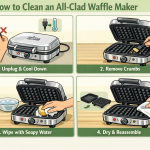
Day-to-day: hot water, dish soap, non-abrasive sponge. For stuck food — deglaze with water while the pan is still warm. It lifts most stuck bits without scrubbing. For removing burnt oil and heavy residue: Bar Keepers Friend (oxalic acid cleaner) restores stainless to near-new. Soak in hot water first, then apply, scrub gently.
Avoid steel wool — it scratches. Avoid chlorine-based cleaners — they cause pitting. Don’t store wet.
Cleaning HexClad
The hex texture traps debris. More thorough cleaning than a flat surface.
Warm soapy water, soft sponge — but work the soap into the hex pattern, don’t just wipe across the top. For stuck food: soak first, then work gently. The PTFE valleys scratch. HexClad specifically says no metal scourers. Follow that advice. For seasoning hybrid cookware — light oil wipe, heat to smoking point, wipe again. Conditions the surface. Not carbon steel seasoning, just surface maintenance.
Pan storage: use pan protectors if stacking. Applies to both brands.
Cleaning Products
Product
Use Case
Works On
Bar Keepers Friend
Stainless steel restoration
All-Clad primarily
Baking Soda
Mild abrasive for stuck food
Both brands
Dish Soap
Everyday cleaning
Both brands
Vinegar
Water spot removal
Both brands
Lemon Juice
Natural acid for discoloration
All-Clad
Stainless Steel Cleaner
Specialty polishing
All-Clad
For HexClad: Bar Keepers Friend is too abrasive for regular cleaning — stick to baking soda if you need mild abrasion. The PTFE valleys don’t need or benefit from oxalic acid.
Where to Buy
Retailer
All-Clad
HexClad
Notes
Amazon
✓
✓
Best for price comparison and deals
Williams Sonoma
✓
✓
Frequent All-Clad sales, 20–40% off
Costco
Limited
✓ (sets)
HexClad sets appear periodically
Sur La Table
✓
✓
Good for handling before buying
Crate & Barrel
✓
Limited
Target
Limited
Limited
Entry options only
Official Brand Stores
allclad.com
hexclad.com
Full selection, warranty support
Don’t buy All-Clad at MSRP. Williams Sonoma and Amazon regularly run 20–40% off sales on D3 sets. Watch for those. HexClad pricing is tightly controlled through their DTC model — less discount variation.
Expert Reviews and Ratings
Wirecutter has recommended All-Clad D3 as the best stainless steel skillet for years. Their long-term testing aligns with what professional cooks say. More skeptical of HexClad’s value proposition at the price point.
Serious Eats — Kenji López-Alt’s heat distribution testing has shown All-Clad’s consistent performance across the pan surface. His writing on why stainless rewards technique is the most useful thing you can read before buying either pan.
America’s Test Kitchen consistently recommends All-Clad D3 in its category. Systematic testing, hard to argue with.
Consumer Reports has rated All-Clad highly for durability and performance. HexClad appears less often in traditional review publications — the DTC marketing model means less independent long-term testing exists.
Good Housekeeping and Food & Wine have covered both brands. Consensus leans toward stainless for serious cooking, HexClad for convenience.
Epicurious tested both. Same conclusion: All-Clad for cooking performance, HexClad for easy cleanup appeal.
Sustainability
All-Clad’s sustainability case is simple: stainless steel is fully recyclable at end of life, and the pan doesn’t have an end of life under normal use. A properly maintained All-Clad D3 lasts 20, 30, 40 years. Longevity is the most environmentally friendly thing a product can do. The limited lifetime warranty covers manufacturing defects.
HexClad’s sustainability issue is the PTFE. When the nonstick degrades to replacement point — 3 to 7 years depending on how hard you cook — the pan goes to landfill. Separating the stainless components from PTFE for proper recycling isn’t practical for most people. The environmental impact of PTFE manufacturing is also a concern some buyers weigh.
The lifetime warranty on HexClad is real but covers manufacturing defects, not normal coating wear. The coating wearing is expected — just not in the warranty.
Factor
All-Clad
HexClad
Recyclable materials
Yes
Partial
Expected lifespan
20+ years
5–10 years (PTFE-limited)
Repairability
Not applicable
Not applicable
Warranty
Limited lifetime
Lifetime
Environmental impact
Low (durable metal)
Moderate (PTFE disposal)
FAQ
Is HexClad better than All-Clad? Depends on what you’re cooking. For searing, pan sauces, high-heat cooking — no, All-Clad is better. For eggs, fish, delicate foods where easy release matters — HexClad is more forgiving. No universal winner.
Why do chefs prefer stainless steel pans? Stainless handles high heat without degradation, develops fond for sauce-building, and rewards technique. Professional kitchens work at high heat and deglaze constantly. Nonstick doesn’t give you fond, can’t handle sustained professional heat, and doesn’t survive commercial kitchen abuse.
Does HexClad contain PTFE? Yes. The recessed hexagonal valleys are PTFE-coated. HexClad is PFOA-free — which matters — but the PTFE is there.
Is HexClad safe? At normal cooking temperatures, yes. PTFE is FDA-approved and inert below roughly 500°F. Don’t preheat any nonstick pan empty at maximum heat. That’s true for HexClad and for everything else with a PTFE coating.
Can All-Clad go in the dishwasher? Most lines, technically yes. Practically, hand-washing extends the surface life and prevents the pitting and cloudiness that detergents cause over time. If you plan to dishwasher everything, buy something cheaper than All-Clad.
Which pan is best for eggs? A dedicated nonstick — All-Clad HA1 or any quality PTFE nonstick — is still the best tool for eggs. HexClad works well. Bare stainless works with proper preheat and butter, but it punishes impatience. Honestly, just get a cheap dedicated nonstick for eggs and spend your budget on stainless for everything else.
Is hybrid cookware worth it? For a specific type of cook — yes. If you want one pan that handles most tasks without extreme searing requirements and you prioritize easy cleanup over perfect crust development, HexClad is a genuine compromise worth making. For cooks who want best performance at specific tasks, separate specialized tools win.
What cookware do professional chefs use? Stainless steel. All-Clad, Mauviel, Demeyere, commercial-grade stainless. Carbon steel for high-heat applications. Dedicated nonstick for eggs and delicate fish. Cast iron for specific uses. Hybrid nonstick — rarely, if ever.
Bottom Line: Which One Should You Buy, and Why?
Here’s the honest answer without softening it.
Buy All-Clad D3 if you cook seriously and want a pan that lasts 20 years without degrading. The $150 fry pan is expensive until you realize it’s the same pan in a decade. Searing, sauce-making, high-heat cooking — it’s the better tool for all of it. Learning to cook on stainless takes maybe a month of adjustment (preheat properly, don’t move food too soon, use Bar Keepers Friend to clean), but these aren’t hard lessons. Every serious home cook eventually ends up with stainless. Might as well skip the intermediate step.
Buy HexClad if you genuinely hate scrubbing stuck food and cook mostly eggs, fish, and vegetables at moderate heat. It’s a real product with real advantages for the right person. The compromise between nonstick convenience and some searing capability is genuinely useful if you never want to think about heat management. Know going in that the nonstick will degrade and you’ll replace it eventually.
Buy All-Clad HA1 nonstick alongside D3 stainless if you want the best of both worlds without HexClad’s price. A $100 stainless D3 skillet for most cooking, a $60 HA1 for eggs — this setup outperforms a single HexClad pan at every specific task and costs roughly the same total.
HexClad’s marketing is seductive. Gordon Ramsay’s endorsement is persuasive. The hex pattern looks genuinely cool. But cookware performance is physics — and physics favors specialized tools over compromises at the premium price both brands occupy.