✍️ 10+ years cooking on All-Clad stainless steel daily🔄 Updated April 2026
All-Clad frying pan, stainless steel skillet, tri-ply construction, polymerized oil, rainbow heat tint, white calcium deposits, burnt food residue, Bar Keepers Friend, chromium oxide layer — every mess this pan creates has a specific fix. Here’s what actually works, why it works chemically, and what destroys these pans slowly without you noticing.
My first All-Clad skillet was a D3 fry pan. Used it hard for two months — seared chicken thighs, made pan sauces, fried eggs I had no business frying in stainless. The inside went from silver to brown in about six weeks. Not ruined. Just covered in polymerized oil and heat tint that I didn’t know how to address.
I scrubbed it with the wrong pad, dulled a patch, and spent the next hour reading forums. The answer was always Bar Keepers Friend — but nobody explained why it works, when not to use it, or what the different types of discoloration actually mean for the pan’s condition. That’s what this guide covers.
⚡ Quick Answer — How to Clean an All-Clad Frying Pan
The Complete All-Clad Frying Pan Cleaning Method
Let it cool first — never cold-water a hot pan; thermal shock warps tri-ply bonded layers permanently
Deglaze while warm — splash of water or wine while the pan is still 130–150°F; wooden spoon lifts 70% of residue in twenty seconds
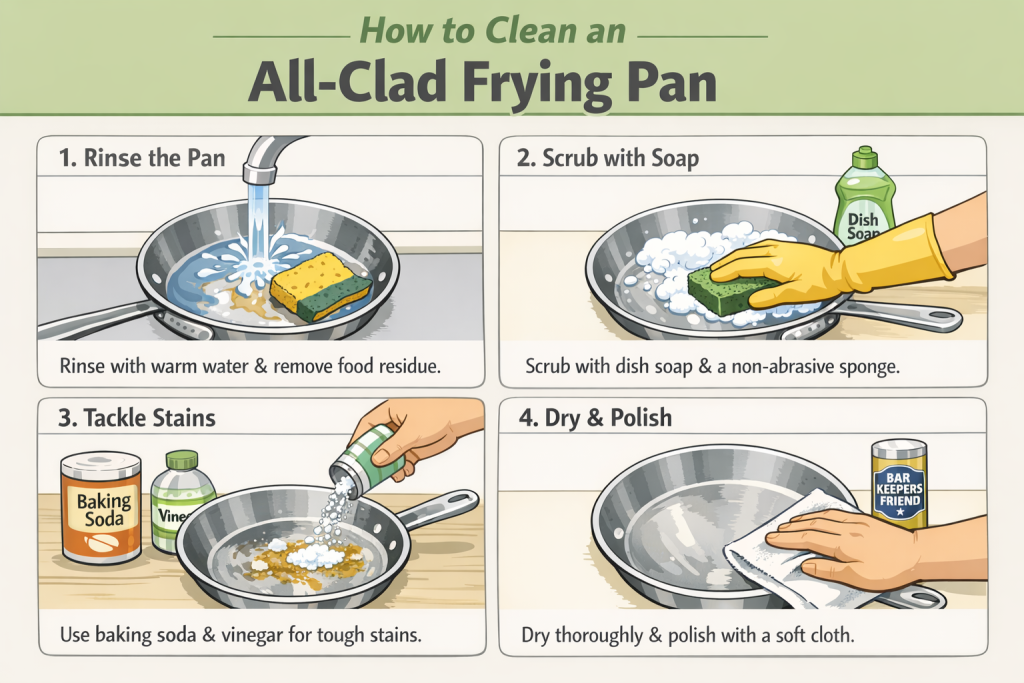
Daily wash: warm water + dish soap + soft sponge — handles normal cooking residue; dry immediately with a lint-free towel
Stuck food: cover with water, bring to a boil with 2 tbsp baking soda, simmer 5–10 min, scrape with wooden spoon
Rainbow stains (heat tint): wipe with undiluted white vinegar, 2–3 minutes, rinse, dry — done
White hard water spots: boil equal parts white vinegar and water in the pan, cool, wash, dry
Brown discoloration and burnt oil: Bar Keepers Friend powder paste, soft cloth in circular motions, max 60 seconds contact, rinse completely
Restore shine: Bar Keepers Friend with a nylon scrubbing pad, scrub with the steel grain, rinse thoroughly, dry with microfiber
Why All-Clad Frying Pans Get Dirty — What Each Type of Mess Actually Is
Stainless steel looks inert. It isn’t. The cooking surface has microscopic pores that open under heat and close as the pan cools. Whatever you cook gets into those pores — proteins, oils, minerals. Understanding the exact type of contamination tells you which cleaning method to use and which ones to skip.
Oil heated past its smoke point stops being oil. It cross-links chemically into a hard polymer — essentially a plastic layer baked onto the cooking surface. That dark ring inside your pan? The brown haze on the exterior bottom? Polymerized oil. Soap doesn’t dissolve polymers. You need either alkaline chemistry (baking soda boil) or oxalic acid (Bar Keepers Friend) to break them down.
Protein Adhesion (Stuck Food)
Egg whites, chicken skin, fish — when these hit a stainless surface that isn’t hot enough, or wasn’t oiled properly, they bond chemically with the steel. Not just “stuck” in a loose sense. Actual protein-metal adhesion at the molecular level. Cold water does nothing. Heat and alkaline chemistry break the bond.
All-Clad’s 18/10 stainless contains chromium, which forms a protective chromium oxide layer on the surface — the thing that makes stainless steel stainless. High heat, especially on a dry or empty pan, causes that layer to thicken unevenly. Light refracts through layers of different thickness and you see blue, gold, purple iridescence. Looks alarming. Completely harmless. The pan is protecting itself. White vinegar dissolves the excess oxide layer in under three minutes.
Calcium and Mineral Deposits (White Spots)
Hard water leaves calcium carbonate behind as it evaporates. White chalky film, small white circles, a hazy surface. Inert and harmless to food — but it accumulates, looks terrible, and builds into a harder layer over time if ignored. Acetic acid (vinegar) dissolves calcium carbonate completely. No scrubbing required.
All-Clad’s FAQ is direct on this: food films left on the pan and reheated cause discoloration and eventual sticking. Proteins and sugars that weren’t fully removed bond to the surface under heat and build a brown, sometimes patchy layer. This is different from polymerized oil — it comes off faster, with less aggressive treatment. Bar Keepers Friend handles both, but the food film discoloration usually requires less contact time.
Type of Mess
What It Is
Appearance
Best Fix
Cosmetic or Functional?
Polymerized oil
Cross-linked polymer from overheated fat
Dark brown or black ring, exterior bottom
Baking soda boil + Bar Keepers Friend
Cosmetic; affects appearance and evenness
Stuck food / protein adhesion
Chemical bond between protein and steel
Stuck bits, brown patches
Deglaze while warm; baking soda boil
Functional if ignored — affects release
Rainbow heat tint
Uneven chromium oxide layer from high heat
Blue, gold, purple iridescence
White vinegar wipe
Purely cosmetic
White calcium spots
Hard water mineral deposits
White haze, chalky circles
Vinegar + water boil
Purely cosmetic
Food film discoloration
Reheated food residue bonded to surface
Brown, patchy, dull surface
Bar Keepers Friend paste
Cosmetic; leads to sticking if severe
Salt pitting
Chloride ions attacking steel surface
Small pits or holes in the metal
Prevention only — no fix
Functional damage — permanent
Rust tint from high-iron water
Iron particles from tap water depositing
Rusty-orange discoloration
Bar Keepers Friend paste
Cosmetic
How to Clean an All-Clad Frying Pan After Every Use
Ninety percent of cleaning problems I see with All-Clad pans come from one thing: waiting too long. Residue that’s still warm is soft and releases in thirty seconds. The same residue twelve hours later requires a baking soda boil and real effort. The cleaning window is right after cooking. That’s when it matters.
1
Let it cool — 5 to 10 minutes, never cold water on a hot pan
All-Clad’s care guide says it clearly: never place a hot pan under cold water. Thermal shock stresses the bonded aluminum-stainless layers in tri-ply construction. The warping this causes is permanent and irreversible. Five minutes off heat, then clean. If you’re truly in a rush, pour warm (not cold) water in the hot pan — never cold.
2
Deglaze while still warm — water or wine, wooden spoon
The single most useful habit for stainless steel pans. Add a splash of liquid while the pan is still 130–150°F — the thermal gradient loosens residue from the surface without any scrubbing. This is exactly how professional kitchens build pan sauces, and it’s also the most effective cleaning step for daily cooking. Twenty seconds. Lifts the fond cleanly.
3
Wash with warm water, dish soap, and a soft sponge or cloth
Standard dish soap is perfectly fine on stainless steel — unlike cast iron, there’s no seasoning to strip. A drop of Dawn and a soft sponge handles most daily cooking residue completely. All-Clad recommends warm soapy water for daily cleaning. That’s all it usually needs.
4
Rinse in hot water, dry immediately with a lint-free towel
Air-drying causes water spots — hard water minerals left behind as water evaporates. Dry the pan with a clean lint-free cloth right after rinsing. Thirty seconds. The pan stays looking like new and the mineral deposits never get a chance to accumulate.
If you deglaze consistently while the pan is warm, you rarely need anything beyond soap and water. Soaking is fine on stainless — no damage risk — but it’s a workaround for not deglazing, not a primary strategy. Warm deglaze eliminates the need for most deep-cleaning sessions entirely.
How to Remove Stuck-On Food from an All-Clad Stainless Steel Frying Pan
Food sticks in stainless for specific, predictable reasons — and understanding them changes both how you clean and how you cook. It’s almost never the pan’s fault. It’s usually the preheating.
Why Food Sticks to Stainless Steel in the First Place
Stainless steel has microscopic pores that open under heat. Cold food dropped into a properly heated pan sears immediately on contact, sealing before it can bond to the pores. The Leidenfrost point — where water droplets skitter across the surface rather than evaporating immediately — is the signal that the pan is at the right temperature. Add oil at this point, then food. Release is almost guaranteed.
Food that’s added before the pan reaches this temperature, or cold food added to a hot pan without oil, bonds to the steel surface as the proteins set. That’s the stuck food you’re dealing with.
Add water or broth to the warm pan and put it on medium heat. Bring to a simmer. The thermally loosened liquid works under the stuck material and releases it from below. Scrape with a wooden spoon. This handles 70% of stuck situations without any products — and it’s also how you make the pan sauce that uses the fond you just lifted.
The Baking Soda Boil (For Stubborn Adhesion)
1
Cover the stuck area with water, add 2 tablespoons baking soda
Enough water to cover the stuck bits — usually 1 to 2 inches. Baking soda’s alkalinity (pH 8–9) breaks down protein bonds chemically while the boiling temperature loosens the adhesion mechanically.
2
Bring to a boil, simmer 5–10 minutes, scrape while hot
All-Clad’s official care page recommends this method specifically. The alkaline boiling solution lifts stuck food from below. Use a wooden spoon to scrape — you’ll see residue lifting off cleanly.
3
Pour out, rinse with hot water, wash normally
Most of the stuck material comes out with the pour. What remains rinses off with a sponge and warm soapy water. Dry immediately.
Flick a few drops of water into the dry preheating pan. If they evaporate instantly — too cold. If they form balls that skitter across the surface (Leidenfrost effect) — perfect. Add oil now. Food dropped into oil on a pan at this temperature releases cleanly, cooks beautifully, and leaves behind fond rather than adhesion. Cleaning becomes trivial.
How to Clean a Burnt All-Clad Frying Pan
A genuinely burnt pan — smoke alarm triggered, black interior, the kind of burn where you’re calculating whether the pan is salvageable — looks irreparably destroyed. It almost never is. Stainless steel is chemically and physically robust. The damage is surface-level contamination, not structural.
Level 1 Light
Scorched fond, light browning, residue that soap didn’t remove
Worst case. Still recoverable. Requires patience and multiple passes — not magic products.
Level 1 — Baking Soda Boil
Fill the pan with water to cover the burnt area. Add 2 tablespoons baking soda. Bring to a boil, simmer 5–10 minutes. The alkaline boiling water chemically softens carbonized food and oil. Pour out, scrape with a wooden spoon, wash with soap and a nylon scrubbing pad. Dry immediately. Most Level 1 burns are done at this point.
Level 2 — Vinegar Soak + Bar Keepers Friend
1
Fill pan with equal parts water and white vinegar, bring to a simmer
All-Clad’s official guide recommends this for discoloration and burnt residue. Simmer 10 minutes. The acetic acid begins dissolving the carbonized layer while heat loosens adhesion.
2
Cool, pour out, apply Bar Keepers Friend paste
Slightly damp pan, BKF powder, small amount of water — work into a paste with a soft cloth. Apply across the affected area. BKF’s oxalic acid dissolves iron oxide and food film discoloration while the fine feldspar abrasive polishes the surface. Max 60 seconds contact time.
3
Scrub in circular motions with nylon scrubbing pad
Nylon (not steel, not the green Scotch-Brite) is safe on stainless steel. Scrub the BKF paste across the surface. Rinse completely — BKF is acidic and needs full removal. Dry immediately.
Level 3 — Full Recovery Protocol
Baking soda boil for 15+ minutes (not 5)
Cool completely, scrape with wooden or silicone spatula
White vinegar + water soak (1:1) for 10 more minutes on remaining residue
Rinse, assess. Repeat BKF pass if needed — usually 2–3 rounds for severe burns
Final rinse with hot water, dry immediately with microfiber
🍳 The Real Myth Here
Most forums say “you need specialty cookware cleaner” for burnt All-Clad. You don’t. Baking soda boil and Bar Keepers Friend handle 95% of everything. The only burnt pans I’ve encountered that couldn’t be recovered were ones that had been attacked with steel wool first — the surface was too scratched to clean properly afterward. The steel wool made it unfixable, not the original burn.
How to Remove Rainbow Stains and Heat Tint from All-Clad Stainless Steel
The iridescent blue-gold-purple swirl. I spent forty minutes on Reddit trying to figure out if I’d permanently damaged my pan the first time I saw it. The thread eventually concluded: “it’s fine, just vinegar.”
That was the right answer, and I should have gotten there faster.
What Rainbow Discoloration Actually Is
All-Clad’s 18/10 stainless steel contains chromium, which forms a protective chromium oxide layer on the surface. High heat — especially a dry, empty pan preheated too long on high — causes that layer to grow thicker in certain spots. Light hits layers of different thickness and splits into the visible spectrum: blue, gold, purple. It’s physics, not damage. The All-Clad FAQ confirms: rainbow coloring is caused by overheating but doesn’t affect performance.
The chromium oxide layer that causes the rainbow is actually the steel’s protection mechanism working correctly. The pan is more corrosion-resistant after this happens, not less.
Removing Heat Tint from an All-Clad Frying Pan
1
Let the pan cool completely
Vinegar on a still-hot pan can cause uneven etching on the stainless surface. Wait until the pan is at room temperature.
2
Pour undiluted white vinegar into the pan, tilt to cover the stained area
You don’t need much. The acetic acid dissolves the excess chromium oxide layer uniformly. All-Clad’s official care guide: “wipe with a sponge or soft cloth and white vinegar” for rainbow discoloration.
3
Wait 2–3 minutes, wipe with a soft cloth, rinse, dry immediately
The stain dissolves. No scrubbing needed. If a faint tint remains, repeat once. The whole process takes under five minutes and requires nothing more than white vinegar from your pantry.
To prevent recurrence: don’t preheat an empty pan on high for more than 30–45 seconds. All-Clad’s tri-ply aluminum core distributes heat so efficiently that medium heat is genuinely enough for most cooking, including searing. The rainbow stain is the pan telling you the heat was too high.
How to Remove White Spots and Hard Water Deposits from All-Clad Pans
White chalky spots, a hazy film, small white circles that look like etching. Not mold. Not structural damage. Not the metal degrading. Calcium and magnesium from hard tap water, left behind as water evaporates. Purely cosmetic and completely removable — but if ignored they build into a thicker, more stubborn layer over months.
The Vinegar Boil Method — From All-Clad’s Own Guide
All-Clad’s care page specifies: for cloudy white hard water spots, boil a 1:1 white vinegar to water solution in the pan. The acetic acid reacts with calcium carbonate and converts it to calcium acetate, which is water-soluble and rinses away completely. Same chemistry as descaling a kettle, just at lower concentration.
1
Add equal parts white vinegar and water to the pan
Enough to cover the affected area. For a 10-inch frying pan, about 1 cup each is sufficient.
2
Bring to a boil, simmer 5 minutes, cool
The boiling acid solution penetrates the mineral deposit and dissolves it. You sometimes see the water turning slightly cloudy as the calcium deposits release.
3
Pour out, rinse with warm water, wash normally, dry immediately
The white spots are gone. If any haze remains, wipe with undiluted vinegar on a cloth and rinse. Dry the pan before putting it away — air-drying brings the mineral deposits right back.
Prevention: dry the pan immediately after every wash with a lint-free towel. Don’t let water pool and evaporate inside the pan. If you live in a hard water area, a monthly vinegar simmer as preventive maintenance keeps deposits from accumulating into a thick layer.
⚠️ Salt Pitting — The One Type of Damage That’s Permanent
White spots from hard water are harmless. White pits — small holes in the steel surface — are a different problem. Salt crystals sitting on the bottom of a cold stainless pan dissolve into chloride ions under moisture, which attack the chromium oxide layer and pit the metal. These pits are permanent — no cleaning method fixes them. Prevention: always add salt to boiling water or to food already in the pan, never to cold water in a cold pan. All-Clad’s FAQ calls this out specifically.
How to Remove Brown Stains and Discoloration from All-Clad Stainless Steel Frying Pans
Brown spots and general browning are the most common complaint from new All-Clad owners. Someone seared a chicken thigh, made a pan sauce, cleaned with soap and water — and the pan still looks brown and splotchy. They think they’ve damaged it. They haven’t. They’ve just left food film on a pan that needs Bar Keepers Friend.
What Brown Stains Are
Two distinct causes. First: polymerized oil that wasn’t fully removed — fat that cross-linked under heat into a brown layer. Second: food film discoloration — protein and sugar residue that was reheated without being fully cleaned, bonding to the surface. Both look similar. Both respond to Bar Keepers Friend. The food film discoloration comes off faster; polymerized oil takes a bit more contact time and sometimes a baking soda boil first.
Bar Keepers Friend Method for Brown Stains — Step-by-Step
1
Make the pan slightly damp — not wet, not dry
A few drops of water on the surface. BKF works best as a paste, not a runny solution. Too much water dilutes the oxalic acid and reduces effectiveness.
2
Sprinkle Bar Keepers Friend powder, work into a paste with a sponge
Use the powder form — The Kitchn, Prudent Reviews, ChefTalk forums, and All-Clad’s own FAQ all specify BKF powder specifically. The liquid and spray versions are less effective on baked-on stains. Work the powder and water into a paste consistency across the stained area.
3
Let paste sit on the stain for 15–45 seconds — not more than 60
BKF’s oxalic acid works quickly. Fifteen seconds for light food film discoloration. Up to 45 seconds for deeper brown staining. Prudent Reviews specifically warns: don’t let BKF soak for extended periods — the potent formula can cause its own discoloration on stainless steel if left too long.
4
Scrub in circular motions with a soft cloth or nylon pad
Both the interior and exterior of the pan. For the exterior bottom where polymerized oil tends to accumulate thickest — apply the same paste and scrub with slightly more pressure. Use a nylon scrubbing pad on stainless (not the green Scotch-Brite — too aggressive).
5
Toothbrush for rivets and the All-Clad logo
The rivets and embossed logo collect dark grime that a cloth can’t reach. Dip an old toothbrush in the BKF paste and work it around every rivet and into the logo lettering. A toothpick removes grime from the rivet-pan joint that even the toothbrush misses. The Kitchn and Prudent Reviews both recommend this specifically.
6
Rinse completely with warm water — no residue
BKF is acidic — any residue left on the stainless surface will continue working and eventually etch the finish. Rinse until the water runs completely clear and you feel no grit. Dry immediately with a lint-free towel.
💡 BKF Frequency
Monthly on daily-use pans. When you start to see brown developing that daily washing doesn’t address — that’s the signal. Don’t use BKF after every cook — the oxalic acid does mild abrasion work each time, and cumulative use faster than necessary dulls the finish over months. Once a month restores the pan without the wear.
How to Restore Shine to an All-Clad Stainless Steel Frying Pan
A pan that’s seen six months of heavy use looks different from a new one. Greyer, duller, the mirror finish gone matte in spots. Nothing is wrong with it — it cooks exactly as well as it did. But these pans cost real money, and they’re supposed to look good. The shine is recoverable.
Bar Keepers Friend Polish
There are two BKF products relevant here: the standard BKF Cleanser and the BKF Superior Cookware Cleaner and Polish. The polish has a finer powder — less abrasion, more optical restoration. Prudent Reviews specifically recommends the polish version for restoring mirror-finish surfaces like the exterior of All-Clad without scratching. Same method as for brown stains but lighter pressure, and you can let it sit a full minute on the exterior mirror finish.
The Flour Polish Method (Surprisingly Effective)
Prudent Reviews documents this: sprinkle baking flour across the clean, dry pan surface. Buff in circular motions with a lint-free cloth. Rinse and dry. The flour acts as a micro-fine abrasive that polishes the steel surface without chemical action. It works especially well on the interior cooking surface where you want optical brightness without any acid exposure. Sounds absurd. Works.
What “Restoring Shine” Actually Means for Stainless
You’re not re-plating or re-coating anything. Stainless steel’s cooking surface is the metal itself — no coating to restore. What you’re doing is removing the micro-layer of accumulated oxidation, food film, and mineral deposit that dulls the reflective surface. Every cleaning with BKF removes a tiny amount of surface material — you’re essentially micro-polishing each time. Done monthly, the pan stays bright. Done daily, you’d eventually dull the finish from over-cleaning. Monthly is right.
Cleaning the Exterior and Rivets of an All-Clad Frying Pan
The exterior bottom is where the most neglected buildup lives. Polymerized oil from burner contact, splattered fat from high-heat cooking, heat tint from the flame hitting the stainless — it all accumulates on the outside. Most people clean the interior and put the pan away with a darkened, gummy exterior. The same BKF method works on the outside.
Exterior Bottom
BKF paste, nylon scrubbing pad, circular motions. The exterior stainless is the same material as the interior — responds to the same chemistry. For very heavy exterior buildup (years of neglect), the baking soda boil in a large pot works: All-Clad in a stock pot full of water, add half a cup of baking soda, bring to a boil, simmer 15–30 minutes. Pull out, scrub with nylon pad and BKF while still hot. Prudent Reviews documents this method specifically for All-Clad exterior restoration.
The Rivets — The Most Annoying Spot
Dark grime accumulates in the crevice between each rivet and the pan body. Regular washing doesn’t reach it. Over time it builds into a hard, dark ring around every rivet that makes an otherwise-clean pan look perpetually dirty.
Fix: BKF paste on an old toothbrush, work it around each rivet in circular motion. Then a toothpick in the actual crevice between rivet and pan body to lift the compressed grime. Takes two minutes per pan. Completely restores the rivet area. Both The Kitchn and Prudent Reviews call this out specifically as the detail that separates a pan that looks cleaned from a pan that looks new.
The Handle
All-Clad’s cast stainless handles get greasy from cooking splatter and hand contact. Warm soapy water and a cloth handles routine cleaning. For grease buildup in the handle’s underside grooves — same toothbrush technique. BKF paste if discoloration has developed.
All-Clad Frying Pan Cleaning Methods Compared
Method
Best For
Works On
Time
Risk to Pan
Warm deglaze while hot
Daily fond and residue
Fresh stuck food, cooking residue
20 sec
None
Dish soap + soft sponge
Normal daily cleaning
Light cooking residue, oil
2 min
None
Baking soda boil
Stuck food, light burns, brown stains
Protein adhesion, carbonized food
10–15 min
None
White vinegar wipe
Rainbow heat tint
Chromium oxide discoloration
3 min
None
Vinegar + water boil (1:1)
White hard water deposits
Calcium carbonate mineral deposits
10 min
None
Bar Keepers Friend paste (soft cloth)
Brown stains, food film, shine restoration
Iron oxide, food film, polymerized oil
5–10 min
Low — max 60 sec contact
BKF paste + nylon pad
Deeper brown stains, burnt exterior
Heavy polymerized oil, baked-on residue
10–15 min
Low — nylon safe on stainless
Vinegar simmer + BKF paste
Moderate burns
Carbonized food + discoloration together
20–25 min
Low
Large-pot baking soda boil
Exterior bottom buildup
Years of polymerized oil on exterior
30–45 min
None
Toothbrush + BKF at rivets
Rivet grime, logo area
Compressed dark residue at joints
2–3 min
None
What NOT to Do When Cleaning an All-Clad Stainless Steel Frying Pan
✅ Safe to Do
Deglaze immediately while warm
Use dish soap — it’s fine on stainless
Bar Keepers Friend powder for stains
White vinegar for rainbow and mineral deposits
Baking soda boil for stuck food and burns
Nylon scrubbing pads on the interior
Toothbrush on rivets and logo
Dry immediately with lint-free towel
❌ Never Do These
Cold water on a hot pan — warps permanently
Steel wool or abrasive scouring pads
Bleach or chlorine-based cleaners
Oven cleaner spray
Ammonia solutions
Leave BKF on more than 60 seconds
Add salt to cold water in a cold pan
Daily dishwasher use long-term
Cold Water on a Hot Pan — The Warp That Never Fixes
All-Clad’s tri-ply construction — stainless, aluminum core, stainless — uses layers that expand at different rates. A hot pan plunged into cold water forces those layers to contract violently and unevenly. The result is a warped base that rocks on the stove, creates hot spots, and never sits flat again. Multiple sources including All-Clad’s own care guide call this out. No cleaning method requires cold-water shocking. Let it cool. Five minutes.
Steel Wool — The Permanent Dull
Steel wool removes stains. It also micro-gouges the stainless surface with thousands of tiny scratches in random directions. These scratches collect food and discolor faster — and they permanently eliminate the brushed finish that makes All-Clad look premium. There’s no re-polishing at home that reverses steel wool damage. BKF with a nylon pad removes the same stains with no surface damage whatsoever. Steel wool has no valid use case on stainless steel cookware.
Bleach and Chlorine Cleaners
Chlorine ions attack the chromium oxide layer that makes stainless steel corrosion-resistant. The result is pitting — the same damage that salt causes when added to cold water, but faster and more widespread. All-Clad’s FAQ explicitly prohibits: “oven cleaners or cleansers with chlorine bleach.” This includes high-chlorine dishwasher pods — another reason to hand wash rather than use the dishwasher daily.
The Dishwasher Reality
All-Clad labels most stainless pans as dishwasher-safe. Technically accurate. But dishwasher detergents are high-alkaline and often chlorine-based. Repeated cycles dull the finish and cause the stainless to develop a grey, cloudy appearance over time. An occasional dishwasher run won’t harm a pan — most of us do it when life gets busy. Making it a daily habit over a year degrades the appearance meaningfully compared to hand washing. All-Clad recommends hand washing.
Tools and Products That Actually Work on All-Clad Stainless Steel
Product / Tool
Use Case
Why It Works
Watch Out For
Bar Keepers Friend (powder)
Brown stains, discoloration, shine restoration, rivet cleaning
Oxalic acid dissolves iron oxide and food film; fine feldspar abrasive polishes without deep scratching
Max 60 sec contact; powder only (not liquid); wear gloves — oxalic acid irritates skin
Bar Keepers Friend Superior Cookware Cleaner & Polish
Restoring mirror finish on exterior surfaces
Finer powder than standard BKF; optical restoration without scratching polished surfaces
Same contact time rule applies
White vinegar
Rainbow heat tint; white mineral deposits
Acetic acid dissolves chromium oxide buildup and calcium carbonate; safe on stainless
Don’t leave on extended periods; don’t use on hot pans
Baking soda
Stuck food (boil method); light burns; brown stains
pH 8–9 alkaline breaks protein bonds and softens carbonized food; safe on stainless
Works best in the boil method — paste alone is less effective on stainless than on cast iron
Nylon scrubbing pad (Scotch-Brite white/blue)
BKF application; moderate scrubbing
Safe abrasion level for stainless steel; recommended by All-Clad
Green Scotch-Brite is too aggressive on the polished finish
Soft cloth or sponge
Daily cleaning; BKF application on sensitive areas
Zero scratch risk; appropriate for daily soap-and-water cleaning
Replace when it starts smelling — a dirty sponge deposits bacteria
Microfiber cloth
Drying; final buff after BKF
Lint-free; pulls moisture off completely without streaking
Wash it regularly — a microfiber saturated with cooking grease smears
Old toothbrush
Rivets, logo, handle grooves
Reaches crevices no cloth or sponge accesses; soft bristles safe everywhere
Designate it for kitchen use — don’t share with bathroom brushes
Toothpick / wooden skewer
Rivet-to-pan joint; grime in narrow crevices
Physically removes compressed residue that even a toothbrush can’t reach
Don’t scratch the stainless surface with it — use on the joint gap, not the pan face
Wooden or silicone spatula
Deglazing; scraping during baking soda boil
Safe on heated stainless; won’t scratch the cooking surface
Metal spatulas cause superficial marks over time — fine functionally but affects appearance
🛒 What’s Actually in My Cleaning Cabinet
Bar Keepers Friend powder (gold can with blue label — the standard version), white vinegar, baking soda, a pack of nylon scrubbing pads, one microfiber cloth dedicated to cookware, two old toothbrushes. Total cost under $20. That’s everything needed to maintain All-Clad stainless steel indefinitely. No specialty products required beyond BKF — and even that costs four dollars.
Prevention and Long-Term Maintenance — How to Keep All-Clad Frying Pans Clean Longer
The cleanest All-Clad pans aren’t the ones cleaned most aggressively. They’re the ones whose owners learned to cook in stainless correctly and deglaze consistently. The cleaning problems most people face are mostly upstream cooking technique problems.
Preheat Correctly — The Single Most Impactful Habit
Medium heat. Three minutes. Water test — drops that skitter mean the pan is ready. Add oil. Then food. This sequence prevents protein adhesion, prevents the overheating that causes rainbow stains, and produces better searing results than blasting a cold pan on high heat. It also means the pan cleans in two minutes rather than fifteen.
High heat on All-Clad isn’t more effective — the aluminum core is already distributing medium-burner heat across the whole surface more evenly than a cheap pan does on high. Cooking at inappropriate temperatures is the root cause of most cleaning problems people complain about.
Deglaze After Every Cook
Thirty-minute-old residue and twelve-hour-old residue are genuinely different cleaning jobs. The deglaze habit — splash of water or wine while the pan is still warm, wooden spoon — costs twenty seconds and prevents the baking soda boil session. I’ve been deglazing consistently for ten years. I use BKF maybe once a month, not once a week.
Dry Immediately After Every Wash
Hard water mineral deposits, water spots, and the early-stage rust tint from high-iron water all result from leaving water to evaporate on the surface. Thirty seconds with a lint-free towel after every wash prevents all three. It’s the easiest preventive step in this entire guide.
Store Without Stacking Directly
The rim of one pan resting on the cooking surface of another creates fine scratches with every movement in the cabinet. Over time this network of cross-grain scratches dulls the interior surface and provides more surface area for food to adhere. Pan protectors — the felt or silicone discs — cost a few dollars and prevent this completely. Hanging is better still if you have the space.
Add Salt Correctly
Salt added to cold water in a cold stainless pan dissolves into chloride ions that pit the metal. The pitting is permanent. All-Clad’s FAQ addresses this directly. Add salt to boiling water or to food already in the pan. Not to cold water, not to a cold pan, not to the pan before adding water. One habit change. No more pitting.
💡 Monthly Maintenance Session
Once a month on daily-use pans: Bar Keepers Friend full clean — interior, exterior, rivets, handle. Five to ten minutes. Prevents food film and polymerized oil from accumulating into a deep layer that requires the baking soda boil. The monthly BKF session is the difference between pans that look used and pans that still look worth what you paid for them five years in.
FAQ: How to Clean an All-Clad Frying Pan
How do you clean a burnt All-Clad frying pan?
Cover the burnt area with water, add 2 tablespoons baking soda, bring to a boil, and simmer for 5–15 minutes depending on severity. The alkaline boiling water chemically softens carbonized food and polymerized oil. Pour out and scrape with a wooden spoon. For residue that remains, apply Bar Keepers Friend powder paste with a soft cloth, let sit 30–45 seconds (max 60), scrub with a nylon pad in circular motions, rinse completely. For severe burns, precede the BKF step with a 10-minute simmer of equal parts white vinegar and water. Two to three BKF passes handles most catastrophic burns. What doesn’t work: steel wool — it removes the stain but permanently scratches the surface.
Is Bar Keepers Friend safe to use on All-Clad stainless steel pans?
Yes — All-Clad’s own FAQ and care page recommend it by name. Bar Keepers Friend contains oxalic acid, which dissolves iron oxide and food film discoloration without damaging the steel, and a fine feldspar abrasive that polishes the surface. It’s effective on both the interior and exterior of All-Clad pans. Two rules: use the powder version (not liquid or spray — less effective), and don’t leave it in contact with the surface for more than 60 seconds. Rinse completely after use. Wear rubber gloves — the oxalic acid formula irritates skin with extended contact.
Why does my All-Clad frying pan turn rainbow colors?
Rainbow discoloration — blue, gold, purple iridescence — is chromium oxidation. All-Clad’s 18/10 stainless contains chromium, which forms a protective oxide layer on the surface. High heat causes that layer to thicken unevenly in patches. Light refracts through different layer thicknesses and produces visible spectrum colors. It’s not damage — All-Clad’s FAQ confirms it doesn’t affect performance. Fix it by wiping with undiluted white vinegar: the acetic acid dissolves the excess chromium oxide layer uniformly. Let it sit 2–3 minutes, wipe, rinse, dry. Prevent it by not preheating an empty pan on high for more than 30–45 seconds.
Can you put All-Clad frying pans in the dishwasher?
All-Clad marks most stainless pans as dishwasher-safe, so technically yes. Practically, regular dishwasher use dulls the finish over time — high-alkaline detergents and thermal cycling degrade the polished surface. An occasional dishwasher run when you’re exhausted won’t cause damage. Daily dishwasher use for a year produces visible greying and cloudiness compared to hand-washed pans. All-Clad recommends hand washing. If you use the dishwasher, avoid detergents with chlorine bleach — chloride ions pit stainless steel.
How do you remove white spots from All-Clad stainless steel pans?
White spots and chalky film are calcium and magnesium deposits from hard water. They’re cosmetic and harmless. Remove them by boiling equal parts white vinegar and water in the pan for 5 minutes — the acetic acid dissolves calcium carbonate and the deposits rinse away. For small spot deposits on a clean pan, wiping with undiluted white vinegar and rinsing immediately is sufficient. Prevent them by drying the pan with a lint-free towel immediately after washing — never air-drying. Monthly preventive vinegar simmers stop deposits from accumulating in hard water areas.
How do you make All-Clad stainless steel frying pans shiny again?
Bar Keepers Friend — powder form, made into a paste with a few drops of water. Apply with a soft cloth or nylon scrubbing pad in circular motions across the interior and exterior. Contact time: 30–45 seconds for light dullness, up to 60 seconds for heavier discoloration. Rinse completely, dry with microfiber, buff lightly as you dry. For the mirror-polish exterior, BKF Superior Cookware Cleaner and Polish (finer powder) gives better optical results without scratching the polished surface. Do this monthly on daily-use pans — the cumulative effect of regular BKF cleaning is a pan that looks better at five years than it did at six months.
How do you remove brown stains from an All-Clad pan?
Brown stains are either polymerized oil or food film discoloration — both respond to Bar Keepers Friend. Make a paste with the powder and a few drops of water. Apply to the stained area, let sit 15–30 seconds, scrub with a soft cloth or nylon pad in circular motions. For deeper staining around the rivets and All-Clad logo, use an old toothbrush with the BKF paste. Rinse completely and dry immediately. For very heavy brown buildup from years of use, precede the BKF step with a baking soda boil (10 minutes) to soften the polymerized layer first — the BKF then removes it in one pass rather than three.
Why is my All-Clad frying pan sticking?
Almost always a preheating issue, not a pan issue. All-Clad’s FAQ is direct: sticking on stainless occurs when you haven’t preheated the pan, added cold food to a hot pan, didn’t use enough oil, or tried to move food before it released naturally. The fix: preheat on medium for 2–3 minutes, use the water test (drops should skitter on a ready pan), add oil and let it heat until shimmering, then add food. Don’t move it until it releases — properly seared food lifts off stainless steel without force. If the pan is clean and properly preheated and food still sticks, check for cooking spray buildup — that polymerizes differently and creates sticking that cleaning doesn’t fix until the residue is removed with BKF.
How do you clean the outside bottom of an All-Clad frying pan?
The exterior bottom accumulates the heaviest polymerized oil buildup — direct burner contact combined with splattered fat from high-heat cooking. Bar Keepers Friend paste with a nylon scrubbing pad handles regular buildup. For years of accumulated darkening, the large-pot baking soda boil is the most effective approach: submerge the pan in a large stockpot of water with half a cup of baking soda, bring to a boil, simmer 15–30 minutes. Remove and scrub the exterior with BKF paste and a nylon pad while still hot. This combination lifts the heaviest exterior buildup without any risk to the pan’s structure or interior surface.
⬇️ Bottom Line
How to Keep an All-Clad Frying Pan Clean Long-Term
Three habits cover the vast majority of it. Not products — habits.
Deglaze every time, while the pan is still warm — twenty seconds, wooden spoon, prevents most of what makes deep cleaning necessary
Dry immediately after every wash — lint-free towel, thirty seconds, prevents mineral deposits and water spots from accumulating
Bar Keepers Friend once a month — interior, exterior, rivets, five to ten minutes; handles everything that daily washing leaves behind
When things go wrong: baking soda boil for stuck food and burns, white vinegar for rainbow stains and mineral deposits, BKF paste for brown discoloration and shine restoration. That’s the complete toolkit. Nothing expensive, nothing specialized, nothing that requires more than ten minutes.
My original D3 fry pan is eleven years old and still looks like it’s worth what I paid for it. Not because I’ve been precious about it — I sear hard, cook acidic things in it occasionally, use high heat when I have to. It looks good because I deglaze when I’m done and use BKF once a month. The maintenance is simple. The pans are built to last. They just need the right habits, not the right products.