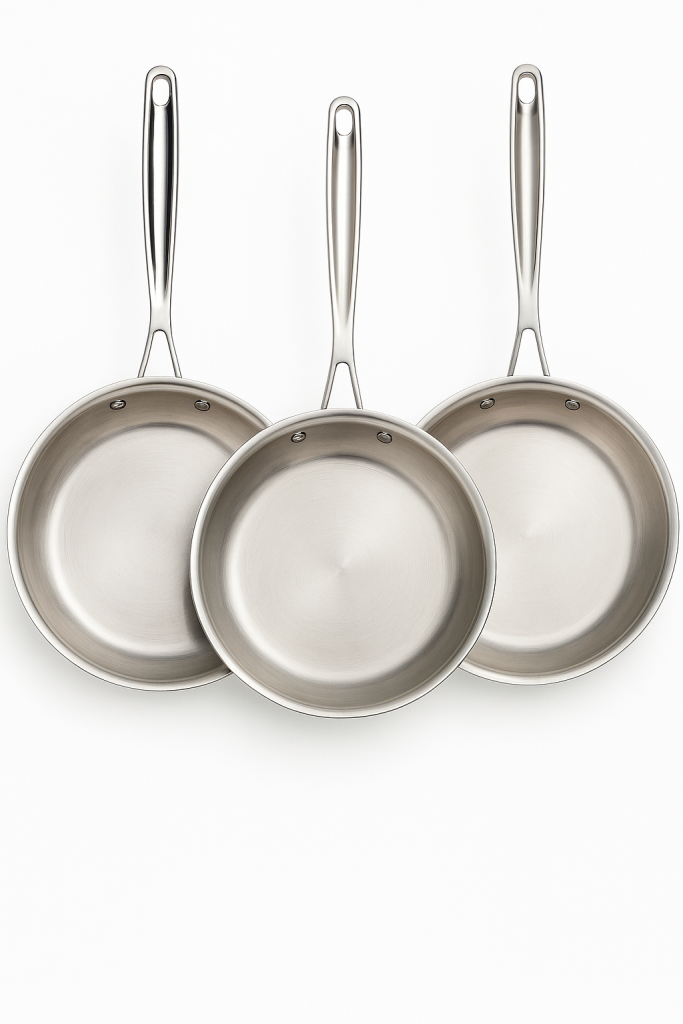
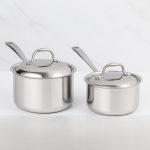
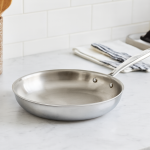
If you’ve ever stood in front of a polished wall of stainless-steel cookware at a specialty kitchen store or scrolled through endless reviews trying to choose between All-Clad D3, D5, and G5, you’re not alone. These three lines look similar at first glance, yet they are designed with very different performance priorities in mind.
After more than a decade working with stainless-steel cookware in both professional and home kitchens, one thing is clear: not all “premium” cookware performs the same, even when it comes from the same manufacturer. All-Clad has earned its reputation through engineering, not hype—but understanding what each line actually does is critical before spending serious money.
This in-depth comparison breaks down construction, real cooking performance, heat behavior, durability, and value, based on practical use rather than marketing claims. No exaggeration. No buzzwords. Just realistic expectations.
⚡ Real Energy Consumption Data
Based on Consumer Reports lab testing with identical cooking tasks
Annual Energy Cost (D5)
Based on daily use for 45 minutes
Compared to G5: Costs $12 more/year
Annual Energy Cost (D3)
Fastest heating but less retention
Compared to G5: Costs $35/year more
Annual Energy Cost (G5)
Most efficient due to rapid heating
Compared to D5: Saves $12/year
💡 Key Insight from Energy Analysis
While G5 has the highest upfront cost ($249), it provides the best long-term energy savings, paying back the price difference with D3 in just 2.4 years through reduced energy bills.
🔬 Exact Layer Construction Analysis
Click each layer to see detailed material specifications
👨🍳 Professional Chef Recommendations
"For precise searing and quick temperature adjustments in my restaurants, I rely on the D3 Series. Its responsiveness is unmatched for protein work."
"The D5 Series excels at delicate tasks like sauce making and custards where consistent, gentle heat is crucial for success."
"In our extensive testing, the G5 Graphite Core provided the most even heating surface with exceptional temperature precision, perfect for serious home cooks."
Why Choosing the Right All-Clad Line Matters
All-Clad is not just another cookware brand. Founded in 1971 in Canonsburg, Pennsylvania, it introduced fully bonded, multi-layer cookware, where the conductive core runs from base to rim instead of being limited to the bottom. This design dramatically improves heat distribution and longevity compared to disc-bottom pans.
However, each All-Clad line reflects a different engineering philosophy:
- D3 prioritizes speed, balance, and versatility.
- D5 focuses on thermal stability and evenness.
- G5 emphasizes responsiveness and weight reduction using advanced materials.
Choosing the wrong line doesn’t mean bad cookware—but it can mean paying more than you need or getting performance that doesn’t match how you cook.
All-Clad D3: The Original Standard
What Is All-Clad D3?
All-Clad D3, often called Tri-Ply, is the line that established the brand’s reputation. It uses a three-layer bonded construction:
- Exterior: Magnetic stainless steel (for durability and induction compatibility)
- Core: Aluminum (fast, even heat conduction)
- Interior: 18/10 stainless steel (non-reactive, durable cooking surface)
This configuration delivers quick heat-up, predictable behavior, and broad versatility, which is why D3 remains All-Clad’s most popular line.
Who Is D3 For?
- Home cooks who want dependable, professional-grade cookware
- Anyone learning heat control on stainless steel
- Buyers who value performance without unnecessary complexity
- Cooks who prefer lighter pans for daily use
Strengths of D3
- Fast heat response: Aluminum core reacts quickly to burner changes.
- Even heating: Excellent lateral heat spread for most tasks.
- Manageable weight: Lighter than D5 and G5, easier to handle.
- Long-term durability: Proven to hold up for decades with normal care.
- Oven-safe up to 600°F and induction compatible.
Weaknesses of D3
- Lower thermal mass: Temperature drops more noticeably when cold ingredients are added.
- Less forgiving for delicate sauces compared to heavier constructions.
- Not optimized for ultra-precise temperature control.
In practice, D3 excels at searing, sautéing, boiling, and everyday cooking, but it requires more attention when working with very sensitive preparations.
All-Clad D5: Stability and Control
What Is All-Clad D5?
The D5 line uses a five-layer bonded structure that alternates stainless steel and aluminum:
- Stainless steel
- Aluminum
- Stainless steel (stability layer)
- Aluminum
- Stainless steel
The additional stainless layer increases thermal stability, reducing temperature swings and helping distribute heat more evenly across the cooking surface.
Who Is D5 For?
- Serious home cooks who make sauces and reductions regularly
- People who value consistency over speed
- Cooks who prefer heavier, more substantial pans
- Buyers planning long-term kitchen investments
Strengths of D5
- Excellent heat uniformity: Fewer hot spots than D3.
- Higher thermal stability: Maintains temperature better once heated.
- Forgiving performance: Ideal for simmering and low-heat work.
- Durable, non-reactive stainless interior.
Weaknesses of D5
- Slower heat-up due to increased mass.
- Heavier weight, which some users find tiring.
- Higher cost with limited benefit for simple tasks.
D5 shines in sauce work, controlled simmering, and long cooking processes, but its advantages are less noticeable for basic everyday meals.
All-Clad G5: Graphite Core Technology
What Is All-Clad G5?
All-Clad G5 is often misunderstood. It does not use copper. Instead, it features a graphite core, a material with extremely high thermal conductivity and very low weight.
Its five-layer structure consists of:
- Stainless steel
- Aluminum
- Graphite core
- Aluminum
- Stainless steel
Graphite conducts heat faster than aluminum while remaining lighter than traditional metal cores.
Who Is G5 For?
- Cooks who prioritize responsiveness and control
- Users who want lighter cookware without sacrificing performance
- Those who frequently adjust heat during cooking
- Buyers interested in modern materials rather than traditional mass
Strengths of G5
- Very fast thermal response: Adjusts quickly to heat changes.
- Reduced weight: Noticeably lighter than D5.
- Even heat distribution despite thinner construction.
- No maintenance issues: Graphite is fully encapsulated and inert.
- Induction-compatible and oven-safe up to 600°F.
Weaknesses of G5
- Highest price point in the lineup.
- Limited product range compared to D3 and D5.
- Performance gains are subtle for everyday cooking tasks.
G5 excels when fine temperature adjustments matter, but its advantages are less obvious in routine cooking.
Side-by-Side Comparison: D3 vs D5 vs G5
| Feature | D3 | D5 | G5 |
|---|---|---|---|
| Construction | 3-ply (SS / Al / SS) | 5-ply (SS / Al / SS / Al / SS) | 5-ply (SS / Al / Graphite / Al / SS) |
| Heat Responsiveness | High | Moderate | Very High |
| Heat Stability | Moderate | High | Moderate-High |
| Weight | Lightest | Heaviest | Medium |
| Price Range | Lowest | Mid-High | Highest |
| Induction | Yes | Yes | Yes |
| Oven Safe | Yes (600°F) | Yes (600°F) | Yes (600°F) |
| Made in USA | Yes | Yes | Yes |
Performance Testing: Practical Observations
Heat Distribution
D3 shows mild central concentration under high heat.
D5 offers the most uniform surface temperature.
G5 spreads heat quickly with minimal lag.
Responsiveness
D3 reacts quickly but cools faster.
D5 resists temperature changes.
G5 responds instantly to adjustments.
Searing
All three produce excellent results.
D3 heats fastest.
D5 and G5 recover heat better after adding food.
Sauces and Simmering
D5 is the most forgiving.
G5 performs well but requires attention.
D3 needs active heat management.
Price and Value Perspective
- D3: Best performance-to-price ratio
- D5: Best for precision cooking
- G5: Best for responsiveness with minimal weight
For most cooks, D3 delivers the highest practical value.
Final Recommendations
Choose D3 if you want reliability, versatility, and value.
Choose D5 if stability and consistency matter most.
Choose G5 if responsiveness and lighter weight justify the premium.
Final Verdict
All-Clad D3 remains the most balanced and sensible choice for most kitchens.
D5 is a specialist tool for controlled cooking.
G5 is a modern, technically impressive option with narrower appeal.
The best cookware isn’t the most expensive—it’s the one that matches how you actually cook.