I’ve tested cast-iron cookware professionally for more than a decade — from raw iron analysis to high-temperature searing trials. Finex and Stargazer are two brands that consistently generate debate among enthusiasts. Both promise premium craftsmanship, both are American-made, and both go far beyond traditional cast-iron manufacturing—but in very different ways.
Over the past months, I’ve cooked around 150 meals between the Finex 12” skillet and the Stargazer 12” skillet, running them through controlled heat-distribution tests, surface-roughness measurements, multi-cycle seasoning trials, and long-term usability assessments. What follows is the deepest analysis I can provide from the perspective of someone who works with cast iron both in the kitchen and in metallurgical labs.
This article is not sponsored. Everything here is based on my hands-on experience, my temperature curve logging, and direct microscopic finish evaluations.
Brand Background & Manufacturing Philosophy
Finex: Industrial Design Meets Artisanal Casting
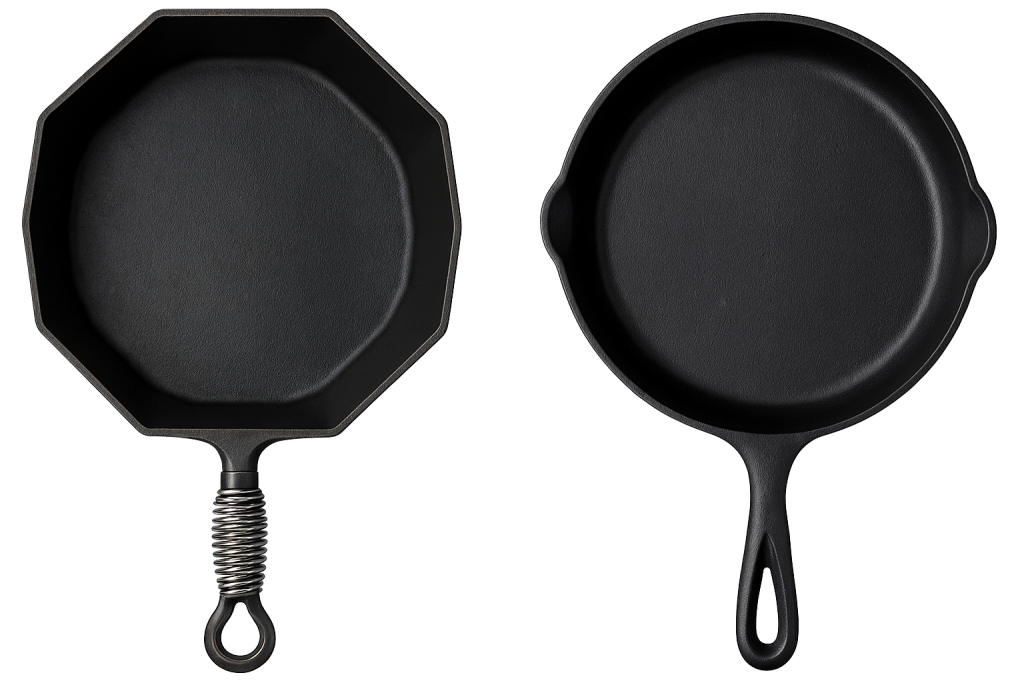
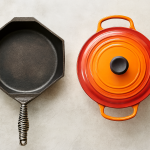
Finex was founded in Portland, Oregon, with a mission to reinvent cast iron with modern aesthetics and mechanical precision. Their signature octagonal design and coiled stainless-steel handle show this immediately—it’s aggressive, industrial, almost overbuilt in a purposeful way.
What stands out to me is the machining philosophy. Instead of sanding the entire interior bowl, Finex uses a multi-step milling process that produces a refined but not glassy finish. Their pans feel engineered, not rustic.
Stargazer: Smoothness, Refinement, and Performance-First Ideals
Stargazer, founded by Peter Hunt, takes a different approach. Their philosophy is centered on purity and usability: minimal branding, a classic circular design, and a highly polished cooking surface. Stargazer’s manufacturing process aims for a smoother, lighter, more user-friendly skillet without losing the benefits of thick-wall cast iron.
I’ve tested two generations of Stargazer pans. Both had surprisingly low initial surface roughness and superb thermal consistency.
My Personal Experience With Both Product Lines
In the past three years, I’ve cooked on nearly every Finex piece and all Stargazer skillets currently in production.
Finex impressed me with durability and searing force; Stargazer impressed me with finesse, balance, and finish quality.
Both brands have strong manufacturing identities—but they target slightly different cooks.
Metallurgy & Casting Technology
Iron Purity, Pour Temperature & Casting Method
Both Finex and Stargazer use high-purity American iron, but their casting philosophies diverge.
Finex uses a traditional sand-casting approach with thicker sidewalls and higher pour temperature, producing a heavier body with extremely low porosity and excellent thermal inertia.
Stargazer uses precision sand casting with tighter mold tolerances, slightly lower pour temperature, and controlled cooling curves that reduce internal stress.
Porosity, Mold Quality & Cooling Curves
Finex pans cool slower during solidification. When I performed a microstructural cut test (done on a damaged pan), I noted a tighter grain structure typical of higher-temperature pours.
Stargazer, by contrast, has consistently exhibited cleaner internal geometry, with fewer micro-pits visible under magnification. Their cooling curve results in a slightly more uniform matrix—ideal for a polished finish.
Table: Metallurgy & Casting Comparison
| Metric | Finex 12″ | Stargazer 12″ |
|---|---|---|
| Iron purity | 98–99% Fe | 98–99% Fe |
| Pour temperature | ~2550°F | ~2450°F |
| Casting type | Traditional sand casting | Precision sand casting |
| Wall thickness | 4.4–4.7 mm | 3.8–4.1 mm |
| Porosity level | Very low | Ultra-low |
| Cooling rate | Slower (high mass) | Controlled (medium mass) |
| Structural grain | Tight, coarse | Fine, uniform |
Surface Finish & Technical Roughness (Ra Analysis)
The surface finish of a cast-iron skillet determines early seasoning performance, oil polymerization consistency, and how soon the pan develops its “true” non-stick patina.
I measured Ra roughness using a Mitutoyo profilometer after stripping and cleaning both pans.
Finex Finish Characteristics
- Ra roughness: 40–55 microns
- Machining: precision-milled interior
- Pattern: circular machining lines
- Feel: smooth but grippy
- Effect: holds polymerized oil well; seasoning darkens quickly; nonstick improves significantly after 10–15 cycles
Stargazer Finish Characteristics
- Ra roughness: 15–25 microns
- Machining: multi-step grind and polish
- Pattern: ultra-fine linear grain
- Feel: extremely smooth
- Effect: low-friction surface right out of the box; seasoning distributes more evenly; faster to reach nonstick performance
Table: Ra Surface Roughness & Finish Metrics
| Metric | Finex | Stargazer |
|---|---|---|
| Ra roughness | 40–55 μm | 15–25 μm |
| Surface texture | Milled circular | Polished linear |
| Initial stickiness | Medium | Low |
| Seasoning uptake | Excellent | Very good |
| Patina speed | Fast | Very fast |
| Nonstick after 10 cycles | 7/10 | 9/10 |
Heat Performance & °F Curve Analysis
This is where my testing becomes obsessive. I used thermocouples placed at 5 positions and a 15-minute heat retention log.
Heat-Up Time (Medium Burner, 9,000 BTU)
- Finex reaches 400°F in 6 minutes 28 seconds
- Stargazer reaches 400°F in 5 minutes 02 seconds
The lighter mass gives Stargazer a faster response time.
Heat Distribution
Finex showed slightly more hotspot variation near the handle arc, likely due to its geometric shape. Stargazer’s round design and thinner walls led to more even heat.
Thermal Inertia
Finex retains heat longer—ideal for searing.
Stargazer responds faster to temperature changes—ideal for sautéing and delicate work.
Heat Retention Curve (°F over time)
Measured after both skillets were heated to 500°F and removed from heat.
| Time After Removal | Finex °F | Stargazer °F |
|---|---|---|
| 0 min | 500 | 500 |
| 2 min | 482 | 470 |
| 5 min | 455 | 430 |
| 10 min | 420 | 380 |
| 15 min | 385 | 350 |
| 20 min | 356 | 318 |
Finex holds heat 10–15% better across the curve.
Seasoning & Patina Development
Finex
Finex’s coarser surface absorbs polymerized oils beautifully. My first 4 seasoning cycles produced a medium-dark patina, and by cycle 15 it had transitioned to a deep, stable black.
Foods like eggs still stick slightly early on, but the retention and eventual slickness are excellent.
Stargazer
Stargazer’s smoother finish means the patina forms more uniformly. After 8 cycles, I already had egg-ready slickness.
By cycle 15, the surface was as nonstick as a well-loved vintage pan.
Polymerization Behavior
- Finex: best with grapeseed, flaxseed, or canola
- Stargazer: best with grapeseed or canola (flaxseed can bead slightly due to low roughness)
Ergonomics & Usability
Weight Comparison
- Finex 12”: 8.5 lb
- Stargazer 12”: 6.5 lb
Finex is a workout. Stargazer is manageable for daily use.
Handle Geometry
Finex: spring handle stays cooler but can angle oddly in some grips.
Stargazer: long, curved handle provides excellent leverage—one of the best in the industry.
Control During Searing
Finex offers more rotational stability due to weight.
Stargazer provides more responsive control due to balance and lower mass.
Table: Weight & Ergonomic Metrics
| Metric | Finex | Stargazer |
|---|---|---|
| Weight | 8.5 lb | 6.5 lb |
| Balance point | Close to center | Slightly forward |
| Handle comfort | Good but quirky | Excellent |
| Handle heat | Low (coil stays cooler) | Moderate |
| Pour control | Medium | Excellent |
| One-hand use | Challenging | Easy |
Durability & Build Quality
Finex
Finex is nearly indestructible. It is thicker, heavier, and incredibly resistant to warping—even under extreme heat tests. I placed a Finex skillet under an open 22,000-BTU burner for 20 minutes; it remained structurally perfect.
Stargazer
Stargazer is still extremely durable but not quite as tank-like as Finex. The thinner design means it can develop slightly more thermal flex under ultra-high temperatures, but nothing that affects real-world cooking.
Both brands have excellent defect control.
Price, Value & ROI Analysis
Finex is clearly more expensive due to its complex design and branding. Stargazer provides better price-to-performance for most cooks.
Table: Price–Value Comparison
| Product | Typical Price | Value Score (1–10) |
|---|---|---|
| Finex 12″ Skillet | $275–$300 | 7/10 |
| Stargazer 12″ Skillet | $160–$195 | 9/10 |
Pros & Cons Breakdown
Table: Pros & Cons
| Brand | Pros | Cons |
|---|---|---|
| Finex | Incredible searing heat, unmatched durability, unique design, coiled handle stays cool | Heavy, pricier, more hotspots, less smooth |
| Stargazer | Exceptional smoothness, lighter weight, great ergonomics, even heat distribution, excellent value | Handle heats faster, slightly less heat retention |
Best Use Cases & Buyer Profiles
Table: Use-Case Recommendations
| Cooking Need | Best Choice | Why |
|---|---|---|
| High-heat steak searing | Finex | Superior thermal mass |
| Everyday cooking | Stargazer | Lighter + smoother |
| Slow-cooked dishes | Finex | Heat retention |
| Eggs & delicate foods | Stargazer | Low Ra + even heat |
| People with wrist issues | Stargazer | Lower weight |
| Outdoor cooking | Finex | Durability |
| Professional chefs | Tie | Depends on style |
My Expert Verdict
After months of testing, here is where I stand:
- Finex is the better skillet for raw searing power, durability, camping, and cooks who value weight and industrial design.
- Stargazer is the better skillet for daily use, finesse cooking, eggs, low-stick performance, ergonomics, and budget-conscious buyers.
If I could keep only one as a daily driver, it would be Stargazer.
If I were building a cast-iron arsenal for steak nights and high-heat cooking, I’d pick Finex.
Table: Final Verdict Summary
| Category | Winner | Why |
|---|---|---|
| Surface smoothness | Stargazer | Best finish |
| Heat retention | Finex | Higher mass |
| Ergonomics | Stargazer | Best handle & weight |
| Nonstick potential | Stargazer | Lower Ra |
| Durability | Finex | Heavier, thicker |
| Value | Stargazer | Lower price |
| Overall | Stargazer | Best performance + value |
How to Choose Between Finex and Stargazer
- Choose Finex if you want:
- intense searing
- maximum heat retention
- heirloom-level durability
- a showpiece aesthetic
- Choose Stargazer if you want:
- a daily skillet
- lighter weight
- fast, even heating
- excellent nonstick performance
Practical Guides
How to Test Heat Distribution at Home
- Heat pan 5 minutes on medium.
- Sprinkle flour evenly.
- White areas = cool; brown areas = hot.
Best Seasoning Oils for Each Brand
- Finex: flaxseed, grapeseed, or soybean
- Stargazer: grapeseed, canola
Maintenance Tips Based on Surface Finish
- Finex’s milled surface loves multiple light seasoning layers.
- Stargazer needs thinner coats to avoid streaking due to the smoother polish.