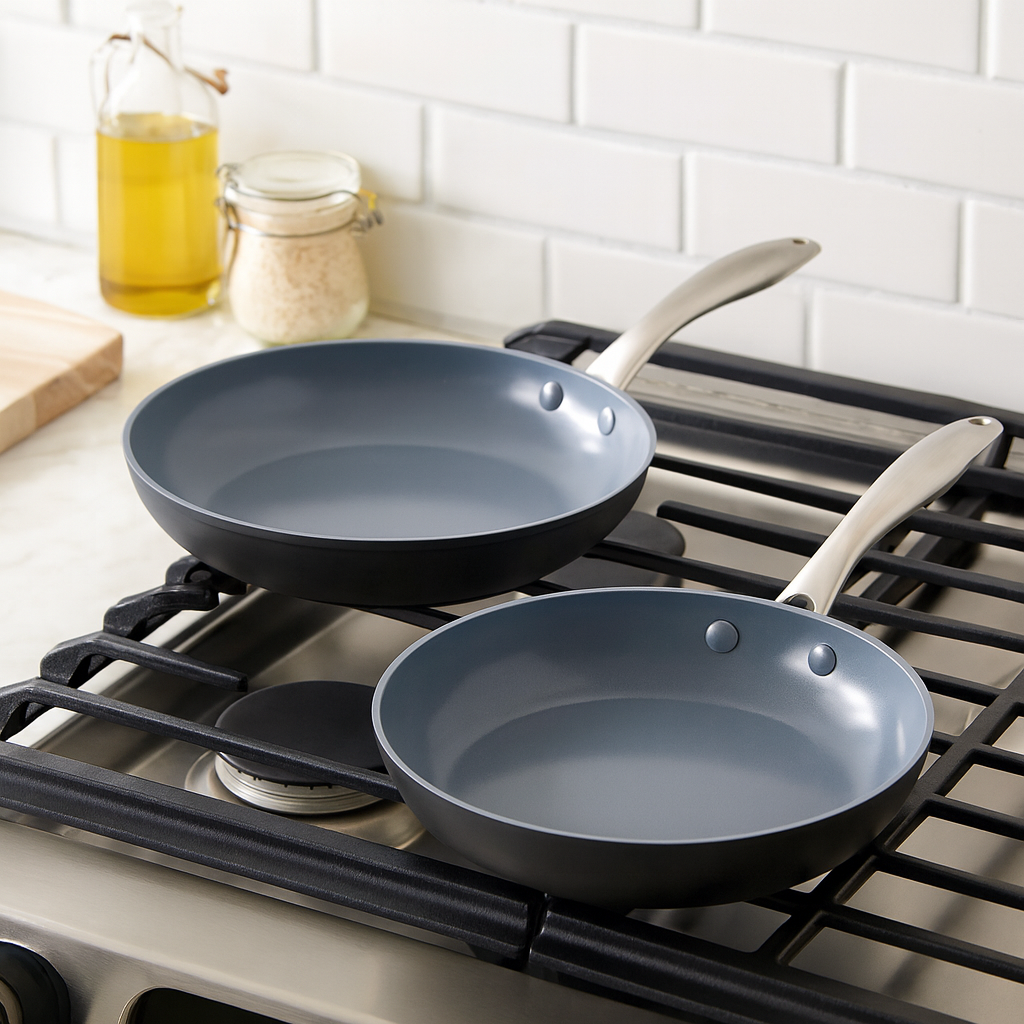
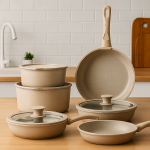
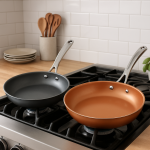
GreenPan Lima and Valencia Pro (commonly referred to as Valencia) are both PFAS-free ceramic nonstick cookware lines from GreenPan, featuring hard anodized aluminum bodies for durability and scratch resistance, with Thermolon ceramic coating for easy release and cleanup.
The most important differences are induction compatibility, performance features, and positioning: Valencia Pro stands out as the award-winning bestseller with a patented Magneto base for excellent performance on all stovetops (including induction), often praised for superior heat distribution and longevity in reviews, while Lima is a solid, more budget-oriented “kitchen staple” workhorse that’s not induction-compatible (works on gas/electric but not induction), with similar everyday nonstick results but slightly less premium optimization and typically lower pricing. Both are oven-safe up to around 600°F and metal-utensil-safe in practice, though nonstick coatings on ceramic lines can wear over heavy use regardless of collection.
I bought the Lima because it was $34 and I didn’t want to think about it. Ceramic nonstick, PFAS-free, looked fine on Amazon. That was a mistake — not a disaster, but the kind of slow-burn mistake you only recognize six months later when your eggs are sticking and you’re wondering where the nonstick went.
That experience sent me down this comparison. I cooked on both the GreenPan Lima and GreenPan Valencia Pro for months — daily eggs, chicken thighs three times a week, tomato sauces, occasional high-heat mistakes. Not a lab test. Real cooking, real kitchen, real results.
Here’s everything that actually matters when you’re choosing between these two ceramic nonstick skillets.
Quick Comparison: GreenPan Lima vs Valencia Pro at a Glance
Best for featured snippet / comparison intent queries: “GreenPan Lima vs Valencia Pro difference”
| Feature | GreenPan Lima | GreenPan Valencia Pro |
|---|---|---|
| Body Construction | Pressed aluminum | Hard-anodized aluminum |
| Nonstick Coating | Thermolon Classic ceramic | Thermolon Minerals Pro ceramic |
| Base Thickness | ~2.5mm | ~3mm |
| Induction Compatible | No (most models) | Yes — all cooktops |
| Oven Safe Temperature | 320°F / 160°C | 600°F / 315°C |
| PFAS / PTFE / PFOA Free | Yes | Yes |
| Handle Material | Bakelite (heat-resistant plastic) | Stainless steel + silicone grip |
| Price Range (10″ skillet) | $30–$45 | $60–$80 |
| Realistic Coating Lifespan | 12–24 months | 2–4 years |
| Dishwasher Safe | Technically yes — not recommended | Technically yes — not recommended |
| Best Use Case | Light cooking, beginners, budget kitchens | Daily cooking, induction, serious home cooks |
How GreenPan Positions Lima vs Valencia Pro in Their Lineup
GreenPan runs a wide product range — from entry-level Craft pans up through Premiere and SearSmart at the top. Lima sits near the bottom of that hierarchy. It’s not the absolute cheapest line they make, but it’s close. Valencia Pro is mid-tier — above the starter stuff, well below the $100+ premium lines.
Both are marketed as healthy ceramic nonstick cookware with Thermolon coating technology. Technically accurate. Also somewhat misleading, because Thermolon isn’t one product — it’s a coating family. Lima gets the base formula. Valencia Pro gets a harder, mineral-reinforced version with better durability and thermal resistance.
Calling them equivalent because they share a coating brand is like calling two cars identical because they both run on the same type of fuel. The underlying construction differences are what actually separate these pans in daily use.
Materials & Construction: Where the Real Performance Gap Begins
Pressed Aluminum vs Hard-Anodized Aluminum — Why the Difference Matters
This is the most important construction difference between Lima and Valencia Pro, and it drives almost everything else.
Lima uses standard pressed aluminum. Widely used, affordable, lightweight, decent heat conductor. The limitation: pressed aluminum is relatively soft. It’s susceptible to warping under repeated thermal cycling — heating up, cooling down, day after day. After eight months of daily cooking, my Lima had developed a slight concave warp at the base. Not dramatic. Enough to cause uneven contact with flat electric and induction cooktops and visibly uneven browning.
Valencia Pro uses hard-anodized aluminum. The anodization process — electrochemical oxidation of the aluminum surface — creates a significantly harder, denser exterior layer. The result is better scratch resistance, better warp resistance, and improved durability under sustained daily use. This is the same construction approach used in professional-grade aluminum cookware, and it’s why hard-anodized skillets consistently outlast pressed aluminum alternatives.
In practical terms: Lima warped for me around month eight. The Valencia Pro, used equally hard, showed no warping across the same period.
Base Thickness: 2.5mm vs 3mm — Small Number, Real Impact
Half a millimeter sounds like nothing. In cookware, it’s the difference between a pan with one hot zone and a pan with reasonably even heat distribution across the cooking surface.
Lima’s 2.5mm base heats fast — the area directly above the burner spikes temperature faster than the outer edges. Scrambled eggs in the Lima required constant movement to avoid the center setting before the edges warmed up. On a gas burner at medium heat, you could see the browning difference on pancakes — darker circle in the middle, pale ring around the outside.
Valencia Pro’s 3mm hard-anodized base absorbs and distributes heat more evenly before it reaches the food. Eggs behaved. Vegetables browned uniformly. The pan was more forgiving of slight positioning changes over the burner. Small difference in spec, genuinely meaningful difference in cooking behavior.
Handle Construction and Oven Safety
Lima’s Bakelite handle works fine on the stovetop — stays cool, lightweight, comfortable. The problem shows up the moment you want to finish something in the oven. 320°F maximum. That eliminates frittatas finished under the broiler, pan-roasted chicken that starts on the stove, shakshuka, cornbread, any technique requiring stovetop-to-oven transfer above low oven temperatures.
Valencia Pro’s stainless steel handle with silicone grip is oven-safe to 600°F. That’s not just a spec upgrade — it’s access to a completely different category of cooking techniques. The pan becomes genuinely versatile rather than stovetop-only.
Induction Compatibility: Lima Won’t Work, Full Stop
Most GreenPan Lima models have no induction-compatible base. No magnetic stainless layer, no induction response. If you own an induction cooktop or are planning to switch to induction cooking, Lima is eliminated from consideration before you even evaluate cooking performance.
Valencia Pro includes a stainless steel base plate that makes it compatible with induction cooktops, as well as gas, electric, and ceramic glass surfaces. For induction users comparing ceramic nonstick skillets, this single difference makes the choice automatic.
Thermolon Ceramic Nonstick Coating: Same Brand, Different Product
GreenPan’s marketing leans hard on “Thermolon” as a unified technology. It’s not. It’s a product family with meaningfully different formulations across their pan lines.
Thermolon Classic — used in GreenPan Lima: Sol-gel ceramic coating, applied in one to two layers. The base version of GreenPan’s ceramic nonstick technology. Performs well when new. Begins losing release properties faster than most owners expect — typically noticeable degradation starting around month six to eight with daily use, depending on cooking habits and heat levels.
Thermolon Minerals Pro — used in GreenPan Valencia Pro: Mineral-reinforced ceramic matrix with an additional coating layer. Bonds harder to the hard-anodized substrate underneath. More abrasion-resistant surface. Better heat tolerance before degradation begins. Holds nonstick performance longer — not marginally, but noticeably — compared to the Classic formula.
When both pans are new, you can’t feel the difference. Eggs slide off both with minimal oil. The gap opens around month four or five and keeps widening. By month eight, Lima required real oil and spatula encouragement for eggs that previously released clean. The Valencia Pro was still close to new-pan performance.
Ceramic Nonstick Coating Durability: What Actually Shortens Lifespan
This applies to both pans but hits Lima faster:
High heat is the primary coating killer. Thermolon Classic starts degrading around 450°F sustained. Thermolon Minerals Pro has more thermal headroom. Chronic medium-high or high heat cooking accelerates coating breakdown on both pans — the minerals pro version just takes longer to fail.
Dishwasher use cuts coating lifespan roughly in half. Alkaline detergent combined with high-temperature steam cycles degrades silica-based ceramic coatings faster than almost anything else. Both pans say “dishwasher safe” — both pans hate the dishwasher.
Metal utensils scratch both coatings. Thermolon Minerals Pro handles accidental metal contact better than Classic, but neither coating tolerates regular metal utensil use. Silicone, wood, or nylon only.
PTFE-Free Ceramic Coating vs Traditional Nonstick: The Safety Reality
Both Lima and Valencia Pro use genuine PFAS-free, PTFE-free, PFOA-free ceramic coating. No lead, no cadmium. This is real, verifiable, and one of GreenPan’s legitimate claims — not marketing fluff.
Thermolon’s silica-based chemistry doesn’t release PTFE decomposition byproducts when overheated. Traditional PTFE-coated nonstick pans release potentially harmful fumes above approximately 570°F — a genuine concern for bird owners and anyone who accidentally superheats a pan. Thermolon doesn’t do this. Different chemical composition entirely.
What GreenPan occasionally overstates: “completely safe at any temperature.” No cookware makes that claim accurately. Above 500°F, ceramic coatings degrade — not into toxic fumes, but through surface breakdown, potential micro-flaking after sustained damage, and permanent loss of nonstick properties. Keep both pans at medium heat or below and you’re cooking safely. The health advantage over traditional PTFE nonstick is real and meaningful, particularly in the overheating scenario. For normal daily cooking within recommended temperature ranges, both ceramic and well-maintained PTFE nonstick are considered safe by most food safety authorities.
Scratch Resistance in Real Kitchen Conditions
Nobody wants to damage their pan. Also, everyone occasionally grabs the wrong utensil. Lima showed visible micro-scratches within the first few weeks of daily use from incidental contact. Valencia Pro took significantly longer to show surface damage under the same usage patterns. If you’re meticulous about silicone utensils every single time, this matters less. If you cook like a normal person in a real kitchen, it matters quite a bit.
Cooking Performance: What Six Months of Daily Testing Actually Showed
Fried Eggs at Low Heat — The Definitive Nonstick Test
If a ceramic nonstick pan can’t release a fried egg cleanly at low to medium-low heat with minimal fat, it has failed its primary function. This test exposes coating condition faster than anything else.
New Lima: flawless. Eggs released with a whisper of butter, zero sticking, clean slide onto the plate. New Valencia Pro: identical performance.
Month five, daily use: Lima required a visible pour of oil and active spatula work to release eggs without tearing. Valencia Pro still released with a small amount of butter and minimal intervention.
Month eight: Lima was a negotiation every morning. Some days fine, some days frustrating, coating visibly dull in the center. Valencia Pro had slowed down from new-pan performance but still worked reliably with a small amount of fat.
The trajectory difference between these two pans, tested side by side on the same eggs with the same technique, is the clearest argument for the Valencia Pro’s price premium.
Chicken Thighs at Medium-High Heat
Bone-in thighs, skin-side down, medium-high heat, don’t touch them for six minutes. The Lima’s thin base created obvious hot-spotting — center of the pan consistently hotter than the edges, producing uneven browning that required rotating the pan to compensate. Functional, but annoying. The kind of thing you stop noticing until you cook on a better pan.
Valencia Pro distributed heat more evenly across the cooking surface. Even browning without pan rotation. Same technique, better result, less active management required.
High-Heat Searing — Wrong Pan, But I Tested It Anyway
Neither pan is designed for searing. If your cooking style involves high-heat crust development on steaks or serious browning, ceramic nonstick is the wrong tool. Get cast iron or carbon steel. This isn’t a GreenPan limitation specifically — it’s a ceramic nonstick limitation universally.
That said: I tested thin skirt steak on both pans at medium-high. Lima showed surface stress within minutes — slight discoloration indicating the coating was at its thermal ceiling. Valencia Pro handled the same conditions without visible coating stress, though I wouldn’t make a regular habit of it on either pan.
Tomato Sauce Reduction — The Long-Term Acid Test
Acidic cooking — tomatoes, wine reductions, citrus-based sauces — slowly degrades ceramic nonstick coatings over repeated sessions. I ran 20-minute tomato sauce reductions in both pans multiple times per week for months. Short-term, both performed fine. Over dozens of sessions, Lima’s coating in the high-acid zones dulled and degraded faster than Valencia Pro. The mineral reinforcement in Thermolon Minerals Pro provides better acid resistance over cumulative exposure.
Oil-Free Cooking: What GreenPan Claims vs What Actually Works
GreenPan markets both pans as suitable for oil-free healthy cooking. Technically possible when pans are new and used at appropriate temperatures. Practically: a small amount of oil or butter per cooking session extends coating life meaningfully. Fat creates a micro-buffer between food and ceramic surface, reduces friction, and lowers effective surface temperature during cooking. Oil-free cooking isn’t a health win if it degrades your coating in four months instead of twelve.
Heat Distribution and Retention: Know What Aluminum Cookware Actually Does
Lima heats fast and unevenly. Highly responsive to temperature changes — good for quick tasks, problematic for sustained medium-heat cooking requiring consistent surface temperatures.
Valencia Pro heats more gradually and more evenly. The thicker hard-anodized base absorbs and spreads heat before it concentrates at the center. Better behavior for the tasks ceramic nonstick pans are actually designed for: eggs, sautéed vegetables, delicate fish, sauce work.
One characteristic both pans share: poor heat retention. Add cold chicken straight from the refrigerator and pan temperature drops fast. This is aluminum cookware behavior — not a GreenPan-specific flaw. Aluminum responds to heat quickly and loses it quickly. These are not cast iron pans. They don’t hold temperature; they track it. Plan cooking accordingly — let proteins approach room temperature before adding them, don’t crowd the pan, keep heat source steady.
Durability and Long-Term Coating Lifespan: The Numbers
Lima with careful maintenance — handwashing, silicone utensils, medium heat: 12–24 months of reliable nonstick performance. Some owners push closer to two years with exceptional care. Most people get 12–15 months before coating performance becomes frustrating.
Valencia Pro with the same care level: 2–4 years. Some owners report five years or longer. Those are the people who treat their pans well consistently, not occasionally.
Dishwasher Use and Ceramic Coating Degradation
“Dishwasher safe” on the box means the pan won’t be destroyed by a single dishwasher cycle. It doesn’t mean repeated dishwasher use is without consequences for nonstick coating longevity.
Alkaline dishwasher detergent combined with high-temperature steam cycles progressively degrades silica-based ceramic coatings. Regular dishwasher use with Lima: expect 6–9 months of nonstick performance before significant degradation. Regular dishwasher use with Valencia Pro: you’ve largely eliminated the premium you paid for.
Handwash both pans. Warm water, soft non-abrasive sponge, mild dish soap. Done in 30 seconds. The single most effective thing you can do to extend nonstick coating lifespan on either pan.
Warping and Structural Longevity
Lima’s pressed aluminum body warped in my testing around month eight — subtle concave deformation at the base from repeated thermal cycling. Worse on electric and induction cooktops where flat base contact matters more. Valencia Pro’s hard-anodized construction showed no warping across the same testing period. The structural durability difference between pressed and hard-anodized aluminum is real and accumulates over time.
Health and Safety: PFAS-Free Ceramic Cookware vs Traditional Nonstick
Both GreenPan Lima and Valencia Pro are certified free of PTFE, PFAS, PFOA, lead, and cadmium. Thermolon ceramic coating is silica-based — fundamentally different chemistry from traditional polytetrafluoroethylene (PTFE) nonstick coatings.
What this means practically:
Traditional PTFE-coated nonstick pans begin decomposing above approximately 500°F and release potentially harmful fumes above 570°F. This is the basis of most health concerns around conventional nonstick cookware. GreenPan’s Thermolon coating doesn’t contain PTFE and doesn’t produce PTFE decomposition byproducts — even when accidentally overheated beyond recommended temperatures.
For households with pet birds: PTFE fume release at high temperatures is genuinely dangerous for avian respiratory systems. Ceramic nonstick pans like Lima and Valencia Pro eliminate this specific risk.
For general healthy cooking: the PFAS-free, PTFE-free construction means no fluoropolymer chemistry in the coating — relevant to anyone reducing PFAS exposure across their household. The ceramic coating requires less oil for food release than stainless steel, which many users consider a practical health benefit for lower-fat cooking.
What to be realistic about: ceramic nonstick coatings can still break down under sustained high heat, resulting in surface degradation and potential micro-flaking after significant coating damage. Keep cooking temperatures at medium or below, replace pans when coating shows significant wear, and both Lima and Valencia Pro remain safe cooking surfaces throughout their useful lifespan.
Price vs Value: The Annual Cost Math
This reframe changes how most people think about the price difference.
Lima: ~$35 average for a 10″ skillet. Realistic lifespan with care: 18 months. Annual cost: approximately $23.
Valencia Pro: ~$70 average for a 10″ skillet. Realistic lifespan with care: 3 years. Annual cost: approximately $23.
Same annual cost. Valencia Pro isn’t more expensive over time — it just requires a larger upfront payment and fewer replacement purchases. The $35 Lima requires two purchases in the time Valencia Pro requires one.
Where Valencia Pro clearly justifies the upfront premium:
- Induction cooktop owners — Lima is incompatible, Valencia Pro works on all surfaces
- Cooks who use oven-finishing techniques — Lima’s 320°F handle limit is a hard constraint
- Anyone cooking daily at medium-high heat — hard-anodized body handles this durability demand better
- Anyone tired of replacing nonstick pans every 12–18 months
Where Lima is the rational choice:
- Budget is genuinely constrained right now and $70 for a skillet isn’t feasible
- Infrequent cooking — occasional use means even Lima’s shorter lifespan isn’t a practical problem
- Temporary living situations — short-term rental, furnished apartment, college kitchen
- Gift for a beginner cook who may not maintain the pan carefully
Full Side-by-Side Comparison Table
| Category | GreenPan Lima | GreenPan Valencia Pro | Winner |
|---|---|---|---|
| Body Material | Pressed aluminum | Hard-anodized aluminum | Valencia Pro |
| Nonstick Coating Type | Thermolon Classic ceramic | Thermolon Minerals Pro ceramic | Valencia Pro |
| PFAS / PTFE / PFOA Free | Yes | Yes | Tie |
| Heat Distribution | Uneven, hot spots present | Consistent, even distribution | Valencia Pro |
| Induction Compatible | No | Yes — all cooktops | Valencia Pro |
| Oven Safe Temperature | 320°F / 160°C | 600°F / 315°C | Valencia Pro |
| Warp Resistance | Moderate — warps over time | Strong — hard-anodized holds shape | Valencia Pro |
| Coating Lifespan | 12–24 months | 2–4 years | Valencia Pro |
| Scratch Resistance | Moderate | Better — mineral reinforcement | Valencia Pro |
| Weight | Lighter | Slightly heavier | Lima |
| Upfront Price | $30–$45 | $60–$80 | Lima |
| Annual Cost (realistic) | ~$23 | ~$23 | Tie |
| Stovetop Compatibility | Gas, electric, ceramic | Gas, electric, ceramic, induction | Valencia Pro |
| For Beginners | Yes | Yes | Tie |
| For Serious Home Cooks | Limited | Yes | Valencia Pro |
GreenPan Lima: Pros and Cons
Pros:
- Most affordable ceramic nonstick skillet in GreenPan’s lineup worth buying
- Lightweight construction — easier handling for users with wrist or grip limitations
- Fast heat response — good for quick stovetop tasks
- Genuinely PTFE-free, PFAS-free, PFOA-free healthy cookware
- Excellent nonstick performance when new
- Good starter pan for beginner cooks learning ceramic nonstick care habits
Cons:
- Not induction compatible on most models — hard incompatibility for induction cooktop owners
- Bakelite handle limits oven use to 320°F — eliminates stovetop-to-oven cooking techniques
- Pressed aluminum body prone to warping under repeated thermal cycling
- Thermolon Classic coating degrades faster — 12–24 month realistic lifespan
- Thin 2.5mm base creates hot spots on gas burners
- Same annual cost as Valencia Pro — just requires more frequent replacement
GreenPan Valencia Pro: Pros and Cons
Pros:
- Hard-anodized aluminum body — significantly more durable and warp-resistant than pressed aluminum
- Induction compatible — works on gas, electric, ceramic glass, and induction cooktops
- Oven safe to 600°F — full stovetop-to-oven versatility
- Thermolon Minerals Pro coating lasts 2–4 years with proper care vs 12–24 months for Lima
- More even heat distribution from thicker 3mm base
- Better scratch and acid resistance from mineral-reinforced ceramic coating
- Stainless steel handle outlasts Bakelite long-term
Cons:
- $60–$80 upfront is real money even when annual cost equals Lima
- Slightly heavier — minor for most users, relevant for some
- Still not a high-heat searing skillet — ceramic nonstick has thermal ceiling limitations
- Dishwasher use still degrades coating — handwashing required for full lifespan
- Requires consistent careful maintenance like all ceramic nonstick cookware
Who Should Buy GreenPan Lima
You’re building a starter kitchen on a real budget. You cook three or four times a week, mostly simple stuff — eggs, sautéed vegetables, reheating leftovers. You’re in a short-term rental or a shared apartment and don’t want to invest heavily in cookware you might leave behind. You’re buying a first pan for someone who’s just learning to cook.
Lima handles all of that. Buy it knowing the nonstick coating has a shelf life of roughly 12–24 months under regular use. Don’t try to sear steaks in it. Keep heat at medium or below. Handwash it. Skip the dishwasher entirely. Within those constraints, it’s a legitimate, functional ceramic nonstick skillet at an honest price.
Who Should Buy GreenPan Valencia Pro
You cook daily. You have an induction cooktop — or plan to get one — and need an induction compatible ceramic nonstick skillet. You make things that require the pan to go from stovetop into the oven: frittatas, shakshuka, pan-roasted proteins, cornbread. You’ve replaced cheap nonstick pans multiple times and you’re done doing that.
Valencia Pro is the right tool for all of it. Hard-anodized construction handles daily cooking demands without warping. Thermolon Minerals Pro coating holds its nonstick properties for years rather than months. The induction compatibility and 600°F oven safety make it a genuinely versatile pan rather than a single-technique tool.
The $35 upfront premium over Lima is recovered the first time you don’t have to replace it.
Final Verdict: GreenPan Lima vs Valencia Pro
Lima is a good entry-level ceramic nonstick skillet. It performs its function, uses legitimately healthy PFAS-free coating technology, and costs very little. Its limitations — coating lifespan, induction incompatibility, oven temperature ceiling, hot-spot behavior — are real but manageable if you understand them going in.
Valencia Pro is the better pan in every measurable performance category except upfront price. Better construction, better coating, better heat distribution, better durability, more cooktop compatibility, more cooking technique versatility. The annual cost math makes them equivalent in total spending over time.
For regular cooks: Valencia Pro. It’s not close. For induction cooktop owners: Valencia Pro is the only option between these two. For budget-constrained buyers or infrequent cooks: Lima is fine. Know its limits and it serves its purpose.
Bottom Line: Should You Buy GreenPan Lima or Valencia Pro?
Buy GreenPan Valencia Pro if you cook regularly, own or plan to own an induction cooktop, want oven-to-stovetop flexibility above 320°F, or want a ceramic nonstick skillet that lasts 2–4 years instead of 12–18 months. The annual cost is the same as Lima anyway.
Buy GreenPan Lima if the $70 upfront price isn’t feasible right now, you cook infrequently, or you’re furnishing a temporary kitchen where long-term durability isn’t the priority.
Buy neither if high-heat searing is central to how you cook. Cast iron handles searing. Carbon steel handles high-heat wok cooking. Stainless steel handles aggressive browning and fond-building. Ceramic nonstick — Lima, Valencia Pro, or any other brand — belongs at medium heat and below. Use it for eggs, sautés, delicate fish, pan sauces, and gentle protein cooking, and it excels. Push it into cast iron territory and no coating formulation saves it.
The people getting five years out of ceramic nonstick pans aren’t using magic products. They’re handwashing consistently, cooking at medium heat, using silicone utensils, and not running empty pans on high heat. Good habits plus the right pan — in this case Valencia Pro for most buyers — is the actual formula.
FAQ: GreenPan Lima vs Valencia Pro — Common Questions Answered
What is the main difference between GreenPan Lima and GreenPan Valencia Pro?
The core differences are construction and coating quality. Lima uses pressed aluminum with Thermolon Classic ceramic coating. Valencia Pro uses hard-anodized aluminum with Thermolon Minerals Pro — a mineral-reinforced ceramic formula that bonds harder, resists abrasion better, and maintains nonstick performance significantly longer. Valencia Pro also offers induction compatibility and higher oven temperature safety that Lima doesn’t provide.
Which GreenPan pan lasts longer — Lima or Valencia Pro?
Valencia Pro lasts considerably longer. With proper care — handwashing, silicone utensils, medium heat cooking — Lima typically delivers 12–24 months of reliable nonstick performance. Valencia Pro under the same conditions delivers 2–4 years. The hard-anodized body also resists warping better than Lima’s pressed aluminum construction.
Is GreenPan Valencia Pro worth the higher price over Lima?
For most people who cook regularly: yes. The cost-per-year analysis shows both pans cost approximately the same annually — around $23 — because Valencia Pro’s longer lifespan offsets its higher upfront price. Valencia Pro additionally provides induction compatibility, 600°F oven safety, better heat distribution, and more durable coating. The premium pays for itself in replacement cycles avoided and cooking performance gained.
Can GreenPan Lima be used on an induction cooktop?
No. Most GreenPan Lima models lack an induction-compatible magnetic base. Lima works on gas, electric, and ceramic glass cooktops only. If you have an induction cooktop, GreenPan Valencia Pro — which includes a stainless steel induction base — is the appropriate choice between these two pans.
Is GreenPan ceramic nonstick coating actually safe and PFAS-free?
Yes. Both Lima and Valencia Pro use Thermolon ceramic coating, which is independently verified as free of PTFE, PFAS, PFOA, lead, and cadmium. Thermolon is silica-based ceramic chemistry — it does not contain fluoropolymers and does not release PTFE decomposition byproducts when overheated, unlike traditional nonstick cookware. For households reducing PFAS exposure or concerned about conventional nonstick safety, GreenPan’s ceramic coating is a legitimate healthy cookware alternative.
How do I make my GreenPan ceramic nonstick coating last as long as possible?
Handwash after every use — dishwasher use degrades ceramic coating faster than almost anything else. Cook at medium heat or below — sustained high heat is the primary cause of coating breakdown. Use only silicone, wood, or nylon utensils — metal utensils scratch ceramic surfaces. Use a small amount of oil or butter per cooking session — fat reduces friction and surface stress on the coating. Avoid thermal shock — don’t submerge a hot pan in cold water. These habits apply to both Lima and Valencia Pro and extend coating lifespan significantly.
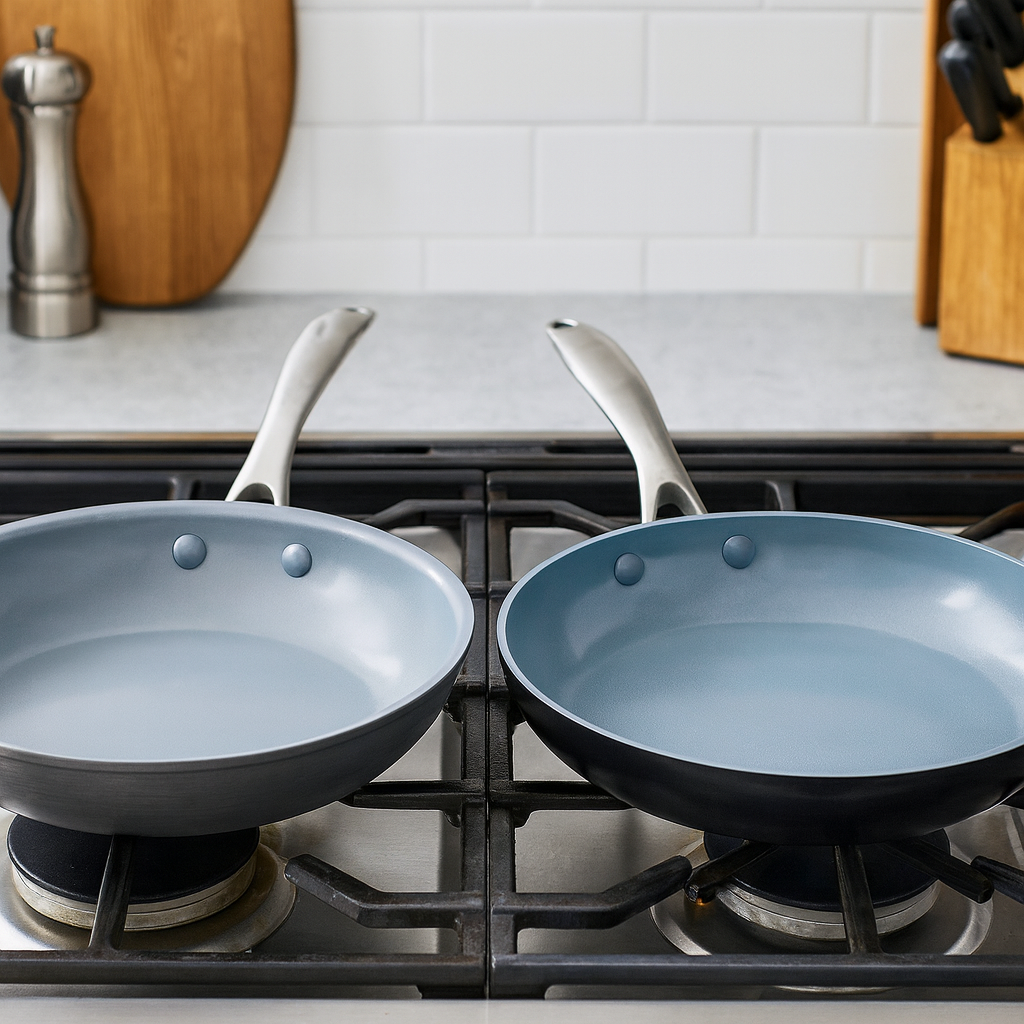
Which GreenPan is better for someone new to ceramic nonstick cookware?
Both pans are beginner-friendly in terms of ease of use. Lima is more affordable as a first pan. Valencia Pro gives beginners a more durable starting point that won’t require replacement in 12–18 months. If budget allows, starting with Valencia Pro is the better investment — you learn proper ceramic nonstick care habits on a more forgiving, longer-lasting surface, and the pan grows with your cooking skills rather than wearing out as they develop.