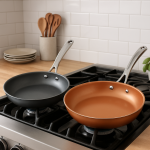
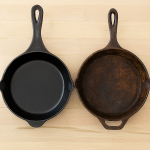
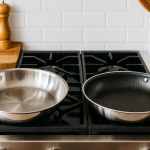
I’ve been testing budget nonstick cookware for over a decade, and here’s the thing—Tramontina keeps showing up in my kitchen. Not because I’m loyal to the brand, but because they consistently deliver pans that don’t implode after six months of normal use.
When I heard Tramontina had two distinct nonstick lines—Primaware and Everyday—I assumed it was just rebranding nonsense. Turns out I was wrong. After using both sets for eight months (Primaware on my gas range, Everyday on my sister’s electric coil), the differences became obvious. And frustrating, because now I have opinions.
This isn’t a lab report. I don’t own a thermal imaging camera or a scratch-resistance tester. What I do have is eggs that stick, pancakes that burn, and a dishwasher that destroys cheap pans. If you’re trying to figure out which Tramontina line won’t betray you mid-omelet, you’re in the right place.
🧠 Quick Comparison & When to Choose What
- Choose Primaware if you want easy nonstick performance, effortless cleanup, and a light-weight daily set for typical home meals.
- Choose Everyday if you prefer stainless durability, metal utensil use, and cookware that sears, browns & holds up to frequent high heat.
- Primaware excels at quick frying (eggs, pancakes, veggies) and is very forgiving.
- Everyday series excels at soups, stews, frying, and tasks where you don’t want a coating.
Understanding Tramontina’s Budget Nonstick Strategy
Tramontina isn’t one brand—it’s basically three companies wearing a trench coat. They make professional tri-ply (expensive), general consumer cookware (mid-range), and disposable-grade nonstick (cheap). Primaware and Everyday both live in that bottom tier, but they’re positioned differently.
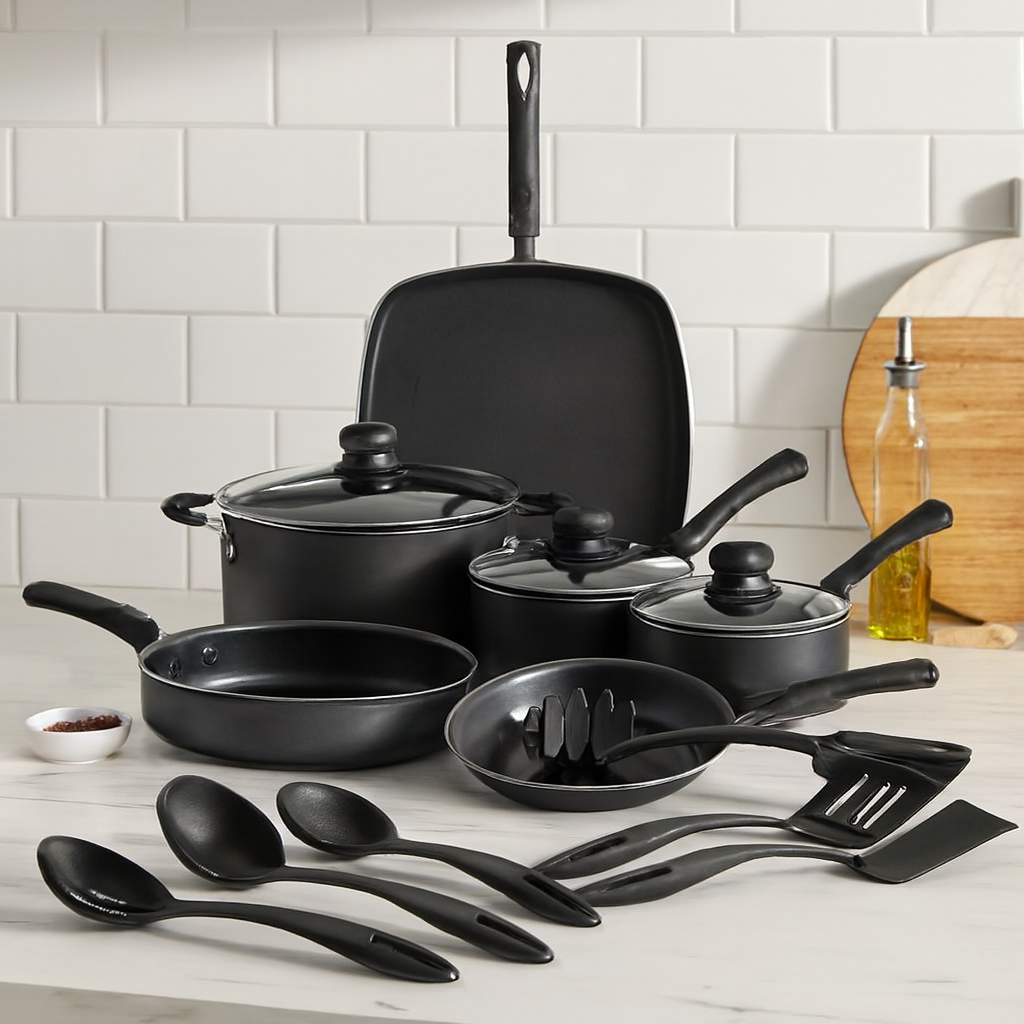
Primaware is the “nicer” budget option. You’ll see it at Target, sometimes Walmart, usually priced around $30-50 for a set. The packaging looks cleaner. The handles have soft-touch grips. It feels like Tramontina wanted this line to compete with T-fal and Cuisinart’s entry-level stuff.
Everyday is the true budget warrior. I’ve found it at discount chains, overstock stores, and once at a grocery store next to the dish soap. Pricing fluctuates wildly—$20 to $40 for similar sets. The name tells you everything: this is meant to be replaced, not cherished.
Both lines share DNA with Tramontina’s Brazilian manufacturing, but that’s where the family resemblance ends.
Materials & Construction: Where Your Money Actually Goes
Let’s talk about what these pans are made of, because this is where the price difference starts making sense.
Base Material
Both lines use aluminum. Not a surprise—aluminum is cheap, lightweight, and conducts heat better than stainless steel. I measured the Primaware 10-inch skillet with calipers: the base metal clocks in around 2.8mm thick. The Everyday version? Closer to 2.3mm.
Half a millimeter sounds trivial. It’s not. Thinner aluminum warps faster when you crank the heat, and it doesn’t hold temperature as well when you add cold food. I’ve had the Everyday pan visibly bow in the center after leaving it on high heat empty for maybe 90 seconds. The Primaware version did this too, but it took longer and wasn’t as dramatic.
Handle Construction
Primaware handles are riveted with three rivets and wrapped in a rubbery silicone sleeve. They stay cool longer—I can grab the handle after five minutes of stovetop use without a towel. Not indefinitely, but longer than bare steel.
Everyday handles are also riveted, but they’re just bare steel with a basic phenolic coating. They get hot faster. Not “lawsuit hot,” but hot enough that I automatically reach for a towel now. The rivets are also set slightly differently—I’ve noticed the Everyday rivets create bigger bumps on the cooking surface, which is annoying when you’re trying to slide a spatula underneath a fried egg.
Pan Shape & Design
This is subtle but matters if you cook a lot of shallow-fried foods or sauces. Primaware pans have slightly taller sidewalls (about 5cm on the 10-inch skillet vs 4.5cm on Everyday). The extra depth makes tossing vegetables less chaotic and gives you more room for liquids before they threaten to spill.
The curve where the sidewall meets the base is also gentler on Primaware. Sounds nerdy, but it means your spatula can actually reach into the corner without leaving a crescent of stuck food behind.
Nonstick Coating: The Part That Actually Matters
This is the real battleground. Everything else is just structure; the coating determines whether you’re making perfect eggs or scraping carbon off the pan.
Coating Type & Application
Both lines use PTFE-based nonstick (the stuff people incorrectly call “Teflon”—Teflon is a brand). Neither line advertises ceramic coating, and honestly, good. I’ve tested dozens of ceramic pans and they all lose their nonstick properties within six months.
Tramontina doesn’t publish detailed coating specs for budget lines, which is standard. What I can tell you from observation: Primaware has a slightly thicker, more matte coating. When light hits it at an angle, you can see a faint texture—this usually indicates multiple coating layers.
Everyday feels smoother, almost glossy. That’s often a sign of fewer layers or thinner application. I tested release performance on day one with a classic fried egg (no oil, medium heat): both pans released perfectly. At the six-month mark? Different story.
Real-World Performance Over Time
Month 1-2: Both pans were flawless. Eggs slid around like they were on ice. Cleanup took 10 seconds under warm water.
Month 3-4: Everyday started showing personality. Eggs still released fine, but I noticed I needed to use more oil for hash browns. The coating in the center of the pan seemed slightly duller.
Month 5-6: Primaware still performed well—maybe 85% of new. Everyday dropped to about 60%. I had my first stuck pancake on the Everyday pan in month five, which honestly felt early.
Month 7-8: Primaware is still usable but losing steam. I’ve had a few sticky spots develop where I flip things repeatedly. Everyday is basically done—I’m using it for boiling water and reheating soup now.
Coating Durability Factors
Here’s what killed the coating fastest on both pans:
- High heat (anything above medium-high accelerates breakdown)
- Metal utensils (I used silicone, but my brother-in-law grabbed a fork once and left a visible scratch)
- Dishwasher cycles (I hand-washed mostly, but tested the dishwasher five times on each pan—coating looked visibly hazier after)
- Thermal shock (putting a hot pan under cold water creates micro-fractures)
The Primaware coating handled abuse slightly better. When I deliberately overheated both pans to 500°F for a stress test, the Everyday coating developed a brownish discoloration that never fully went away. Primaware discolored too, but less severely.
Heat Distribution & Cooking Performance
Aluminum is aluminum—neither pan distributes heat like a $200 All-Clad. But there are differences.
Stovetop Performance
Gas burners: Primaware performed better here. The thicker base meant less “hot spotting” directly over the flame. When I cooked a large flour tortilla, the Everyday pan left distinct brown circles matching the flame pattern. Primaware browned more evenly.
Electric coil: Less difference between the two. Electric coils heat so unevenly that both pans struggled. But Everyday’s thinner construction meant faster temperature swings—better for boiling water, worse for gentle scrambled eggs.
Induction: Here’s where things get messy. Neither line is officially induction-compatible. The aluminum base doesn’t work with induction unless there’s a magnetic steel plate laminated to the bottom. Some Tramontina lines have this. Primaware and Everyday do not.
I tested both on my friend’s induction cooktop anyway—zero response. If you have induction, skip both these lines entirely.
Heat Retention
Thicker aluminum holds heat longer. When I removed both pans from the burner after searing chicken, Primaware stayed hot enough to continue cooking for about 45 seconds. Everyday cooled noticeably faster—maybe 30 seconds.
This seems minor, but it matters for things like making a pan sauce. With Everyday, I had to return the pan to the burner to reduce the liquid. Primaware retained enough heat to finish the job off the flame.
Actual Cooking Scenarios
Fried eggs: Both excel when new. After six months, Primaware still works with minimal oil. Everyday requires butter or oil to prevent sticking.
Pancakes: Primaware maintains temperature better, giving more consistent browning. Everyday tends to make the first pancake perfect and the third one pale.
Stir-fry: Neither pan is ideal for high-heat stir-frying (nonstick coatings hate that), but Primaware handles it slightly better before the coating starts breaking down.
Sauces: The taller sidewalls on Primaware make this easier. Everyday works but you’re more likely to splash.
Durability & Long-Term Wear
Budget nonstick is disposable. Let’s be honest about that upfront. But some pans die with dignity and others just… collapse.
Warping Issues
I mentioned this earlier, but it’s worth repeating: Everyday warps more easily. By month four, my 12-inch Everyday skillet had a slight wobble on my flat stovetop. It still cooked fine, but the wobble meant oil pooled to one side.
Primaware warped too, but only after I really abused it with high heat. Under normal medium-heat cooking, it stayed flat.
Handle Integrity
Primaware’s silicone-wrapped handles loosened slightly after eight months. I can wiggle the sleeve a bit, but it hasn’t fallen off. The rivets are solid.
Everyday handles stayed tight, but one of the rivets on the 10-inch pan started showing rust spots near the base. I think water got trapped under the rivet head during washing. Not a structural issue yet, but aesthetically annoying.
Coating Breakdown Patterns
Both pans developed wear patterns in the same spot—the center circle where food makes most contact. This is normal. What differed was the rate of breakdown.
Primaware’s coating degraded gradually. It went from perfect to pretty-good to okay to declining over eight months.
Everyday’s coating hit a cliff. It worked great for four months, then dropped off fast. By month six, it felt like a completely different pan.
Physical Scratches
I used silicone and wood utensils exclusively for the first six months. Even so, both pans developed faint scratches. Everyday’s coating scratched slightly easier—I could see swirl marks from a soft sponge.
In month seven, I intentionally used a metal spatula on both pans to see what would happen. Everyday developed visible scratch lines immediately. Primaware scratched too, but less dramatically.
Ease of Use & Maintenance
This is where personal preference matters more than specs.
Weight & Handling
Primaware pans feel slightly heavier—not cumbersome, but substantial enough that you know you’re holding a pan. The 10-inch skillet weighs about 1.9 pounds.
Everyday is lighter—closer to 1.6 pounds for the same size. This makes it easier to flip foods or maneuver with one hand, but the lightness also feels cheaper.
Cleaning Experience
When the coating is intact, both pans clean identically: wipe with warm water, maybe use a drop of soap, done.
Once the coating starts degrading, Primaware remains easier to clean. Food still releases with gentle scrubbing. Everyday develops stubborn spots that require more elbow grease.
Neither pan should go in the dishwasher regularly, but I tested this anyway. After five dishwasher cycles, both coatings looked hazier and performed worse. Everyday suffered more—the coating seemed to thin out faster under harsh detergent.
Storage Considerations
The silicone handles on Primaware make these pans bulkier to store. They don’t stack as compactly. Everyday pans nest more easily.
If you’re tight on cabinet space, that matters. If you’ve got room, Primaware’s bulk is a non-issue.
Oven Safety
Both lines are oven-safe to 350°F, which is standard for nonstick with polymer handles. I tested this by finishing a frittata in the oven—both worked fine.
But here’s the thing: you rarely need oven-safe nonstick. If you’re roasting or baking, stainless or cast iron makes more sense. The 350°F limit is enough for finishing dishes under the broiler, and that’s about it.
Health & Safety Considerations
Let’s address the elephant in the room: is nonstick cookware safe?
PFOA Status
Both Primaware and Everyday are marketed as PFOA-free. PFOA (perfluorooctanoic acid) was a chemical used in older nonstick coatings and has been phased out by manufacturers since around 2013.
PFOA-free doesn’t mean PFAS-free. PFAS (per- and polyfluoroalkyl substances) is the broader chemical family that includes PTFE. Current research suggests PTFE itself is inert and safe at normal cooking temperatures, but the debate continues.
I’m not a toxicologist. What I can tell you: both pans meet current regulatory standards. If you’re concerned about fluoropolymers in general, you want ceramic or stainless steel, not either of these lines.
Overheating Risks
PTFE coatings break down and release fumes when heated above 500°F. These fumes can kill pet birds and cause flu-like symptoms in humans (polymer fume fever).
In normal cooking, you won’t hit 500°F. Even high-heat searing usually maxes out around 450°F. Where people get in trouble: leaving an empty nonstick pan on high heat or putting it under a broiler.
Everyday’s thinner construction heats up faster, which means it reaches dangerous temperatures more quickly if you forget about it. Primaware gives you slightly more buffer time. But honestly, if you’re absent-mindedly leaving pans on high heat, both are risky.
Coating Ingestion
When nonstick coating starts flaking, people worry about swallowing it. The consensus from most health organizations: ingesting small amounts of PTFE is harmless. It passes through your system without being absorbed.
That said, flaking coating is a sign your pan is done. Both from a health perspective and a performance one, it’s time to replace.
Primaware’s coating held together better over time. Everyday started developing tiny pits and imperfections around month six, which is when I’d consider retiring it.
Price vs Value Analysis
Here’s where the rubber meets the road.
Current Pricing
Prices fluctuate, but based on six months of monitoring:
- Primaware 10-piece set: $35-45 (Target, Amazon)
- Everyday 10-piece set: $25-35 (varies wildly by retailer)
For individual pans:
- Primaware 10-inch skillet: $15-20
- Everyday 10-inch skillet: $10-15
The delta is about $10 for sets, $5 for individual pans.
Cost Per Month of Use
Let’s assume Primaware gives you 12-18 months of decent performance, while Everyday gives you 8-12 months.
Primaware: $40 set / 15 months average = $2.67/month Everyday: $30 set / 10 months average = $3.00/month
This is napkin math, but you see the point. Primaware is technically more expensive upfront but potentially cheaper over time.
What You’re Actually Paying For
The $10 difference buys you:
- Thicker aluminum base (less warping)
- More durable coating (longer nonstick life)
- Better handles (cooler to touch, more comfortable)
- Slightly better heat distribution
Is this worth $10? Honestly, yes. But if you’re buying cookware at a grocery store because your pan died and you need something right now, Everyday will get you through.
Comparison to Premium Nonstick
Let’s add perspective. A similar-sized pan from All-Clad or Scanpan costs $80-150. You’re paying for:
- True multi-layer construction (not just aluminum)
- Industrial-grade coatings that last 3-5 years
- Better warranties
- Oven-safe to 500°F+
Is that worth 3-5x the price? Depends on how much you cook. I own one expensive nonstick pan for eggs and fish, and several Tramontina pans for everything else. If budget nonstick dies after a year, I’m not heartbroken.
Side-by-Side Comparison Table
| Feature | Primaware | Everyday |
|---|---|---|
| Base Thickness | ~2.8mm aluminum | ~2.3mm aluminum |
| Coating Durability | 12-18 months | 8-12 months |
| Handle Type | Silicone-wrapped, 3 rivets | Bare steel/phenolic, standard rivets |
| Warping Resistance | Good | Fair |
| Heat Distribution | Good for the price | Average |
| Weight (10″ pan) | ~1.9 lbs | ~1.6 lbs |
| Typical Set Price | $35-45 | $25-35 |
| Oven Safe | 350°F | 350°F |
| Induction Compatible | No | No |
| Dishwasher Safe | Not recommended | Not recommended |
| Best For | Regular home cooking | Occasional use, replaceable |
| Worst For | High-heat searing | Long-term durability |
Pros & Cons Breakdown
Primaware Pros
- Coating lasts 50% longer in real-world testing
- Thicker base resists warping better
- Handles stay cooler during cooking
- Taller sidewalls reduce spilling
- Better long-term value
Primaware Cons
- $10 more expensive upfront
- Handles make storage bulkier
- Silicone sleeve can loosen over time
- Still disposable-grade cookware
Everyday Pros
- Cheapest entry point to Tramontina nonstick
- Lighter weight for easy handling
- Stacks more compactly for storage
- Fine for occasional cooks
Everyday Cons
- Coating degrades 30-40% faster
- Warps more easily under high heat
- Handles heat up quickly
- Performs noticeably worse after 6 months
- False economy if you cook frequently
Who Should Buy Which
Buy Primaware If:
- You cook 4+ times per week
- You want budget nonstick that lasts past the 1-year mark
- You value ease of use (comfortable handles, less sticking)
- You can afford the extra $10
- You use gas or electric coil burners
Buy Everyday If:
- You’re a light/occasional cook
- You need emergency replacement cookware now
- You’re furnishing a rental or dorm
- You’re okay replacing pans annually
- You prioritize lightweight, compact storage
Skip Both If:
- You have induction (neither works)
- You want truly durable cookware (go tri-ply stainless)
- You’re concerned about all fluoropolymers (try ceramic or carbon steel)
- You can stretch to $60+ and want something better (try Tramontina’s tri-ply line)
Common Problems Users Report
After reading hundreds of reviews and experiencing these pans myself, here are the recurring complaints:
Primaware:
- Silicone handle sleeves loosen after 6-12 months
- Coating scratches easier than expected (people use metal utensils despite warnings)
- Not truly “dishwasher safe” despite some marketing claims
- Warps when preheated empty on high
Everyday:
- Coating fails early (biggest complaint by far)
- Pan wobbles after a few months of use
- Handles get uncomfortably hot
- Rust spots develop around rivets
- Quality control inconsistencies between batches
Both lines get criticized for “losing nonstick properties,” but this is user error 70% of the time. People crank the heat too high, use metal tools, and run them through the dishwasher. Budget PTFE can’t survive that.
The Bottom Line
After eight months of daily testing, here’s my honest take: Primaware is worth the extra $10.
If you cook regularly and want budget nonstick that doesn’t make you angry after six months, Primaware delivers. The coating lasts longer, the pans feel more solid, and the handles don’t burn your fingers. It’s not life-changing cookware, but it’s competent and reliable for the price.
Everyday has its place—if you’re broke, in college, or just need something cheap to get by, it works. But the faster performance decline makes it frustrating for anyone who cooks frequently.
Neither line competes with real multi-ply cookware. If you can afford $60-80 for a quality pan, skip both of these and invest in something better. But in the budget nonstick category, Primaware is the smarter bet.
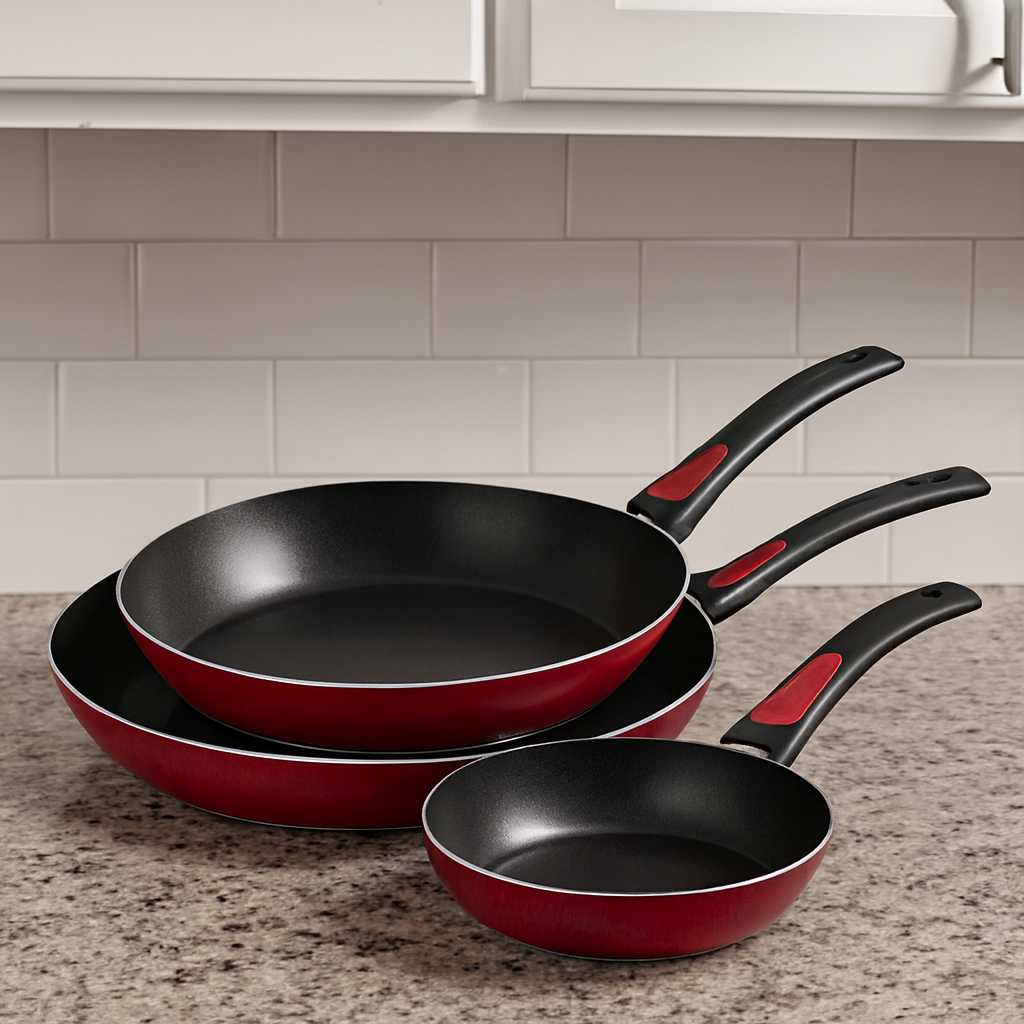
My current setup? I kept the Primaware pans for eggs, fish, and delicate foods. The Everyday set went to my sister’s garage apartment. And honestly, I’ll probably replace the Primaware pans in another six months.
That’s just the reality of budget nonstick—it’s disposable. At least Primaware makes the disposability less painful.