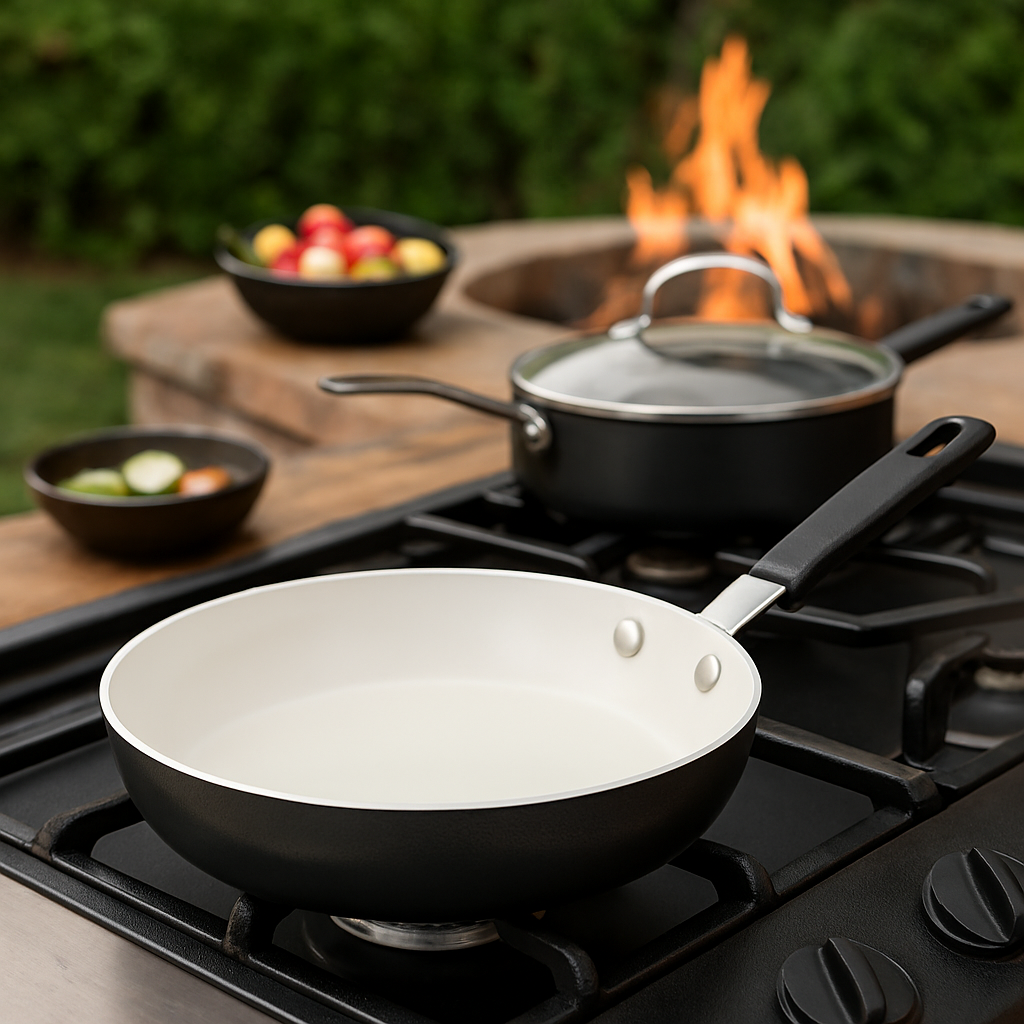
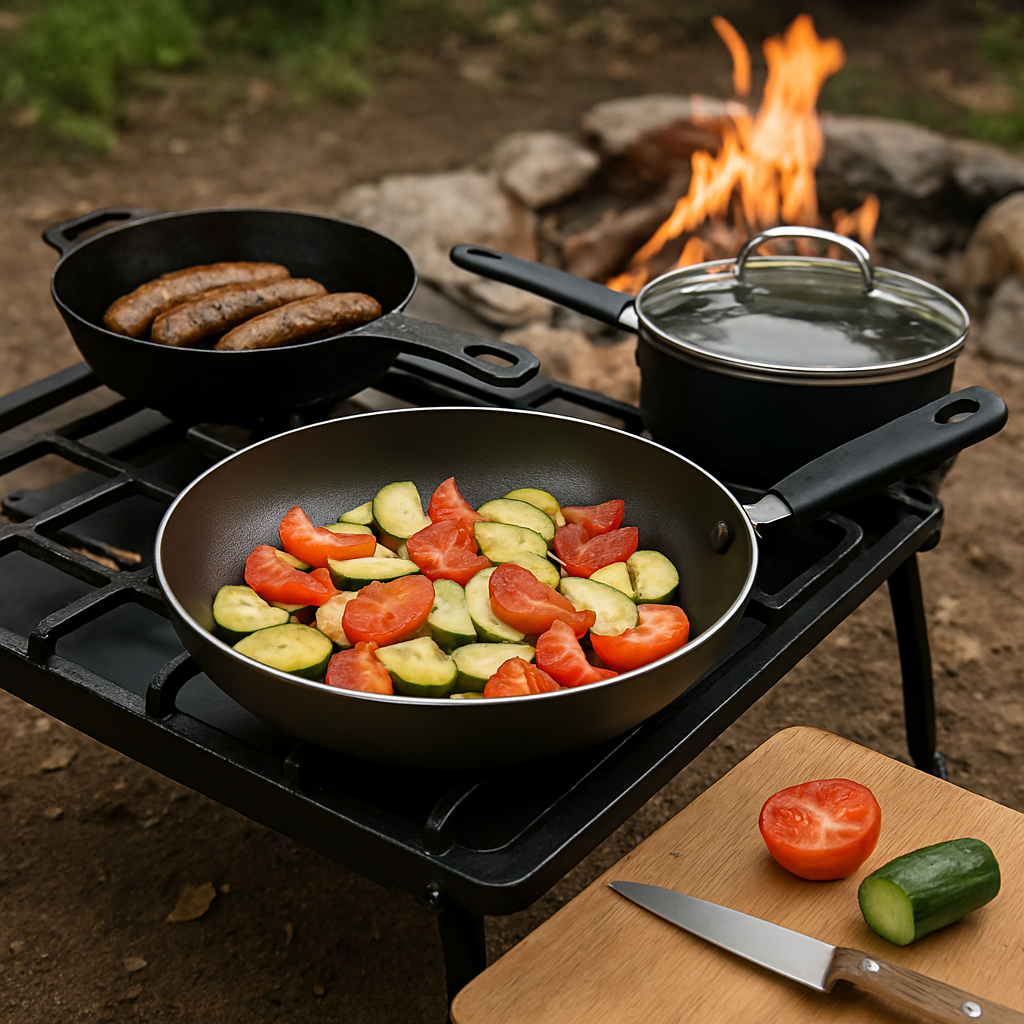
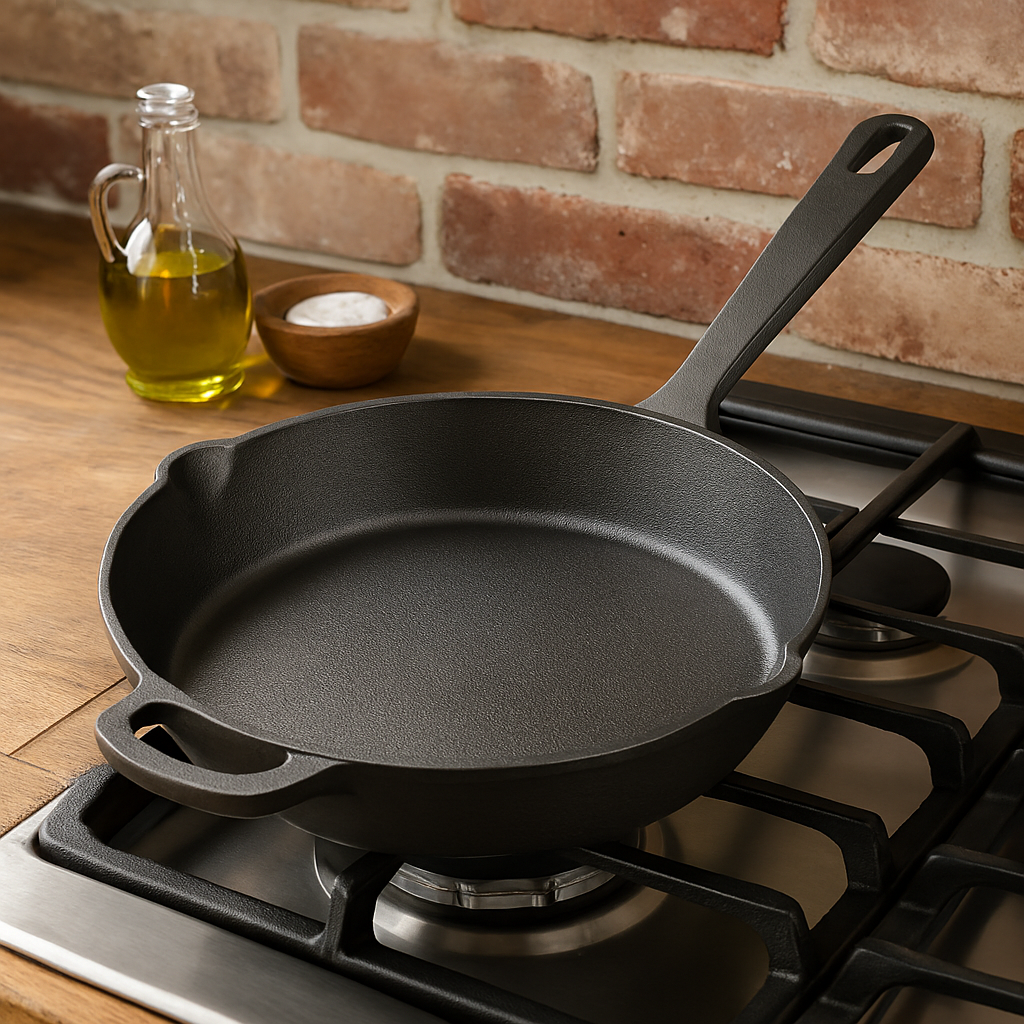
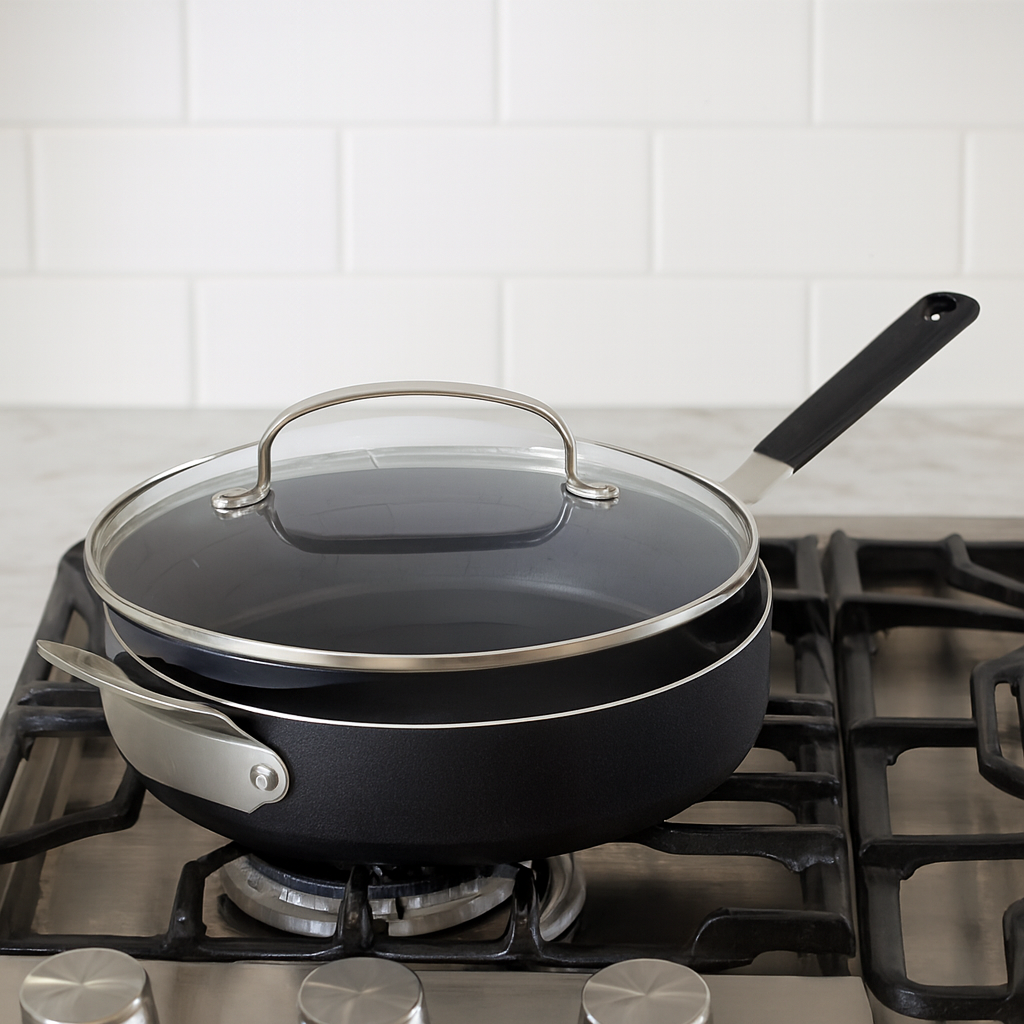
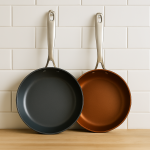
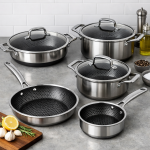
Ceramic nonstick. Carbon steel. Raw cast iron. Stainless. Knives. A whole kitchen in one lineup — not just three fry pans with a headshot. Either GreenPan was building something real here or this was the most elaborate brand exercise I’d encountered. Had to find out which.
(Side note: I actually own a Bobby Flay cookbook from 2003 that I bought at a thrift store for $1.50. The man can cook. Whether that has anything to do with pan performance is a different question entirely.)
Bought pieces across every category. Cooked real food — eggs most mornings, steaks, pan sauces, braised short ribs, a whole roasted chicken, a frittata I completely ruined in month two for unrelated reasons. Documented what degraded, what surprised me, what I’d actually keep. Changed my mind about some things halfway through. Here’s the honest version.
Quick Summary — Ratings at a Glance
Category
Rating
Verdict
Ceramic Nonstick 10″ Fry Pan
4.1/5
Excellent early release, finite lifespan
Ceramic Sauté Pan 3qt
3.9/5
Good capacity, helper handle runs hot
Carbon Steel Frypan
4.4/5
Best piece in the collection — not close
Cast Iron Skillet
3.8/5
Solid, doesn’t beat Lodge on value
Stainless Steel (fully clad)
4.0/5
Good — verify clad vs impact-bonded first
Knives
3.5/5
Competent, nothing more
Full Cookware Set Value
3.7/5
Premium price, partially justified
Short answer: Carbon steel — buy it, full stop. Ceramic is genuinely good for what ceramic is. Everything else depends on which specific piece you’re looking at, and I mean that literally.
GreenPan has been making PFAS-free ceramic nonstick cookware since 2007. Their Thermolon coating — sol-gel ceramic chemistry bonded to aluminum substrate — was one of the first commercial alternatives to Teflon that didn’t rely on fluoropolymers at all. Before Thermolon, “safe nonstick” wasn’t really a category that existed in the mainstream. It was just Teflon, or cast iron, or stainless if you knew how to use it.
The Bobby Flay collaboration adds heavier gauge bodies, darker gunmetal exterior finishes, and — crucially — material categories that have nothing to do with ceramic coating. The carbon steel and cast iron pieces are traditional cookware with no chemical surface treatment. Just raw metal and heat. That’s why this line is more interesting than most celebrity collabs. It’s not just “ceramic nonstick in a different color.”
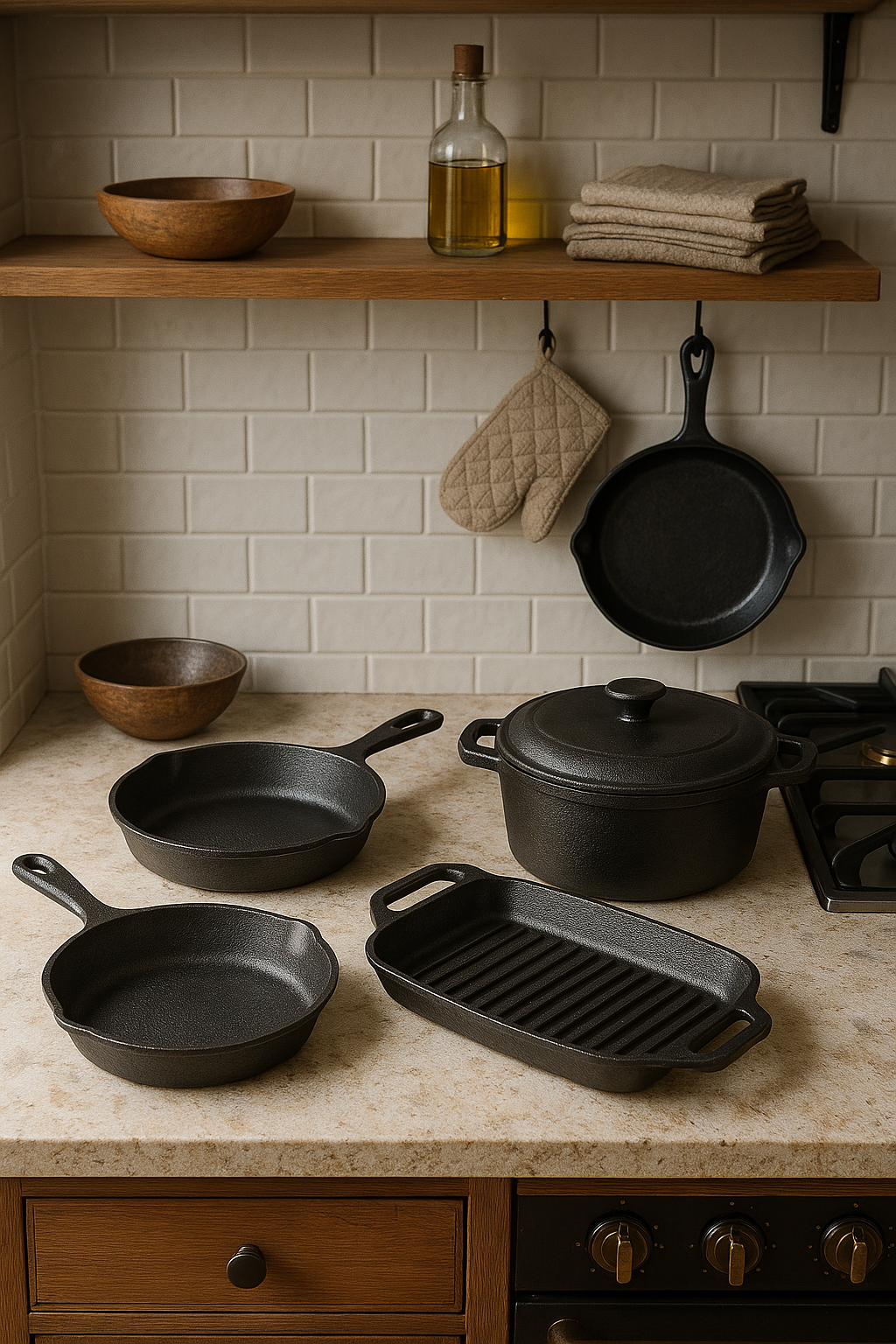
Cast iron skillet — Raw, uncoated. Light factory seasoning. Oven-safe with no temperature ceiling.
Stainless steel — Pay attention here. Some pieces are fully clad (aluminum core running floor to rim). Others are impact-bonded (aluminum disc at base only). Different performance. Same visual aesthetic. Read individual product specs before buying.
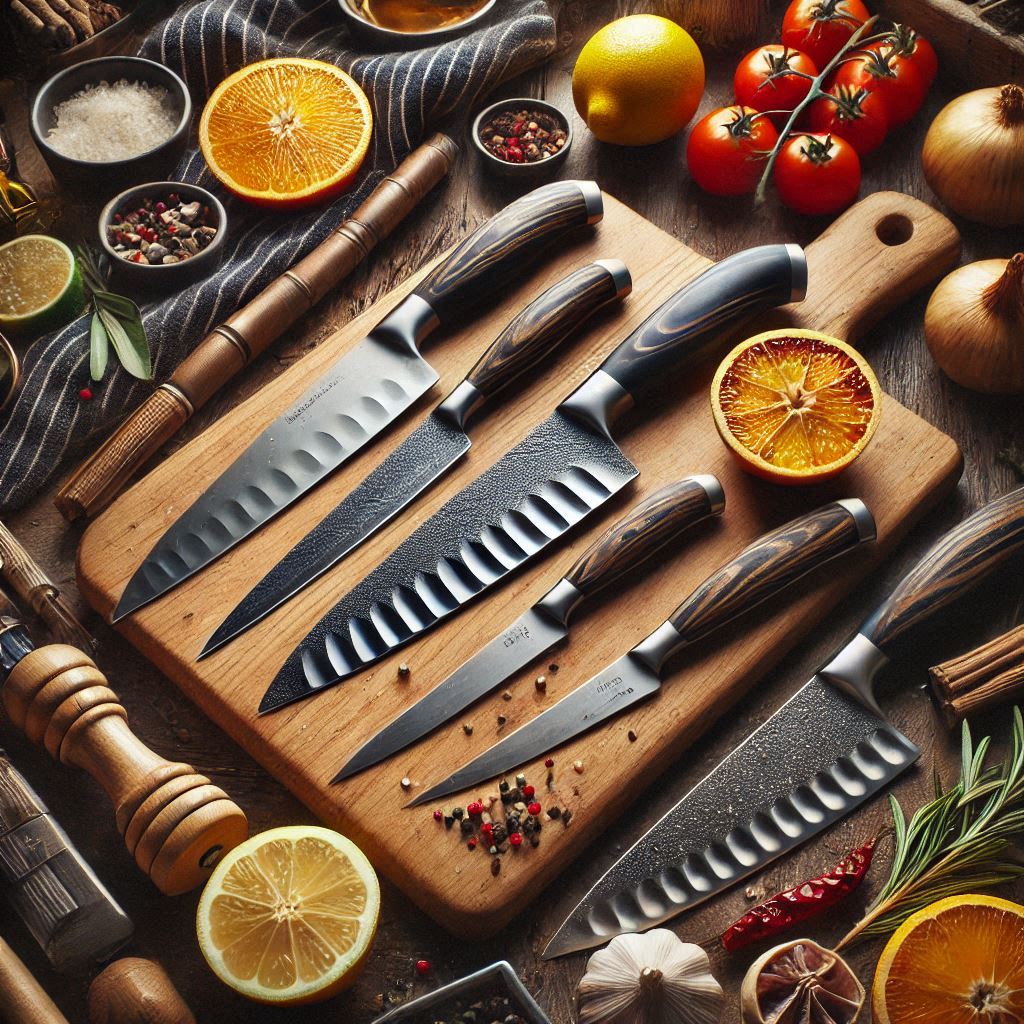
Knives — German high-carbon stainless. Full tang. Triple-riveted composite handle. Chef’s knife, santoku, paring, bread knife.
Sets — Bundled combinations at different price points. Usually the cheapest entry but check exactly what’s included.
How Bobby Flay Differs From Standard GreenPan Lines
Valencia Pro uses Thermolon Minerals Ultra. Bobby Flay uses Thermolon Metals Elite — same base sol-gel chemistry, different hard particles embedded in the coating matrix for greater scratch resistance. Both PFAS-free. The Elite formulation is harder. In six months of daily use I noticed a real difference at pan edges, where abrasion accumulates fastest. Bobby Flay held up better. Not dramatically, but measurably.
The bodies are heavier. Valencia Pro base gauge feels noticeably thinner. Bobby Flay pans have more heft — better heat retention, less warping risk, more like what you find in a restaurant supply store. The kind of cookware that gets used hard and doesn’t flex.
GreenPan Bobby Flay Ceramic Nonstick Review
How Thermolon Actually Works — And Why It Eventually Doesn’t
Ceramic coatings operate on surface energy physics. The ceramic layer has naturally low surface energy — food molecules have weak attraction to it compared to bare metal. New pan, no oil, eggs slide. Simple.
What ceramic doesn’t have: PTFE’s self-lubricating fluorine-carbon molecular structure. Teflon is almost frictionless because of how those molecular bonds are arranged — it actively repels. Ceramic achieves low adhesion through a different mechanism, and that mechanism is less durable under sustained thermal cycling and mechanical contact.
This is the ceiling. Every ceramic nonstick pan eventually degrades. Thermolon Metals Elite slows degradation by embedding harder particles in the sol-gel matrix to resist microscopic abrasion. It doesn’t change the fundamental physics. Ceramic nonstick is a consumable surface. All of it. At every price point. The honest conversation is how long, not whether.
Months 1–3: Better Than I Expected
Scrambled eggs, zero fat, cold pan to medium. They moved like the surface was already greased. Delicate fish released without any coaxing. A fried egg came out clean every single morning for three months. I went in skeptical and came out using this pan every morning for a quarter of a year straight. Didn’t expect that.
If you bought this pan for low-to-medium heat cooking — eggs, fish, vegetables, pancakes — it delivers completely in the early period. No qualifications.
Months 4–6: Here’s Where It Gets Real
Eggs started catching at the outer edge — two or three millimeters of sticking where tool contact and thermal cycling accumulate fastest. I started adding a small knob of butter. Partly habit. Partly preemptive. That probably extended the coating life by a few more months.
By month six: light fat application every time. Not optional anymore. The pan still worked well. It just stopped feeling effortless without help.
Normal. Completely normal. Budget ceramic nonstick starts catching in month two, sometimes earlier. Thermolon Metals Elite made it to month five before I felt genuinely compelled. That gap is real and worth paying for — assuming you’ve accepted what ceramic nonstick fundamentally is.
Scratch Resistance — Real Test
Wood and silicone tools only throughout the entire test. No metal. At month six: no visible scratching under normal light. Under raking light — angled lamp, close range — faint tool marks visible near center. Nothing affecting function.
Stress test: deliberately dragged a metal fork across a spare piece of coating. Scratched immediately, clearly. Don’t use metal. Hard particle reinforcement means harder ceramic surface, not scratch-proof. No coating is scratch-proof. Anyone telling you otherwise is selling something.
Heat Tolerance — Marketing vs What’s Actually True
Thermolon is rated to 450°C. PTFE starts decomposing — potentially releasing toxic fumes — around 260°C. That’s a genuine safety advantage. Real. Not marketing spin. If you’ve ever accidentally cranked a Teflon pan to high heat and noticed an odd smell, now you know what that was.
Here’s the contradiction the box won’t flag: high heat is also the fastest way to wreck a ceramic coating. Not through toxicity — through thermal stress on the sol-gel matrix structure. Every cook past medium-high accelerates surface roughening. The safety ceiling is high. The longevity ceiling is medium-high. These are two different conversations and most people conflate them.
10″ Fry Pan — The Daily Driver
This is the piece most people buy first. Right call.
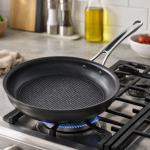
2.4 lbs. Enough weight to feel intentional without fatiguing your wrist. Handle angle works for tossing and oven transfer. Heats evenly — tested with butter, watched it melt uniformly center-to-edge with no puddling at the sides. No hotspots on gas or electric coil. Oven-safe to 600°F. The lid, if purchased separately, is rated to 425°F only. Don’t mix those numbers up.
Ceramic Sauté Pan
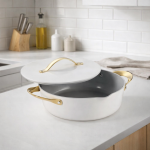
Genuinely useful piece. Straight walls, 3-quart capacity, good for braising chicken thighs or reducing a sauce that needs room. The lid seats snugly.
One complaint that lingered through the entire testing period: the helper handle — the small loop opposite the main grip — gets uncomfortably warm after about 12 minutes of stovetop use. Not dangerous. But reach-for-a-towel territory. A silicone sleeve would cost GreenPan maybe $0.40 to add. It’s not there. Minor annoyance, but a real one.
Common Complaints Worth Knowing
Coating performance decline noticeable around 18–24 months of daily use regardless of care level
Handle screws back out with heavy sustained use — tighten with hex key every few months
Lid fit loosens slightly over time, letting steam escape on longer cooks
GreenPan Bobby Flay Carbon Steel Frypan Review
Best piece in the collection. I’m not hedging that.
Construction
2.2 lbs for the 10″. Lighter than cast iron by a full pound, heavy enough to feel serious. Hammered interior texture isn’t decorative — the dimpled surface gives polymerized oil mechanical anchoring during seasoning buildup. Matters for patina longevity, not just looks.
Gauge is consistent base through wall. No thinning at the rim — a failure point on cheap carbon steel. Long riveted steel handle, oven-safe without limit, gets very hot during stovetop use. Always use protection.
Factory Seasoning: Treat It Like It Doesn’t Exist
Looks seasoned. Isn’t. The factory layer is a thin rust-prevention oil coating applied before shipping. A suggestion. A gesture.
Wash once with hot water and dish soap. Dry completely over medium heat. Apply the thinnest possible oil layer — flaxseed or grapeseed, so thin you question whether you applied anything. Heat on medium until smoking stops. Wipe. Repeat three to four times. Then cook bacon. Or pork belly. Something fatty, forgiving, extended.
By day four of real cooking: release performance indistinguishable from good ceramic nonstick. By week three: recognizable dark patina, eggs sliding without thought. It compounds. That’s the whole mechanism.
(I know people who gave up on carbon steel because they didn’t season properly, cooked eggs on day one, had them stick catastrophically, and returned the pan. Don’t be those people. Give it a week.)
Searing Performance
Ran a parallel test. Ribeyes in carbon steel and cast iron simultaneously, same heat level, same starting temperature.
Carbon steel hit crust faster. Lighter mass, faster heat response. Deep Maillard browning in under 3 minutes per side. When I added a second steak immediately after the first, temperature dropped slightly and recovered within 90 seconds. The pan responds to changes quickly — useful for real-time adjustments mid-cook.
Cast iron: heavier mass means slower initial response but better temperature stability when loading multiple pieces simultaneously. For one steak on a weeknight, carbon steel wins. For a dinner party dropping four cold lamb chops in at once, cast iron holds temp better. Different tools. Both legitimate.
What Carbon Steel Cannot Do
Tomato sauce. Wine reductions. Citrus. Vinegar. Anything acidic strips seasoning and imparts metallic flavor until the patina rebuilds. Not a Bobby Flay issue — carbon steel across the board. Use stainless for acids. Use carbon steel for fat, protein, high heat. That’s the division of labor.
The 20-Year Argument
A well-seasoned carbon steel pan at year five is a fundamentally better cooking surface than the same pan new. Seasoning layers build, polymerize, fuse. The nonstick performance deepens over time in a way no coating can replicate. A carbon steel pan from 1965 still performs if properly maintained. No coating degrades, no bonded layer separates. Buy it young. Cook aggressively. It rewards you.
GreenPan Bobby Flay Cast Iron Skillet Review
Raw, Not Enameled
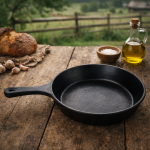
Traditional raw cast iron. No enamel barrier between you and the iron. You season it, you maintain it, it builds history over decades. Reactive to acid when unseasoned. Develops genuine nonstick depth over years of cooking. Factory seasoning is more functional than most — cooked bacon first session and it released reasonably well. Better than many Lodge factory finishes, though Lodge has closed that gap in recent years.
Thermal Mass — The Actual Physics
Cast iron stores heat energy and releases it slowly. Drop a cold ribeye into a screaming-hot cast iron pan and the temperature barely registers the intrusion — the iron has too much stored energy for a room-temperature piece of protein to matter. That’s the whole point.
It’s also why cast iron takes forever to preheat. Ten minutes minimum on medium before heat distributes evenly. Cast iron conducts heat poorly through the metal itself — it heats via radiation and convection from the source below, not lateral conduction through the material. Once it’s up to temperature: stable, consistent, reliable. Getting there requires patience.
Underpreheat is the single most common cast iron mistake. If your steak stuck, you probably didn’t wait long enough.
Searing Results
With proper preheat the crust development is exceptional. Measured surface temperature before and after adding a cold steak: less than 15°F drop at the contact point, recovery in under 60 seconds. That’s the mass working exactly as intended.
Bobby Flay vs Lodge Cast Iron — Honest Take
Lodge achieves equivalent raw cast iron performance at meaningfully lower cost. The Bobby Flay piece has a slightly smoother factory surface — visible difference on day one, tactile difference when you run your finger across it. By year two that distinction disappears under built seasoning. Both pans will be exactly as good as their owners made them through cooking.
Buy Bobby Flay for coordinated aesthetics. Buy Lodge for maximum raw cast iron value per dollar.
GreenPan Bobby Flay Stainless Steel Review
The Construction Problem You Need to Know About
Not all Bobby Flay stainless pieces share the same construction. This matters more than anything else in this section.
Fully clad: Aluminum core runs floor to rim. Heat distributes across the entire cooking surface — base and sidewalls. Critical for sauces, reductions, braises where sidewall temperature matters.
Impact-bonded: Aluminum disc at base only. Good heat distribution across the bottom, uneven up the sides. Fine for boiling, adequate for basic frying. Not adequate for a pan sauce where sidewall scorching becomes a real risk.
Both constructions exist in this line. Same aesthetic. Check every individual product listing before purchasing. This is not an exaggeration.
Fully Clad Performance
Made a beurre blanc in the fully clad saucepan. Emulsified butter sauce with a narrow temperature window, extremely sensitive to uneven heat — if your pan has hot spots, the sauce breaks or scorches at the edges. It held temperature clean, reduced evenly, didn’t break. That test tells you more about a stainless pan than any spec sheet.
vs. All-Clad D3
At equivalent prices, All-Clad D3 is fully clad consistently across the entire range. No exceptions. For pure stainless performance reliability, All-Clad wins. Bobby Flay stainless wins on aesthetic integration with the rest of the collection — carbon steel, ceramic, cast iron, knives, all coordinated.
Your priority determines which matters more.
GreenPan Bobby Flay Knives Review
What You’re Actually Getting
German high-carbon stainless steel. Rockwell 56–58 HRC. Same broad category as Wüsthof Classic and Henckels Professional. Softer than Japanese options (60–62 HRC). Rolls under impact rather than chipping. Resharpens more easily. Needs more frequent honing to stay sharp between sharpenings.
Full tang — blade steel runs uninterrupted through the handle. Triple-riveted composite handle. Balance point just forward of the bolster, works well in a pinch grip for most hand sizes.
Real Kitchen Use
Broke down a whole chicken. Sliced tomatoes paper-thin. Worked through butternut squash from raw. Julienned aromatics fine enough for a proper mirepoix. No complaints through any of it. Factory edge sharp enough for immediate use.
By month two: honing before every session. By month four: proper sharpening needed. Normal for German steel at this hardness. Not failure — maintenance schedule.
Bottom Line on the Knives
Not the reason to buy this collection. If knives matter to you as tools, buy cutlery separately. Wüsthof Classic, Global G-series, MAC Professional will outperform these at equivalent per-knife prices.
Buy the knives here for visual coordination. For not researching six separate cutlery options when you’re already buying a full kitchen. They’ll handle everything a home cook needs. Just not remarkably.
GreenPan Bobby Flay vs Valencia Pro
Feature
Bobby Flay
Valencia Pro
Ceramic Coating
Thermolon Metals Elite
Thermolon Minerals Ultra
Body Gauge
Heavier
Standard
Exterior Finish
Dark gunmetal / matte
Brushed bright stainless
Scratch Resistance
Higher (hard particle reinforced)
Standard ceramic
Induction Compatible
Yes
Yes
Oven Safe (pan)
600°F
600°F
Oven Safe (lid)
425°F
425°F
Carbon Steel Available
Yes
No
Cast Iron Available
Yes
No
Knives Available
Yes
No
Price vs Line
15–25% higher
Baseline GreenPan
For ceramic only: Valencia Pro is the rational value choice. Coating performance gap is real but not dramatic enough in year one to justify the premium if nonstick pans are all you want.
For a full kitchen build: Bobby Flay wins by default. Valencia Pro carbon steel doesn’t exist. You can’t buy it. If you want a coordinated multi-material kitchen from one GreenPan lineup, Bobby Flay is the only option.
GreenPan Bobby Flay vs Caraway vs HexClad
This is the comparison most review sites skip. It shouldn’t be. Caraway and HexClad are the two brands most likely to show up in the same search session as GreenPan Bobby Flay — and they’re genuinely different products solving different problems.
GreenPan Bobby Flay vs Caraway
Feature
GreenPan Bobby Flay
Caraway
Coating
Thermolon Metals Elite
Sol-gel ceramic (proprietary)
PFAS-free
Yes
Yes
Body Material
Hard-anodized aluminum
Aluminum
Oven Safe
600°F
550°F
Induction
Yes
Yes
Carbon Steel Option
Yes
No
Cast Iron Option
Yes
No
Stainless Option
Yes
No
Knives
Yes
No
Visual Identity
Dark gunmetal / professional
Sage, cream, navy — lifestyle
Price Tier
Mid-premium
Mid-premium
Caraway is a direct ceramic nonstick competitor — PFAS-free, sol-gel coating, similar price tier. Where they diverge: Caraway built a lifestyle brand around aesthetics first. The sage-colored lids, the pan racks, the Instagram presence. GreenPan Bobby Flay is a professional kitchen aesthetic. Darker, more serious-looking.
For ceramic nonstick performance, both brands operate in the same tier. Caraway’s storage system — magnetic lid holder and canvas pan organizer — is genuinely thoughtful for small kitchens. GreenPan Bobby Flay wins if you want materials beyond ceramic nonstick under one brand.
If you’re choosing between just these two for ceramic pans: comes down to which aesthetic fits your kitchen and whether Caraway’s storage accessories solve a real problem you have.
GreenPan Bobby Flay vs HexClad
Feature
GreenPan Bobby Flay
HexClad
Coating Type
Thermolon ceramic (PTFE-free)
Hybrid stainless + PTFE
PFAS-free
Yes
No — contains PTFE
Heat Tolerance
450°C safe for coating
260°C PTFE limit
Metal Utensil Safe
No
Yes (by design)
Nonstick Durability
2–4 years
3–5+ years
Searing Capability
Good
Better — exposed stainless peaks
Induction
Yes
Yes
Oven Safe
600°F
500°F
Celebrity Collab
Bobby Flay
Gordon Ramsay
Price
Mid-premium
Premium
HexClad uses a laser-etched stainless surface with PTFE nonstick recessed in the valleys. The exposed stainless peaks handle searing. The PTFE valleys handle release. Clever hybrid — and the PTFE is there. HexClad is not PFAS-free. It contains polytetrafluoroethylene, same family as traditional Teflon.
If PFAS-free and fluoropolymer-free cooking is your priority: GreenPan Bobby Flay wins this comparison clearly. Full stop.
If you want maximum durability and aren’t concerned about PTFE: HexClad’s hybrid surface lasts longer, tolerates metal utensils, and handles aggressive cooking better than pure ceramic nonstick.
Two different products for two different buyers. Don’t let the similar price points and celebrity names confuse you into thinking they’re solving the same problem.
Performance Testing: Actual Results
Eggs — Ceramic Nonstick (Month 1 vs Month 6)
Month 1: Three-egg scramble, zero fat, medium-low. Moved freely, set softly, folded out clean. No residue.
Month 6: Same test. Caught at outer edge — small patch of sticking. Added butter. Released completely. Still functional, just not frictionless anymore.
Steak Sear — Carbon Steel vs Cast Iron
Carbon steel: ribeye, high heat, 3 minutes per side. Deep Maillard browning, clean deglaze. Fast heat response made mid-cook adjustments easy.
Cast iron: same protocol. Slightly more even browning edge-to-edge because thermal mass stabilizes surface temperature. For one steak: marginal difference. For multiple pieces simultaneously: cast iron wins on temperature maintenance.
Pan Sauce — Stainless Fully Clad
Shallots reduced in butter, deglazed with white wine, mounted with cold butter. Emulsion held without breaking. Even reduction, no sidewall scorching. Direct proof of clad construction quality.
Warping Test
High heat to cold water thermal shock across all pieces. Zero warping observed anywhere. Heavier gauge construction earns its place here.
Durability and Long-Term Ownership
Ceramic: Plan to Replace It
2–4 years with proper care. Not a defect — the physics of sol-gel ceramic coating under thermal cycling and mechanical contact has a finite service life. Thermolon Metals Elite raises that ceiling. Doesn’t eliminate it.
Maximize lifespan: medium heat or below, no dishwasher ever, no metal utensils, no thermal shock, air-dry before stacking, pan protectors between stacked pieces.
Carbon Steel and Cast Iron: Permanent
These will outlast your kitchen and probably the next one. No coating degrades, no bonded layer separates. The metal is the cooking surface. Maintain the seasoning and these pieces are effectively permanent.
Stainless: Indefinite With Care
Doesn’t degrade under heat, acid, or sustained use. Dishwasher dulls exterior finish over time and can loosen handle hardware. Handwash for longevity even if technically dishwasher-safe.
Price vs Value Analysis
The Branding Premium
There is one. Probably 10–20% above equivalent construction without the name. Less egregious than most celebrity cookware collaborations — I’ve seen brands charge 50% premiums for zero construction difference. The heavier gauge bodies here are real. You’re getting a measurably better-built product than budget GreenPan tiers, not just a logo swap.
Cost-Per-Year Math
Ceramic nonstick at 3-year lifespan: $80 fry pan ÷ 36 months = $2.22/month. Reasonable.
Carbon steel at 20-year lifespan: $90 ÷ 240 months = $0.38/month. The cheapest cooking surface you’ll ever own on a long enough timeline.
Cast iron: similar math. Cost-per-decade of quality raw cast iron is essentially negligible.
When the Premium Makes Sense
You’re starting a kitchen from scratch. You want one brand across material types. Design coherence matters — and it matters to more people than will admit it. You’re replacing worn-out equipment and want something that survives more than two years.
Pros and Cons: Every Category
Ceramic Nonstick
Pros: PFAS-free Thermolon Metals Elite coating, excellent early release performance, heavier gauge than most competitor ceramic, genuine safety advantage over PTFE at high heat Cons: Finite coating lifespan (2–4 years), strict care protocol required, premium price for a consumable surface, helper handle on sauté pan runs warm
Carbon Steel Frypan
Pros: Improves with every cook, exceptional searing performance, lighter than cast iron, induction compatible, essentially permanent, develops natural nonstick through seasoning Cons: Significant upfront seasoning investment, reactive to acidic ingredients, requires ongoing maintenance, handle gets very hot
Cast Iron Skillet
Pros: Superior thermal mass for searing, oven-safe indefinitely, builds real nonstick depth over years, exceptional temperature stability Cons: Heavy, slow 10-minute preheat required, acid-reactive when unseasoned, Lodge achieves equivalent performance cheaper
Stainless Steel
Pros: Fully clad pieces perform genuinely well, versatile across all cooking methods, induction compatible, effectively permanent Cons: Construction inconsistency across the line, requires technique to prevent sticking, impact-bonded pieces overpriced for what they deliver
Knives
Pros: Full tang construction, good balance and ergonomics, adequate edge retention for home use, visually coordinated with cookware Cons: German steel (56–58 HRC) needs more frequent maintenance than Japanese alternatives, dedicated cutlery brands outperform at equivalent prices
Who Should Buy This Collection
First-time homeowners: Strong fit. Ceramic handles easy daily cooking. Carbon steel grows with skill over years. Everything coordinates visually out of the box.
Home cooks cooking 4–6 nights weekly: Good fit. Heavier construction handles daily wear. Multiple material options grow your cooking range without switching brands.
Design-focused buyers: This line was built for you specifically. Coordinated gunmetal aesthetic across ceramic, stainless, carbon steel, cast iron, and knives. No other single brand matches this at this material range.
PFAS-concerned cooks: Very strong fit. Ceramic entirely free of PTFE, PFOA, PFAS, lead, cadmium. Carbon steel and cast iron have zero coating — raw metal only. The most chemical-free cooking setup you can build from one brand.
Who Should Skip It
Purely performance-per-dollar buyers: De Buyer Mineral B for carbon steel, Lodge for cast iron, All-Clad D3 for stainless each outperform in their category at lower total cost.
People who put everything in the dishwasher. The ceramic degrades early. The carbon steel strips. The cast iron rusts. This collection requires handwashing discipline every time.
Anyone needing serious knives. Buy those separately from a dedicated cutlery brand.
FAQ
Is GreenPan Bobby Flay ceramic nonstick safe? Yes. Thermolon Metals Elite coating contains no PTFE, PFOA, PFAS, lead, or cadmium. No toxic fume release at high heat unlike Teflon-based nonstick. One of the safest commercial nonstick coating options available today.
Is the GreenPan Bobby Flay collection PFAS-free? Yes, across all ceramic-coated pieces. PFAS-free cookware is GreenPan’s core identity — every Thermolon piece is free of per- and polyfluoroalkyl substances. Carbon steel and cast iron pieces use no coating at all.
How long does the ceramic coating last? With proper care — medium heat max, no dishwasher, no metal utensils, no thermal shock — expect 2–4 years of genuinely good nonstick performance. Above average for ceramic nonstick at any price.
Is GreenPan Bobby Flay better than Valencia Pro? Heavier gauge and better scratch resistance, yes. Pure ceramic value, no — Valencia Pro costs less for similar coating performance in year one. For a full kitchen build, yes — Bobby Flay is the only GreenPan option with carbon steel and cast iron.
How does GreenPan Bobby Flay compare to Caraway? Both are PFAS-free ceramic nonstick at similar price tiers. Caraway wins on lifestyle aesthetics and storage accessories. Bobby Flay wins on material range — carbon steel, cast iron, stainless, and knives alongside ceramic. For ceramic-only buyers Caraway is a direct competitor worth comparing. For a full kitchen build Bobby Flay is the more complete solution.
How does GreenPan Bobby Flay compare to HexClad? They’re different products. HexClad uses a hybrid stainless-PTFE surface — not PFAS-free, contains polytetrafluoroethylene. Bobby Flay ceramic is fully PTFE-free. HexClad has better durability and tolerates metal utensils. Bobby Flay wins on PFAS-free safety. If fluoropolymer-free cooking is the priority, Bobby Flay wins clearly. If maximum durability matters and PTFE isn’t a concern, HexClad is the stronger option.
Is the carbon steel pan preseasoned? Factory seasoning exists and looks real but isn’t functional. Treat as bare metal. Season with 3–4 rounds of thin oil on medium heat before first use. Cook fatty foods — bacon, pork belly — for the first several sessions to build patina.
Can GreenPan Bobby Flay pans go in the dishwasher? Some are technically listed as dishwasher-safe. In practice: dishwasher degrades ceramic coating significantly faster, strips carbon steel seasoning completely, dulls stainless finishes over time. Handwash everything.
Is the stainless steel fully clad? Not all pieces. Verify construction for each individual item before purchasing. Fully clad pieces perform significantly better for sauces and braises. Impact-bonded pieces are adequate for simpler tasks but overpriced given the construction tier.
Is GreenPan Bobby Flay worth the money? Carbon steel: yes, clearly — lowest lifetime cost of anything here. Ceramic: yes, with understood finite lifespan. Knives: only if visual coordination outweighs cutlery performance for you. Cast iron: Lodge is better value unless aesthetics matter.
Final Verdict
The GreenPan Bobby Flay collection is the most complete cookware ecosystem GreenPan has built under one aesthetic. Not a cynical cash grab. Not best-in-class at every individual category. Something more specific: a well-built, visually coherent, PFAS-free kitchen for home cooks who want to stop making separate purchasing decisions for five different material types.
The carbon steel frypan is the standout. The ceramic nonstick is excellent for what ceramic nonstick is — a genuinely good cooking surface with a finite lifespan and better safety profile than PTFE. The cast iron works but doesn’t beat Lodge on value. The stainless performs if you land on fully clad construction. The knives are fine.
Compared to Caraway and HexClad: Bobby Flay occupies a distinct position. Broader material range than Caraway. More PFAS-conscious than HexClad. A different product for a different kind of buyer.
Bottom Line: Is the GreenPan Bobby Flay Collection Worth Buying?
Yes — for the right buyer.
Buy without hesitation: The carbon steel frypan. Best piece in the line, best long-term value, gets better with every single cook. If you buy nothing else from this collection, buy this.
Buy if PFAS-free matters to you: The ceramic fry pan and sauté pan. Understand the lifespan ceiling, keep heat below medium-high, handwash always. You’ll get 3+ solid years.
Research carefully before buying: Stainless steel. Confirm fully clad construction on the specific piece. Don’t pay premium prices for impact-bonded pans.
Skip for performance-only buyers: Knives — better options at the same price from dedicated cutlery brands. Cast iron — Lodge gets you there cheaper if aesthetics don’t factor in.
The GreenPan Bobby Flay line was built for someone setting up a kitchen around PFAS-free cooking, who values restaurant-influenced design, and wants ceramic, carbon steel, and cast iron coordinated under one roof without researching six separate brands for six months. If that’s you — this collection delivers on that promise completely.