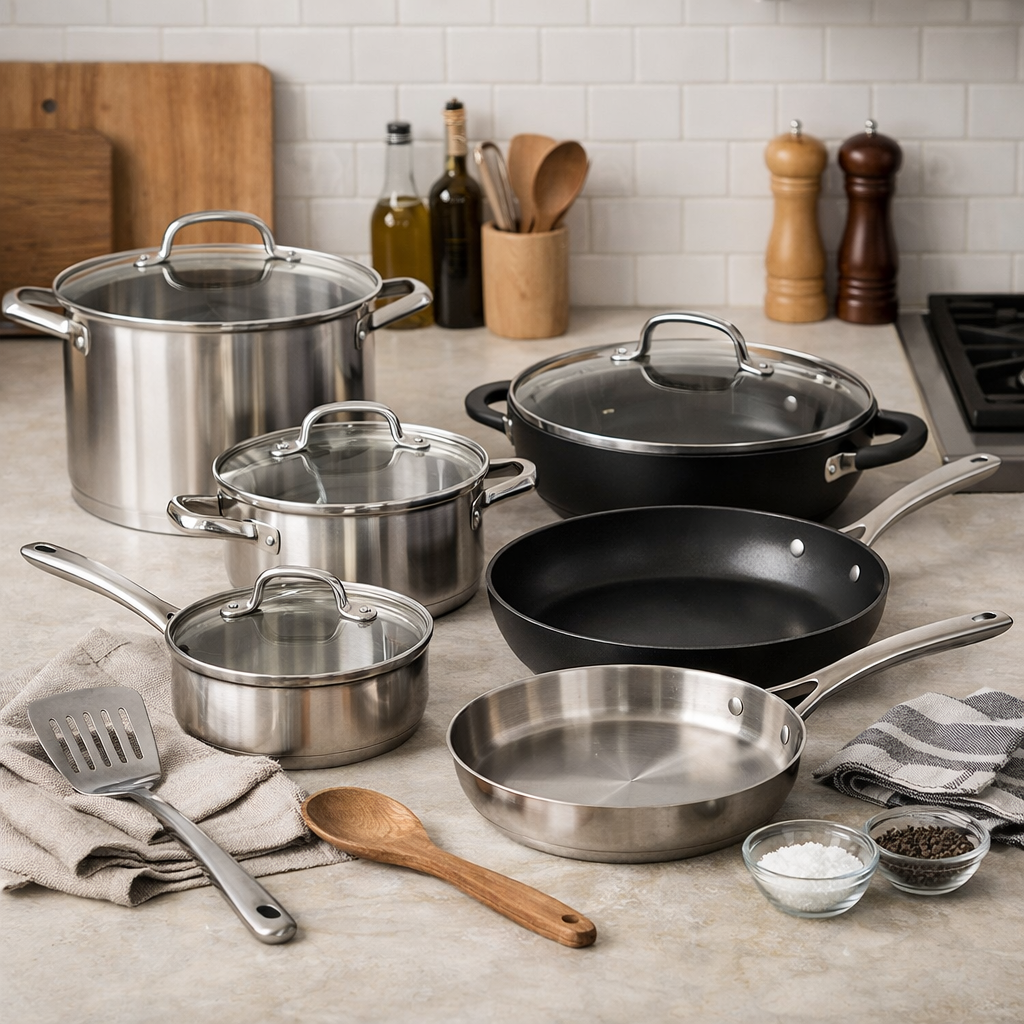
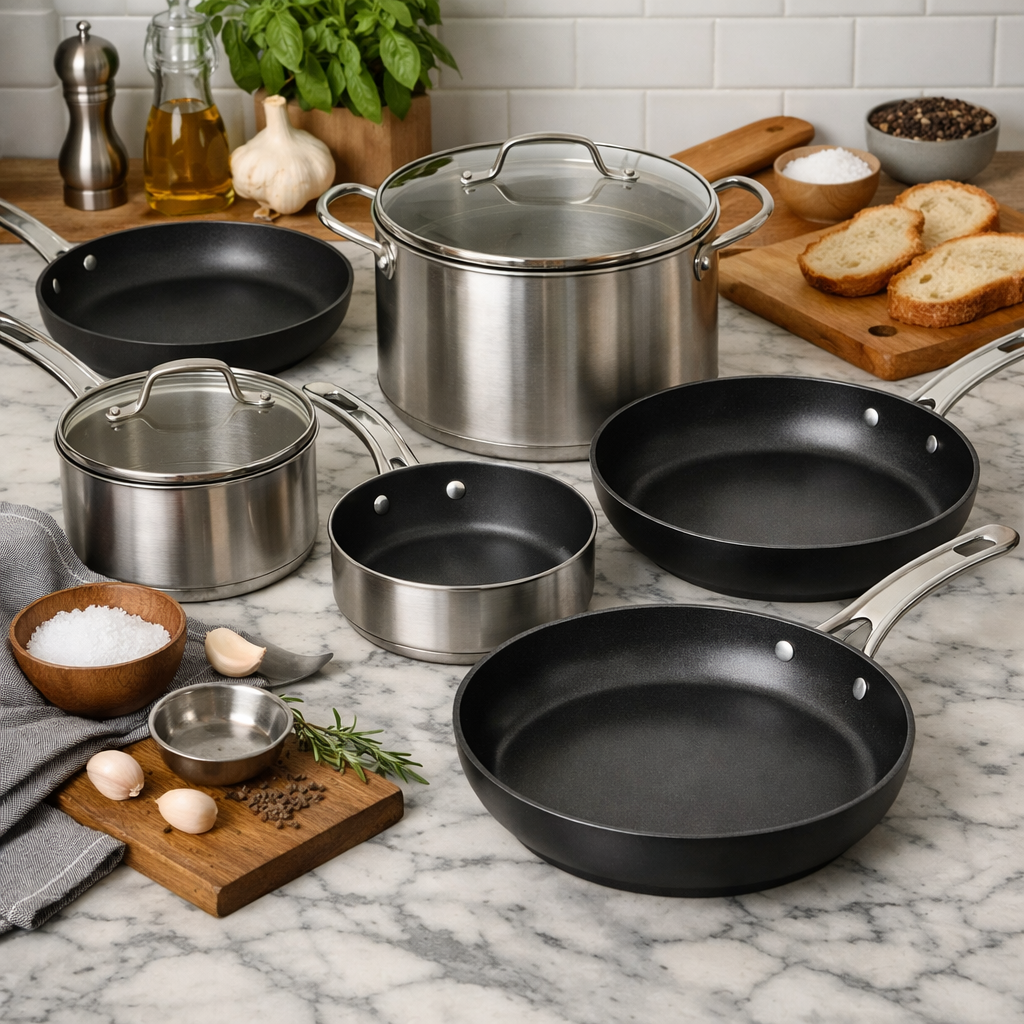
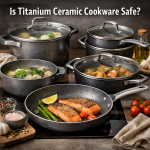
MasterClass Premium Cookware is a solid budget-to-mid-range pick for light home cooks. The nonstick release is genuinely good out of the box. The pans look more expensive than they are. Daily use in a low-to-medium-heat kitchen feels easy and mostly pleasant.
But the coating shows wear faster than I’d like. The base is thinner than what competitors offer at similar prices. And anyone cooking at high heat regularly — searing, high-temp stir-fry, anything aggressive — will run into problems within months.
Treat it right and you get 2–3 years of good cooking. Don’t, and you’re back on Amazon in 14 months.
Category
Score
Overall
7.5 / 10
Nonstick Performance
8.2 / 10
Durability
6.8 / 10
Ease of Use
8.0 / 10
Value for Money
8.5 / 10
Heat Distribution
6.5 / 10
Why I Tested This
People ask me constantly: “What do I actually buy when I don’t want to spend $150 on a pan but also don’t want the $15 thing from Walmart disintegrating in three months?”
MasterClass keeps coming up. Especially on Amazon, where it lives in that crowded, confusing middle zone between obvious junk and recognizable mid-tier brands. The reviews are good. The photos look premium. The price is surprisingly reasonable. So I bought several pieces and cooked with them daily for 90 days to find out if the reality matches the listing.
It mostly does. With caveats. And the caveats matter depending on how you cook.
I tested the 11-inch frying pan hardest — eggs every morning, weeknight stir-fries, the occasional seared chicken thigh. I also ran the 3-piece saucepan set through daily sauce work and used the casserole dish for braises and batch cooking. I ran pans through the dishwasher on purpose. I overheated one deliberately. I used a metal fork on the coating once, just to see.
Here’s what I found.
What Is MasterClass Premium Cookware?
MasterClass is a UK-based kitchenware brand — zero connection to the US online education platform, despite the identical name causing constant confusion in search results. They make cookware, bakeware, and kitchen tools across multiple price tiers. The “Premium” line is their flagship: hard-anodized aluminum bodies, multilayer PTFE nonstick coating, induction-compatible bases.
In the US it’s primarily an Amazon brand. You’ll occasionally find pieces on Walmart.com or smaller online kitchen retailers, but Amazon is where most American buyers encounter it.
The full range covers:
Product Type
Available Sizes
Key Feature
Approx. US Price (2026)
Nonstick Frying Pans
8″, 9.5″, 11″
PTFE multilayer coating
$22–$38
Saucepan Sets
2-piece, 3-piece
Induction base, glass lids
$45–$75
Casserole Dishes
9.5″, 11″
Dual-handle, oven-safe
$38–$55
Bakeware
Various
Carbon steel, nonstick
$15–$32
Wok / Stir-fry Pan
11″, 12″
Deep sides, flat base
$32–$42
The market positioning is specific. MasterClass isn’t going after All-Clad buyers. It’s not competing with Calphalon’s upper lines or trying to justify a $120 price tag. It’s aiming squarely at T-fal’s mid-tier, Tramontina, GreenPan’s entry range — the “I want something decent without paying premium prices” buyer. And in that lane, it competes seriously.
Materials & Construction
Aluminum core. PTFE nonstick coating in multiple layers — MasterClass calls it “triple-layered” in marketing materials, though they don’t publish the exact specification or coating thickness anywhere I could find. The aluminum is hard-anodized, meaning it’s been through an electrochemical process that makes the surface denser, harder, and more corrosion-resistant than raw aluminum.
That’s all good. Standard stuff for this price range.
Where things get interesting — and where MasterClass makes its trade-off most visible — is the base thickness. I measured the 11-inch frying pan at approximately 2.8mm. T-fal’s Unlimited line runs closer to 3.5mm. Some Calphalon pieces hit 4mm. That gap matters more than it sounds: thinner aluminum heats up fast and cools fast, which sounds convenient but means less thermal stability, more pronounced hot spots, and a higher risk of warping when temperatures change suddenly.
It’s not a defect. It’s a cost decision. Aluminum is expensive. Thicker bases cost more to manufacture. MasterClass keeps the price down by keeping the base lean, and they’re not alone in doing this — nearly every nonstick pan under $40 makes the same call. Knowing it going in just means you cook accordingly.
The handles are riveted steel with soft-touch overmolding. They stayed cool throughout testing, even on high gas burners. The rivets are solid — no wobble, no loosening after 90 days of daily use. The downside of rivets is that the small gaps between rivet and pan body trap grease and food debris over time. Not a dealbreaker, but something you’ll notice cleaning after the third month.
Induction Compatibility
The Premium frying pans and saucepans use an encapsulated magnetic stainless steel disc bonded to the aluminum base. This works on induction cooktops. It works fine. But — and this is real — it doesn’t work as evenly as a fully clad pan would. The disc covers most of the base but the heat still concentrates toward the center slightly. On gas and electric ceramic, this is barely noticeable. On induction, if you’re making a large omelet or sautéing a full pan of vegetables, the center cooks faster than the edges. Adjust accordingly.
Nonstick Performance: The Frying Pan Review
Out of the box, the MasterClass nonstick frying pan is genuinely impressive. Eggs slide. I mean actually slide — tilt the pan and the egg moves freely, no coaxing, no spatula required. For the first two months I was cooking eggs with about half a teaspoon of butter and getting a perfect release every single time.
That’s not nothing. Budget pans at $15–$20 often don’t deliver this out of the box. MasterClass does.
The Weekly Egg Test
Every Sunday morning: one egg, 1 tsp butter, medium-low heat. Same pan, same burner, same technique.
Weeks 1–10: flawless. Egg moves freely, pan wipes clean with a paper towel. Week 14: slight resistance at the edges. Still releasing, just not gliding. Week 18: needed a silicone spatula to fully release. Still functional nonstick — just noticeably degraded from the original performance.
That trajectory is normal for PTFE at this price. It’s not a failure. It’s just the physics of how these coatings work — they’re not permanent, they’re consumable, and MasterClass performs as well as anything in this price range through that degradation curve.
Cooking Spray Warning
MasterClass recommends cooking spray or minimal oil. Skip the cooking spray. Aerosol sprays — PAM, generic store brands — contain propellants and emulsifiers that leave a residue on nonstick surfaces that polymerizes at heat over time, building up an invisible layer that actually reduces nonstick performance faster than regular oil use would. Use butter, olive oil, or a neutral oil applied with a paper towel or brush. Your coating will last noticeably longer.
Scratch Resistance
Silicone utensils: no visible effect after 90 days. Wooden spoon: fine. Metal fork, used once intentionally: immediate visible scratches.
The multilayer coating means one scratch doesn’t kill the pan — the layers below still function. But scratches accumulate, each one slightly accelerating the wear. Use proper utensils and the coating stays intact; ignore this and you’ll see the difference within six months.
Nonstick degradation timeline:
Test
Month 1
Month 3
Month 6
Egg Slide Test
Excellent
Good
Moderate
Oil Requirement
Minimal
Minimal
Noticeably more
Post-Cook Cleanup
Wipe only
Light wash
Soft sponge needed
Coating Integrity
Perfect
Good
Minor wear visible
Cooking Performance: Pots, Pans, and Real Food
Heat Distribution
Honest weak point. The thin aluminum base with the encapsulated induction disc means heat concentrates toward the center. Sautéed onions brown faster in the middle of the pan. A large omelet cooks unevenly if you leave it stationary. These are adjustments, not disasters — experienced cooks make them automatically. But if you’re coming from a thicker pan or a tri-ply stainless setup, the difference is noticeable.
Sauces and Simmering — Where It Genuinely Shines
The saucepan set was the unexpected standout. Béchamel, marinara, hollandaise, curry bases — the aluminum’s fast heat response actually works in your favor here. You need to drop the temperature quickly when a sauce starts catching? The pan cools fast. You need to bring something to a simmer without overshooting? Easy. The MasterClass pots and pans handle liquid cooking better than I expected at this price, and I’d recommend the saucepan set to anyone who cooks sauces regularly.
Meat at Medium-High Heat
Chicken thighs, pan-fried salmon, pork chops: all fine at medium-high heat. The pan manages these without drama. The nonstick coating survives the temperature if you’re not cranking the burner all the way up.
Steak? No. Don’t. Not because MasterClass specifically can’t handle it — because no PTFE pan should be used to sear steak. You need 450–500°F minimum for a proper Maillard reaction crust. That’s right at or above the threshold where PTFE starts degrading. Use cast iron. Use carbon steel. Use stainless. Save the MasterClass pan for everything else.
I cooked a Thai curry stir-fry at medium-high for 12 minutes. Zero coating change. Then I left the same pan preheating empty on a high gas burner for four minutes — forgot about it. Came back to slight surface discoloration and permanently reduced nonstick performance in that spot. Sustained empty preheating at high heat is how you kill these pans fast.
Durability: What Happens After Six Months
Two to three years with careful use. Twelve to eighteen months if you’re rough with it. I said this upfront and I’ll repeat it because it’s the most important thing to understand before buying.
Warping
Three deliberate thermal shocks during testing — hot pan into cold water, something you absolutely should not do but most home cooks do at least occasionally. After the third one, the base showed a slight convex bow. Invisible on a gas grate. Visible if you set the pan on a flat granite countertop and push on the center. On an induction cooktop, this could eventually cause uneven contact and further heat distribution problems.
Thicker-based pans survive thermal shock better. Physics. Not a MasterClass-specific failure — just the consequence of the thinner base.
Dishwasher Reality
The box says dishwasher safe. Technically the pan survives the dishwasher — it doesn’t fall apart, the handle doesn’t detach, nothing catastrophic happens. But after 20 cycles during testing, the exterior anodized finish went from a clean matte dark gray to a dull, slightly blotchy surface, and the nonstick interior showed wear that I’d normally expect to see two or three months later. Alkaline dishwasher detergent is hostile to both hard-anodized aluminum and PTFE coatings. High-temperature drying cycles accelerate degradation further.
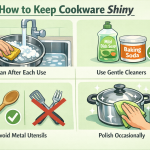
Handwash. Every time. Warm water, dish soap, soft sponge. Takes 45 seconds. Saves months of coating life.
Handle Durability
Zero issues. Ninety days of daily use, rivets solid, overmold grip intact, no loosening. This is a genuine strength of the construction.
Ease of Use
The 11-inch frying pan weighs 1.65 lbs. Light. Genuinely light compared to cast iron (typically 5–6 lbs) or even most stainless steel pans of comparable size. One-handed tossing is easy. Pouring is easy. For someone cooking multiple things simultaneously and moving pans around the stove constantly, this matters.
Cleanup in the first few months: wipe with a damp cloth, done. As the coating ages: warm soapy water and a soft sponge, maybe two minutes. Nothing difficult at any point in the lifespan.
Storage is fine. The handles don’t nest as cleanly as T-fal’s removable-handle Ingenio system, but that’s a specific design feature, not a universal standard. Stack with a pan protector between pieces and you’re good.
Health & Safety: The PTFE Question
PTFE has had a PR problem for twenty years and most of it traces back to PFOA — a processing chemical used in older Teflon manufacturing that the EPA classified as a likely carcinogen and pressured manufacturers to phase out. That phase-out completed globally around 2013. MasterClass Premium cookware is PFOA-free. Any cookware manufactured after 2015 in a reputable facility should be.
PTFE itself is chemically inert. It doesn’t react with food. It doesn’t leach into food at normal cooking temperatures. The FDA considers it safe for food contact applications. Eating a small flake of degraded coating — which happens sometimes as pans age — passes through the body without being absorbed.
The real hazard is thermal degradation above 500°F.
Temperature
What Happens
Risk Level
Up to 390°F / 200°C
Normal nonstick function
Safe
390–500°F / 200–260°C
Coating stable, minor discoloration possible
Low risk
500–570°F / 260–300°C
Coating begins degrading, fumes possible
Avoid
570°F+ / 300°C+
Significant fume release
Dangerous
Above 500°F the coating breaks down and releases fumes that cause flu-like symptoms in humans — polymer fume fever — and are acutely lethal to birds. If you have pet birds, PTFE cookware in your kitchen is a genuine risk. For everyone else, the danger scenario is narrow: empty pan, high burner, forgotten. Don’t do that and you’re fine.
Ceramic Comparison
GreenPan, Caraway, Our Place — ceramic-coated pans avoid PTFE entirely. If that matters to you for personal or philosophical reasons, ceramic is your category. The practical trade-off: ceramic coatings typically last 12–18 months of regular use before meaningful nonstick degradation, compared to 24–36 months for a well-maintained PTFE pan. Neither is inherently dangerous in normal home cooking. The choice comes down to priorities.
Price vs Value
The 11-inch MasterClass frying pan runs $28–$38 on Amazon depending on timing and deals. For that price you get a pan that noticeably outperforms the $15–$20 junk tier and performs comparably to pans costing $10–$15 more from recognized US brands.
Cost-per-year math: $32 over 2.5 years = $12.80/year. T-fal Unlimited at $50 over 4 years = $12.50/year. The numbers are essentially identical. The difference is consistency — the T-fal performs more evenly through years 2 and 3 due to the thicker base, while MasterClass starts showing its age more noticeably.
Are you paying for branding? Somewhat. The packaging is investing in premium aesthetics. But the performance backs up the price for the target use case. This isn’t pure brand markup — it’s a modest premium on a product that genuinely delivers at its price point.
Side-by-Side Comparison: MasterClass vs The Competition
Brand / Product
Price (11″)
Base Thickness
Induction
Coating
Est. Lifespan
Dishwasher
MasterClass Premium
~$32
2.8mm
Yes
PTFE triple layer
2–3 years
Avoid
T-fal Unlimited
~$50
3.5mm
Yes
PTFE titanium-infused
3–4 years
Yes (with care)
GreenPan Valencia Pro
~$60
3.0mm
Yes
Ceramic (Thermolon)
1.5–2.5 years
Yes
Tramontina Professional
~$35
3.2mm
No
PTFE
2–3 years
Avoid
Calphalon Classic
~$45
3.3mm
No
PTFE dual layer
2–3 years
No
MasterClass is competitive. Doesn’t beat T-fal Unlimited on long-term durability, but costs $18 less and delivers comparable initial performance. Against GreenPan, the PTFE coating lasts longer in daily use. Against Tramontina, it’s close — Tramontina has a slightly thicker base for similar money and adds induction compatibility to fewer pieces. Against Calphalon Classic, MasterClass wins on price and matches on lifespan.
Pros & Cons
Pros:
Excellent initial nonstick performance — better than the price suggests
Real value; outperforms budget competitors at $15–$20 by a clear margin
Lightweight construction makes daily cooking physically easier
Handles stay cool consistently; riveted construction is solid throughout
Induction compatible across the full frying pan and saucepan range
Looks significantly more expensive than it costs — genuinely
PFOA-free; safe at all normal cooking temperatures
Wide product range — frying pans, saucepans, casseroles, woks, bakeware — allows a complete matched set on a reasonable budget
Cons:
Thinner base than comparable competitors creates hot spots and warping vulnerability
Coating degradation becomes noticeable by months 4–6 with regular use
“Dishwasher safe” labeling is misleading — accelerates wear substantially
High-heat limitations restrict versatility for serious cooks
Rivet design accumulates food debris over time
Induction heat distribution is slightly uneven compared to fully clad cookware
2–3 year lifespan means real cumulative replacement cost for frequent cooks
Who Should Buy MasterClass Cookware?
Buy it if you:
Are setting up a first apartment or starter kitchen
Cook mostly at low-to-medium heat — eggs, sauces, sautéed vegetables, fish, pasta
Want something that looks good without paying mid-tier brand prices
Cook 3–4 times a week rather than twice a day
Already have cast iron or stainless for high-heat cooking
Will handwash and use silicone or wooden utensils
Skip it if you:
Cook at high heat regularly — searing, wok cooking, anything aggressive
Want cookware that lasts 5–10 years without replacement
Run everything through the dishwasher out of habit or necessity
Have concerns about PTFE and prefer ceramic or stainless alternatives
Cook professionally or at high volume in a home kitchen
FAQ
Is MasterClass cookware good quality? Yes, for its price range. Above-average nonstick performance in the early months, solid physical construction, usable durability for 2–3 years with proper care. Not the best cookware on the market. Genuinely good for what you pay.
Is MasterClass cookware non-toxic? Yes. PFOA-free, which addresses the main historical concern with PTFE cookware. Safe at all normal cooking temperatures. The only real risk is sustained overheating above 500°F — an empty pan left on a high burner unattended. Don’t do that and there’s no health concern.
Does the nonstick coating last? With silicone or wooden utensils, handwashing, and medium heat: 2–3 years of solid performance. With dishwasher use, metal utensils, or regular high-heat cooking: 12–18 months. Better than budget pans. Not as durable as T-fal Unlimited or All-Clad nonstick.
Is MasterClass cookware induction compatible? Yes across the frying pan and saucepan range. Works reliably. Heat distribution is slightly uneven compared to fully clad cookware due to the disc-base design, but for most everyday cooking this is barely noticeable.
Is MasterClass better than T-fal or GreenPan? Against comparable-price T-fal: roughly equal out of the box, T-fal has a durability edge long-term. Against GreenPan: MasterClass PTFE coating outlasts GreenPan ceramic in daily use, but GreenPan wins if PTFE-free is your priority. Neither comparison is a clear knockout.
Is MasterClass cookware worth the money? For most home cooks, yes. Better performance than budget cookware, lower price than recognized mid-tier brands, and real nonstick function for 2–3 years. The replacement cost calculus is the main caveat for frequent cooks.
Bottom Line: Is MasterClass Premium Cookware Worth Buying in 2026?
Yes. For the right cook.
MasterClass Premium sits in a genuinely useful spot in the US market. It’s meaningfully better than the budget nonstick pans flooding Amazon at $15–$20. It’s accessible in price. It delivers real, usable nonstick performance for 2–3 years when you treat it correctly. The thin base and the coating wear rate mean it’s not a “buy once for a decade” situation — but it was never trying to be that, and the price reflects it honestly.
First apartment kitchen? Get it. Cooking mostly eggs, sauces, weeknight dinners at normal temperatures? Get it. Budget-conscious and don’t want to compromise on daily usability? Absolutely get it.
The frying pan is the star of the range. The saucepan set is solid and practical. The casserole dish performs well for braises and oven work. The whole lineup holds together as a coherent, usable kitchen setup for a price that makes sense.
Where it falls short is predictable and consistent: high heat, dishwashers, daily heavy use over multiple years. Push it there and you’ll be disappointed. Not because MasterClass failed — because nothing at this price point survives those conditions for long.
The most practical recommendation I can give: buy the MasterClass 11-inch frying pan and 3-piece saucepan set, treat them with basic care, and add a cast iron skillet for anything that needs serious heat. That combination covers 95% of what a home kitchen actually needs, costs less than a single mid-range All-Clad piece, and will serve you well for years.
Verdict: Recommended — with clear caveats understood going in.