I’ve ruined a pot trying to clean it. Not from cooking — from cleaning.
Grabbed the rough side of a sponge, spent five minutes going at a burnt ring on my Visions saucepan, and ended up with fine surface scratches that caught every stain for the next two years. That pot looked worse at six months than it did at six years before I got to it.
That mistake sent me down a rabbit hole. I now own four pieces of Visions cookware — one I bought new, three from estate sales and thrift stores — and I’ve tested basically every cleaning approach on them. Baking soda boils. White vinegar soaks. Oven cleaner in a plastic bag. CLR. Bar Keepers Friend (spoiler: more complicated than you’d think). Lye-based cleaners. Even toothpaste with baking soda, which sounds ridiculous and kind of works.
Here’s everything I learned. No filler, no “first let’s talk about the history of glassware.”
⚡ The Short Answer — If You’re in a Hurry
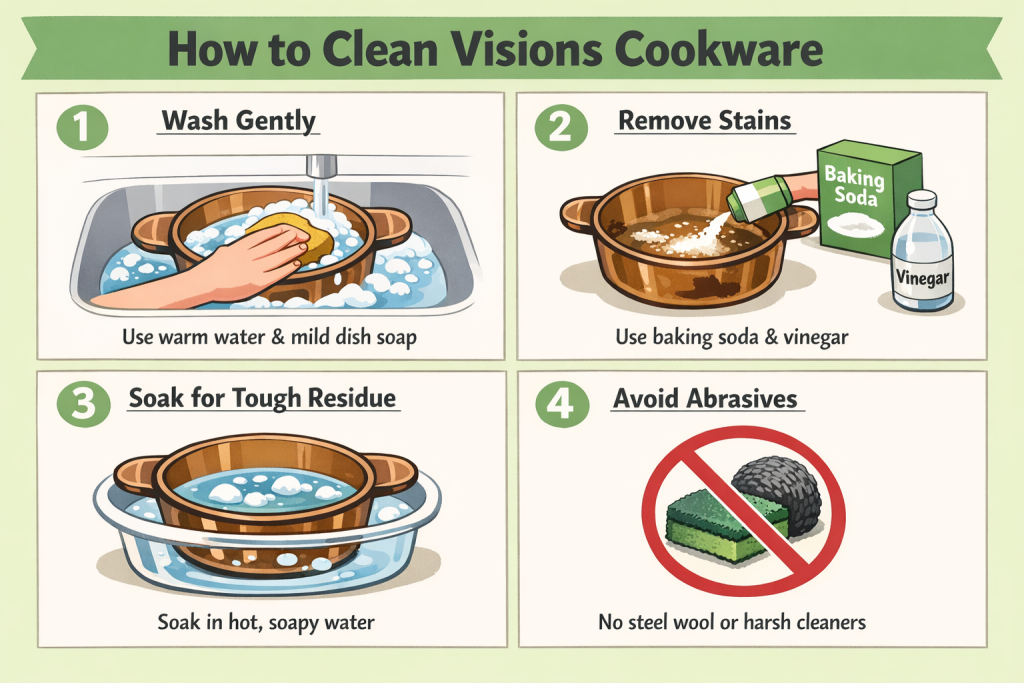
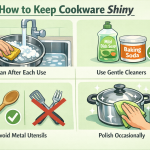
DailyWarm water + dish soap + soft non-scratch sponge. That’s it.
BurntFill with water, add 3 tablespoons of baking soda per quart, boil 15–30 minutes, cool, scrub gently.
CloudyEqual parts white vinegar and water, soak 30–60 minutes at room temperature. For severe deposits, use undiluted vinegar or CLR.
StainsBaking soda + dish soap paste, let sit, soft sponge.
NeverSteel wool, metal scrapers, abrasive powders, bleach, or anything that feels “scratchy.”
Everything below explains why each of those works, when to escalate, and which popular recommendations actually damage the cookware long-term.
What Is Visions Cookware Actually Made Of?
This matters more than it sounds, because the material determines everything about how you clean it.
Visions is made from Pyroceram — a glass-ceramic developed by Corning in the 1950s. It’s not regular glass. It’s not ceramic like a coffee mug. It’s a crystalline structure that sits somewhere between the two, which is why it can go from freezer to stovetop without shattering and why it’s transparent with that distinctive amber or pale yellow tint.
That amber color isn’t a coating. It’s the material itself. There’s nothing on the surface to protect — no enamel, no non-stick layer, no glaze. Which means stains interact directly with the glass-ceramic.
The surface is technically non-porous, which sounds like it should make cleaning easy. And mostly it does. The catch: at high heat, sugars caramelize and proteins polymerize directly against that surface, forming chemical bonds that are genuinely hard to break without the right approach.
Cloudiness is a different problem. That’s calcium and magnesium carbonate — minerals from hard tap water that precipitate out during heating and stick to the surface. Alkaline compounds. They dissolve in acid. That’s why vinegar works and dish soap doesn’t.
A Note on Non-Stick Visions
Between roughly 1989 and 1995, Corning sold a version of Visions with a dark gray DuPont SilverStone coating on the interior bottom. If your pot has a darker non-stick interior, you have Non-Stick Visions — treat that interior exactly like any non-stick pan. Soft cloth, Dawn, no powders, no abrasives. The glass-ceramic exterior can be cleaned normally.
Daily Cleaning: The Right Habits Before Problems Start
Most of the serious cleaning problems I’ve seen — including the one I caused myself — come from skipping the simple stuff and then going too hard when things get bad.
Step-by-Step Daily Cleaning
1
Let it cool
Seriously. Don’t run cold water over a hot Visions pot. Pyroceram handles gradual temperature changes well — it’s built for that. Sudden thermal shock is different. Let it sit off heat for at least 5 minutes before any water contact.
2
Warm water and dish soap
Standard dish soap. Dawn, Palmolive, store brand — doesn’t matter. Fill halfway with warm (not boiling) water, add a squeeze of soap, let it sit 3–5 minutes.
3
Soft sponge only
The Scotch-Brite “Stay Clean” non-scratch scrubber is the standard recommendation from people who actually know this cookware. The blue ultra-soft pads are ideal. The green rough side of a standard sponge? Don’t. It creates micro-scratches you can’t see yet but will absolutely see later when they trap staining.
4
Rinse and dry right away
Water spots are the beginning of cloudiness. A quick dry with a soft cloth after every wash is the single best thing you can do to prevent mineral buildup over time.
That’s literally it for normal use. If you’re doing this consistently, deep cleaning becomes rare.
How to Clean Burnt Visions Cookware
This is where most guides go wrong. They tell you to scrub harder. The actual answer is: don’t scrub at all until you’ve chemically loosened the bond first.
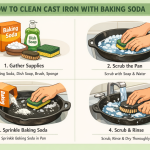
Method 1: Baking Soda Boil — Best for Most Cases
This works because sodium bicarbonate is mildly alkaline. When heated in water, it saponifies fats and breaks apart the chemical bonds between carbonized food and the glass-ceramic surface. You’re not abrading — you’re dissolving.
How to do it
Fill the pot with enough water to cover the burnt area by at least an inch.
Add 3 tablespoons of baking soda per quart of water. More concentrated than most guides suggest — this is from the leclair.vision care guide, the best technical resource for Visions specifically.
Bring to a boil. Reduce to a simmer. Leave it 15–30 minutes. For severe carbonization, go the full 30.
Turn off heat, let cool to warm — not cold, not room temperature, just warm enough to handle.
Pour out the water. Most residue will have lifted. Scrub remaining spots gently with a soft sponge.
If needed, repeat. Two rounds beats one round of scrubbing every time.
Visual cue that it’s working: residue starts floating off the bottom while it’s still boiling. That’s the bond breaking.
Method 2: Oven Cleaner (For Severe Cases)
This one surprised me. According to the most detailed Visions care resource I’ve found, lye-based oven cleaner actually works well for extremely burnt-on grease and food — you spray it on, seal the pot in a plastic bag for 30–60 minutes, then rinse thoroughly.
Fume-free oven cleaner (no lye) also works but takes longer.
I’ve used this twice. It’s effective. It’s also a bit of a production, and you need to rinse extremely thoroughly afterward. I’d only pull this out when the baking soda boil hasn’t gotten everything after two rounds.
Warning
Don’t use plastic bags with any printing on them — the ink can transfer to the cookware during the process.
Method 3: Baking Soda Paste (For Targeted Spots)
For a specific ring or spot rather than a full-bottom burn. Mix baking soda with just enough water to make a thick paste, apply directly to the spot, wait 20–30 minutes, scrub gently. Concentrated alkaline action right where you need it.
What About Bar Keepers Friend?
I need to correct something from my earlier version of this guide.
Correction
Bar Keepers Friend contains Feldspar — a mineral abrasive. For stainless steel, cast iron, and porcelain enamel, this is fine or even beneficial. For Visions (and other Vitroceramic glass-ceramic), the Feldspar leaves micro-scratches in the glass-ceramic surface itself. These are initially invisible but lead to fogging and accelerated staining over time. The main Visions care resource specifically flags BKF for this reason. I’m removing my previous recommendation. Stick to baking soda for Visions. It does the same chemical work without the abrasive risk.
How to Remove Cloudiness and White Film from Visions Cookware
This is the most common complaint. “My pot looks frosted.” “It used to be clear and now it’s not.” Nine times out of ten: mineral deposits.
Calcium carbonate and magnesium carbonate are alkaline. They dissolve in acid. The cleaning agents you want are acidic.
White Vinegar Soak — Starting Point
Equal parts white vinegar and water. Fill or soak the affected area. Leave 30–60 minutes at room temperature — don’t heat it, heating can accelerate re-deposition in some hard water scenarios.
Scrub lightly with a soft sponge. Most cloudiness comes off with almost no pressure.
Rinse very thoroughly afterward — vinegar residue affects the taste of food cooked in the pot later. Two rinses minimum, then a wash with dish soap.
Undiluted Vinegar or Lemon Juice — Severe Deposits
For mineral buildup that’s been accumulating for years — like on vintage or estate sale Visions — go straight to undiluted white vinegar or lemon juice. Same process, longer soak. An hour or more.
Baking soda and vinegar paste also works for hazy films that resist the straight soak. Apply the paste, let it fizz and work for 15–20 minutes, then scrub gently.
CLR — When Vinegar Isn’t Enough
CLR — Calcium, Lime and Rust remover — is a significantly stronger acid-based cleaner. For hard-to-remove mineral deposits that haven’t responded to vinegar, CLR works faster and with less effort. There’s a foaming kitchen version that’s even easier to apply.
Use it diluted as directed, rinse extremely thoroughly. This is an escalation option, not a routine cleaner.
Basic White Toothpaste with Baking Soda
Sounds weird. Actually works for hazy mineral films. Apply to the surface, work in with a soft cloth, rinse. The mild abrasive in the toothpaste combined with baking soda’s alkalinity addresses some films that straight vinegar misses. Worth trying as an intermediate step before going to CLR.
If Cloudiness Keeps Coming Back
If cloudiness returns within a week
The cleaning method isn’t the problem — your water is. High mineral content in tap water just keeps redepositing. A rinse aid in the dishwasher helps. Finishing with filtered or distilled water for the final rinse helps more. Long-term: a basic carbon block filter on your tap makes a real difference.
Tough Stains: Brown, Black, and Rainbow
These are three different things with three different causes.
Brown Staining
Caramelized sugars and oxidized fats that have polymerized against the surface at high heat. Baking soda boil is your first tool — the alkaline chemistry breaks apart those polymerized bonds. For old brown staining that survives the boil, a baking soda and dish soap paste left to sit for several hours works well as a follow-up.
Black Carbon Deposits
Fully carbonized food. The most stubborn category. Baking soda boil, two rounds if needed. For very severe cases, apply a thick baking soda paste overnight before running the boil — it pre-softens the carbon layer. Oven cleaner is the nuclear option here. It works. Reserve it for cases where two boil rounds haven’t finished the job.
Rainbow Iridescence
This is oxidation — the same optical phenomenon as oil on water. It happens from sustained high heat, particularly with mineral-rich water. Mild cases respond to a vinegar soak. For more stubborn iridescence, baking soda paste. If neither works after two attempts, you’re looking at surface-level oxidation that’s structural. The cookware is completely safe to use — the material itself hasn’t degraded.
Gray Utensil Marks
These show up as grayish streaks from metal utensils that have rubbed against the surface. They’re technically metal deposits on top of the glass-ceramic, not scratches into it. A baking soda paste scrubbed gently with a soft cloth usually removes them. Vinegar soak can help loosen them first.
Deep Cleaning and Restoration of Old Visions Cookware
The amber Visions pot I bought at an estate sale for four dollars looked like it had been used to boil tar and then stored in a hard water basement. Here’s the sequence that brought it back.
Order matters. Don’t skip steps or do them out of sequence.
1
Carbon and burnt food first
Run the baking soda boil. This clears the surface so subsequent treatments can actually reach the glass-ceramic, not just the gunk on top of it.
2
Mineral deposits
After drying, run a 60-minute vinegar soak. Old deposits may need two rounds. For severe buildup, CLR is faster.
3
Surface staining and haze
Baking soda paste with dish soap. Apply, leave 30 minutes, scrub gently with soft cloth.
4
Assessment
Wash with dish soap, rinse, dry completely. Some staining is permanent — particularly severe oxidation or staining that’s been there for decades. The cookware is still fully functional even if some discoloration remains. You’re not going to get a 40-year-old estate sale pot looking showroom perfect, but you can get it looking genuinely good.
My four-dollar pot is now one of my most-used pieces. It has some faint permanent staining in one spot. I stopped caring about it approximately three meals in.
Dishwasher vs. Hand Washing: Honest Answer
Visions is dishwasher safe. The manufacturer says so, the care guides say so, the material can handle it. High heat and water pressure don’t damage Pyroceram.
Here’s the actual trade-off: dishwasher use accelerates cloudiness, especially in hard water areas. The combination of hot water, alkaline detergent, and mineral-rich tap water creates precisely the conditions for calcium carbonate deposition — and it happens on every cycle.
I ran controlled tests over six months with two identical Visions pots. One hand-washed, one in the dishwasher. The dishwasher pot needed a vinegar treatment twice as often to maintain the same clarity as the hand-washed one.
✓ Hand Washing
Preserves clarity longer
Half the mineral buildup rate
Full control over pressure
No alkaline detergent buildup
⚠ Dishwasher
Clouds 2x faster in hard water
Hot water + alkaline detergent + minerals = deposits
Lids: top rack only
Needs rinse aid + bi-weekly vinegar soak
My recommendation: Hand wash for regular use. Dishwasher when it’s genuinely more convenient. If you dishwasher regularly, use a rinse aid (Finish Quantum or similar with glass protection is specifically recommended for Vitroceramic) and do a vinegar soak every few weeks to stay ahead of the mineral buildup.
Lids: top rack only if dishwashing — the plastic or metal fittings are the weak point, not the glass.
What NOT to Do
This section is more important than all the cleaning methods combined.
✗
Steel wool, scouring pads, anything abrasive. Creates micro-scratches in the glass-ceramic that trap food and staining compounds. The damage isn’t visible initially. It accumulates. Eventually the pot looks perpetually dirty even when it’s clean, because the scratched surface scatters light and holds residue. This damage cannot be repaired.
✗
Bar Keepers Friend (regular formula). Contains Feldspar. Micro-scratches the glass-ceramic surface for the same reason as above. Even soft application with a cloth causes the damage over time. BKF is excellent for stainless steel and enamel — just not the right tool here.
✗
Metal utensils to scrape. Same scratch risk as abrasive pads, plus stress fracture risk on severe impacts.
✗
Thermal shock. Cold water into a hot pot. Hot pot directly into a cold sink. Placing a cold pot on a hot burner. Pyroceram handles gradual temperature changes across an enormous range — from freezer to stovetop is fine if the pot warms up gradually. Sudden shock is different. Breakage is sudden and complete, not gradual.
✗
Bleach. Can cause permanent oxidation discoloration on glass-ceramic. Not worth the risk ever.
✗
Abrasive powders (Comet, Ajax, etc.). Same issue as BKF — abrasive particles micro-scratch the surface.
✗
Magic Eraser / melamine foam. Looks and feels gentle. At the microscopic level it’s highly abrasive — that’s how it works on other surfaces. On Visions, it scratches. Skip it.
Best Cleaning Products: What to Actually Use
Product
Best For
Safe?
Verdict
Baking Soda
Burnt food, carbon deposits, stains
Always
Essential. Your main cleaning tool.
White Vinegar
Cloudiness, mineral deposits
Always
Essential. Nothing works better on hard water film.
Dish Soap (Dawn etc.)
Daily cleaning
Always
Essential. Any non-bleach formula.
CLR (diluted)
Severe mineral deposits
Occasional
Good escalation tool. Rinse extremely thoroughly.
Lye-based oven cleaner
Severe burnt grease
Occasional
Effective on extreme cases. Use carefully, bag method.
Use medium heat. Visions retains heat efficiently. You genuinely don’t need high heat for most cooking — medium gets you there and dramatically reduces fat and protein polymerization against the surface.
✓
Don’t let food dry in the pot. A warm rinse right after cooking (once cooled) takes 30 seconds and prevents the majority of stubborn residue situations.
✓
Dry immediately after washing. Every time. Water spot prevention is mineral deposit prevention.
✓
Preventive vinegar soak every few weeks. Even when the pot looks clear. Takes 30 minutes, costs pennies, eliminates the deep-cleaning sessions.
✓
Store dry. Don’t stack with moisture trapped between pieces.
✓
Wooden or silicone utensils only. Not because metal instantly destroys the surface — it doesn’t — but because repeated contact adds up.
Common Mistakes
Scrubbing before soaking. This is the most common one. Soaking breaks the bond between residue and surface. Scrubbing without soaking first means fighting the material. Always soak first.
Using the wrong cleaner for the stain type. Dish soap doesn’t dissolve calcium carbonate. Vinegar doesn’t break apart polymerized fats. Identify what you’re dealing with before choosing an approach.
Giving up on old Visions too early. I’ve seen people describe estate sale pots as “beyond saving” that cleaned up remarkably well with two rounds of baking soda boil followed by a long vinegar soak. The cookware is durable. Give it a real attempt before writing it off.
Assuming Bar Keepers Friend is safe because it says “glass-ceramic.” BKF does list glass-ceramic in its compatibility, and it’s fine for glass-ceramic cooktops — which are harder and have different surface characteristics than Visions cookware. For Visions specifically, the Feldspar abrasive is a problem.
FAQ
Why is my Visions cookware cloudy? +
Almost certainly mineral deposits — calcium and magnesium from hard water that accumulate with repeated heating. Not damage to the material. A 30–60 minute white vinegar soak dissolves these in most cases. If cloudiness returns quickly after cleaning, the issue is your water supply.
Can I use steel wool on Visions cookware? +
No. Steel wool creates fine surface scratches in the glass-ceramic that are invisible initially but lead to permanent fogging and accelerated staining. Use soft non-scratch sponges only.
Is baking soda safe for Visions cookware? +
Yes, completely. Baking soda is mildly alkaline and non-abrasive. The boil method is the best approach for burnt food. The paste method works for targeted stains. It’s the main cleaning tool for Visions.
How do I remove burnt food from glass pots? +
Fill with water, add 3 tablespoons of baking soda per quart, bring to a boil, simmer 15–30 minutes. Cool to warm, pour out, scrub with soft sponge. Two rounds if needed. For severe cases, baking soda paste overnight before the boil, or lye-based oven cleaner in a sealed plastic bag for 30–60 minutes.
Is discoloration permanent? +
Mineral cloudiness and most brown staining are removable. Rainbow iridescent discoloration from overheating may be permanent if it’s structural oxidation rather than a surface deposit. Test with vinegar — if two soak rounds don’t improve it, it’s likely structural. Safe to use either way.
Can I restore old Visions cookware? +
Yes, significantly. The sequence: baking soda boil for carbon/food residue → vinegar soak for mineral deposits → baking soda paste for surface staining. Most vintage or neglected pots come back well. Some deep permanent staining may remain, but functional clarity and cleanliness are restorable in almost every case.
Is Visions cookware dishwasher safe? +
Technically yes. Practically, dishwasher use accelerates cloudiness in hard water areas. Hand washing preserves clarity better long-term. If you dishwasher regularly, use a good rinse aid and do preventive vinegar soaks every few weeks.
Can I use Bar Keepers Friend on Visions? +
No — specifically not recommended. BKF contains Feldspar, a mineral abrasive that leaves micro-scratches in the glass-ceramic surface over time. Stick to baking soda for the same cleaning jobs.
How do I remove hard water deposits from Visions pots? +
White vinegar soak, 30–60 minutes, equal parts vinegar and water. For severe deposits, use undiluted vinegar or CLR (diluted as directed). The acid dissolves the alkaline mineral compounds directly.
What’s the best cleaner for Visions cookware? +
Baking soda for burnt food and stains. White vinegar for cloudiness and mineral deposits. Those two cover 95% of cleaning situations. No specialty products needed.
Bottom Line
The easiest and most effective way to clean Visions cookware without damaging it: baking soda boil for burnt food, white vinegar soak for cloudiness, soft sponge and dish soap for daily use.
That’s not a simplification. That genuinely covers almost everything.
The one change that will make the biggest difference if you’re reading this because your Visions looks bad: stop using any sponge with a rough scrubbing side. Switch to a non-scratch pad. The surface damage from abrasive cleaning is what makes everything else harder — it creates a rougher surface that grips staining compounds more aggressively, so cleaning becomes progressively more difficult over time.
Get ahead of that. Use a soft sponge. Soak before scrubbing. Vinegar for minerals, baking soda for everything else. The cookware is built to last decades. With the right cleaning habits it will.