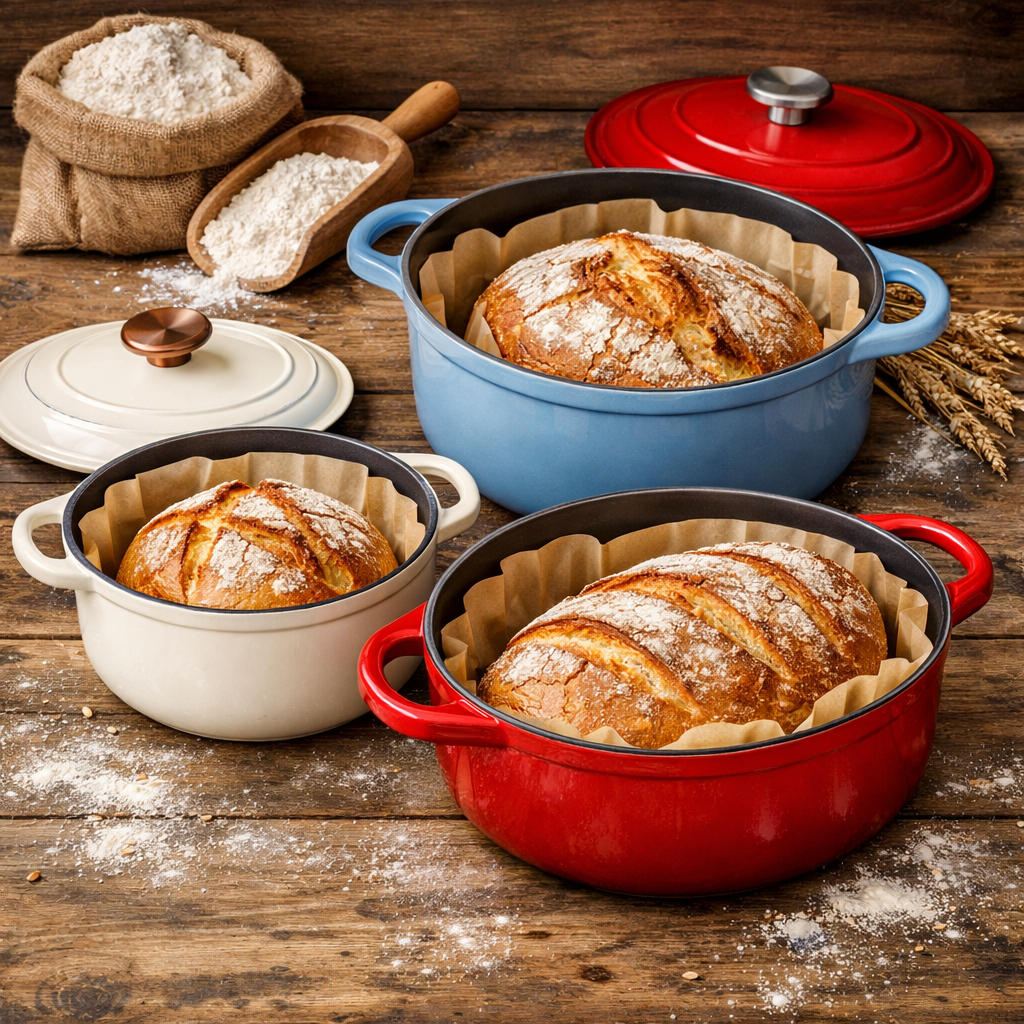
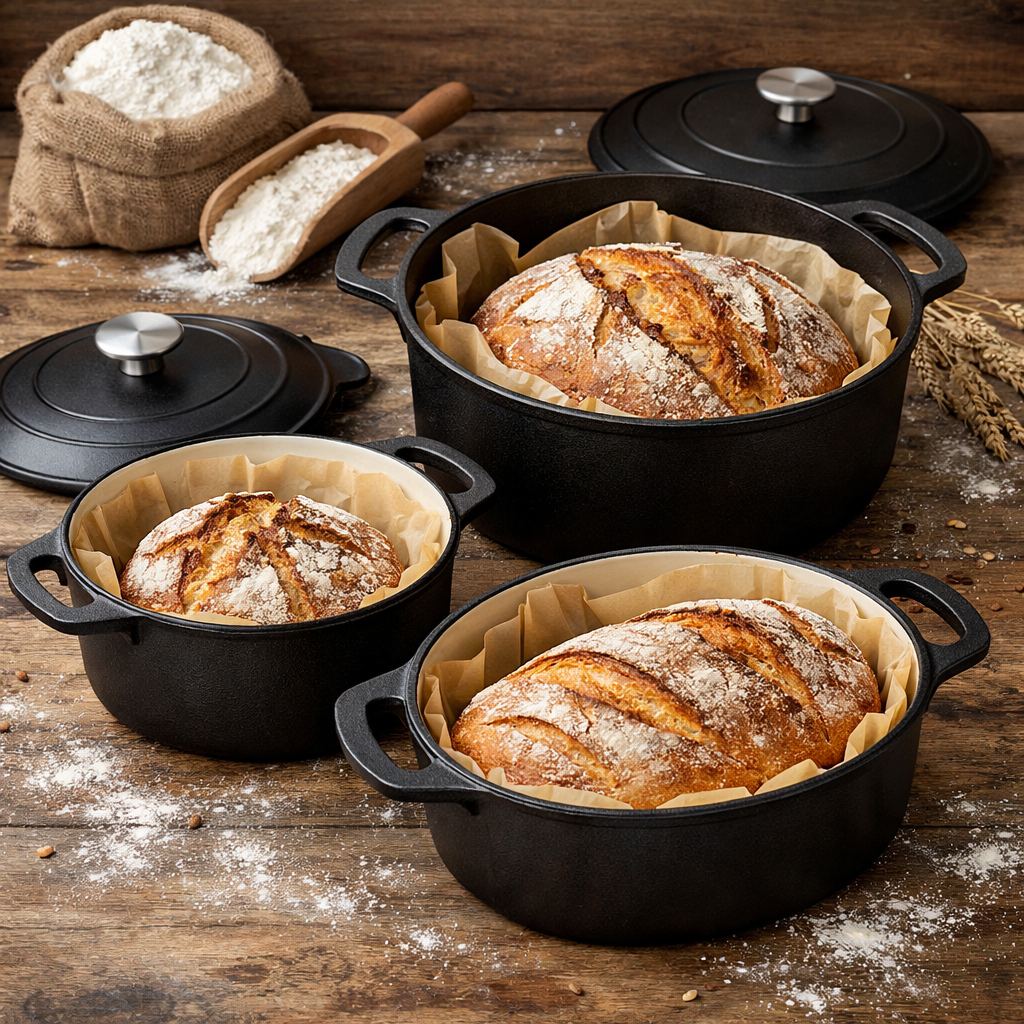
Sourdough, boules, bread bowls — after years of baking, I finally have a real answer
I ruined so many loaves before I figured this out.
Not because my starter was bad. Not because I couldn’t shape. I was dropping perfectly good dough into the wrong size pot and wondering why everything came out flat and pale and kind of sad. The 7-quart Dutch oven I’d been using for everything — soups, braises, bread — was killing my oven spring and I had no idea.
Took me an embarrassingly long time to connect those dots.
Once I did, I got a little obsessed. I baked the same 500g sourdough recipe in a 4-quart, a 5-quart, a 5.5-quart, a 6-quart, and a 7-quart. Same day. Same oven. Same dough, divided and shaped identically. Measured dome height, photographed crust color, noted crumb structure. Ate a lot of bread that week. Here’s what I found.
The Short Answer (If You Just Want to Know)
Situation
Best Size
Best overall
5.5 qt (5.2L)
Best for beginners
5.5 qt round
Standard sourdough (500g flour)
5 qt (4.7L) or 5.5 qt
Large loaves (750g+ flour)
6 qt (5.7L)
Bread bowls
4–5 qt (3.8–4.7L)
Batards / oval loaves
6–7 qt oval
Small-batch testing
4 qt (3.8L)
Avoid for standard recipes
7 qt round
The 5.5-quart handles 80% of home baking situations. The rest of this article explains the why — and when you actually need to go bigger or smaller.
Why This Matters More Than Your Hydration Level
Here’s the thing nobody tells beginners: your oven is actively working against you.
Home ovens vent steam continuously. That’s fine for roasting a chicken. For bread it’s a problem. The dough’s surface dries out before the loaf finishes expanding. The crust sets early, oven spring stops, and you’re left with a dense brick that no amount of fancy scoring will fix. Bakers in professional kitchens don’t deal with this because commercial deck ovens inject steam directly. Home bakers have to create that environment themselves.
A Dutch oven does it by trapping the steam the dough produces naturally. In the first 20 minutes of baking, a shaped loaf releases enough moisture to create a humid microclimate inside the pot. That humidity keeps the outer skin soft and extensible while the whole loaf expands. Then you pull the lid, the steam escapes, and dry heat finishes the job — crackly, dark, deeply colored crust.
The size of the pot controls how concentrated that steam is. Too small and the dough physically can’t expand — it hits the walls. Too large and the steam disperses so fast it barely helps. Both failures produce bad bread, just in different ways.
The ideal Dutch oven gives your dough about 1.5 to 2 inches of clearance on all sides. That’s it. That’s the whole sizing puzzle.
What Each Size Actually Does
4-Quart (3.8L)
Interior diameter: ~8.5–9 inches Works for: up to 14 oz (400g) total dough weight
A real bread pot — just for small loaves. The tight interior actually creates excellent steam concentration, which is why bread bowls come out so well in a 4-quart. The crust is sturdier, the walls are thicker, the whole thing holds soup longer before going soggy. Not an accident.
The issue is vertical clearance with standard recipes. A 500g boule hits the lid around minute 12, right when oven spring is peaking. The top gets squashed. I’ve also had the dough fuse to the wall at the contact point — annoying to clean, and you lose a chunk of crust when you pry it off.
Bottom heat distribution is uneven too. Less air mass between the dough and the cast iron means the bottom edge sometimes scorches while the interior is still underbaked.
Use it for bread bowls and test batches. Don’t try to force a standard recipe into it.
5-Quart (4.7L)
Interior diameter: ~10–10.5 inches Works for: 16–23 oz (450–650g) total dough weight
This is where Dutch oven bread starts working the way it’s supposed to.
A standard 500g sourdough boule has the right amount of room. Steam concentration is close to ideal. Oven spring is dramatic — the kind that makes you want to photograph the loaf before cutting it. I’ve baked well over 200 loaves in a Lodge 5-quart and the results are consistently what I’d be proud to serve.
Gets tight above 650g. I pushed a 700g miche into mine once. Sides touched the wall. Loaf was edible but had a flat spot where it pressed against the cast iron. Fine for home eating, not something you’d bring to a dinner party.
If your recipes call for 500g flour and that’s what you mostly bake, a 5-quart is completely sufficient. Not a compromise. It’s also cheaper than the 5.5-quart at most price points, which is a legitimate reason to choose it.
5.5-Quart (5.2L) — This Is the One
Interior diameter: ~10.5–11 inches Works for: 18–28 oz (500–800g) total dough weight
Le Creuset made their flagship round this size for a reason. It’s the range where steam efficiency and dough capacity overlap perfectly. A 700g boule has room to bloom properly. An 800g works with tight shaping. The concentrated steam still does its job — I tested this directly against the 7-quart with identical dough and the difference in crust color is visible the moment you pull the lids.
It also forgives mistakes. Over-proofed dough that’s spread wider still has clearance. Imperfect shaping matters less because the steam environment compensates. Specifically for beginners — this is the size where things start clicking even when your technique isn’t there yet.
Staub’s 5.5-quart performs just as well. Lodge makes an enameled version for a fraction of the price. I’ve used all three. The bread is the same. Really.
6-Quart (5.7L)
Interior diameter: ~11–11.5 inches Works for: 25–35 oz (700g–1 kg) total dough weight
Step up here when you’re regularly baking large loaves. A 900g sourdough has comfortable room to rise without touching the walls. 1kg works well. Good for batards in a round pot too — the wider diameter means an elongated loaf still has clearance on all sides.
Loses some ground with smaller doughs. A standard 500g boule in a 6-quart sits a little lost. Steam still works but disperses slightly faster. You sometimes need extra time lid-off to develop the crust color the 5.5-quart produces automatically. Small difference — but it’s there.
7-Quart (6.6L)
Interior diameter: ~11.5–12.5 inches Works for: 32–42 oz (900g–1.2 kg) total dough weight
Don’t buy this as your bread pot unless you’re baking 1kg loaves every week.
I ran the same 500g boule in a 7-quart and a 5.5-quart on the same day. The 7-quart dome came out 2.5 inches. The 5.5-quart was 3.5 inches. The 7-quart crust was pale, thick, leathery — needed 10 extra minutes uncovered and still wasn’t right. The loaf spread sideways. It looked like something baked without any special technique, because in terms of steam dynamics, that’s essentially what happened.
For 1 to 1.2 kg loaves the 7-quart is legitimately the right tool. Those are big loaves. Most home bakers don’t bake them regularly. A 7-quart is a better braise pot than a bread pot for the majority of people reading this.
Size by Dough Weight — Reference Table
Dough weight is the total weight of everything in the bowl: flour, water, salt, starter or yeast, add-ins.
Dough Weight
Approx. Flour
Best Pot
Notes
10–14 oz (300–400g)
~8–10 oz
4 qt (3.8L)
Bread bowls, small loaves
16–21 oz (450–600g)
~12–16 oz
5 qt (4.7L)
Standard sourdough, most recipes
21–28 oz (600–800g)
~16–21 oz
5.5 qt (5.2L)
Ideal range
28–35 oz (800g–1 kg)
~21–26 oz
6 qt (5.7L)
Family loaves, ryes
35–42 oz (1–1.2 kg)
~26–32 oz
7 qt (6.6L)
Large-batch baking
42 oz+ (1.2 kg+)
32 oz+
Two pots
Easier than one giant loaf
Practical check: measure your shaped dough ball. The Dutch oven interior should be 1.5 to 2.5 inches wider in diameter. That clearance is what allows the bloom.
By Bread Type
Sourdough boules
5-quart or 5.5-quart, round. Most recipes are built around 500g flour. The steam at this size is why Dutch oven sourdough looks bakery-quality. The round interior pushes expansion upward — tall dome, open ear, blistered crust. Hard to replicate otherwise in a home oven.
Pain de campagne, country loaves, basic artisan boules
Same answer. 5.5-quart every time.
Batards
Batards need length. A round 5-quart compresses the ends — you get thick, dense tips and an uneven bake. Go oval 5–6-quart, or a round 6-quart with enough diameter that an elongated shape still has clearance. If batards are your main thing, buy oval and don’t compromise on this.
Sandwich bread
Not really what a Dutch oven is designed for. You want a Pullman pan for flat-top, tight-crumb sandwich bread. A free-form sandwich loaf in a 6-quart oval gets interesting crust character — just don’t expect uniform slices.
Bread bowls
4 to 5-quart. You’re baking a 12–18 oz boule to hollow out for soup. Tighter pot, sturdier crumb, thicker walls. The 4-quart produces slightly denser walls from concentrated steam, which means the bowl stays intact longer once you pour in the soup. Practical detail that actually matters when you’re eating it.
Small-batch testing
4-quart. I keep one specifically for this. New flour, different hydration, experimental inclusion — 300g of flour in the 4-quart instead of committing to a full batch of something uncertain.
Round vs. Oval
Round pots push expansion upward. Good for tall boules with open crumb. Symmetrical rise, no weak points in the interior.
Oval pots let dough elongate. Right for batards and oblong loaves. Round boule in an oval pot usually works but can produce an asymmetrical rise — one end higher than the other, depending on how the dough was shaped.
First pot: round, no question. Most recipes assume it. Add oval later if batards become a regular thing.
Side note: some home ovens heat unevenly at the corners and you get paler crust at the ends of oval loaves. Seen it in at least three different ovens over the years. If it happens to you, rotate the pot at the 15-minute mark.
Sizes in Quarts and Liters
US Quarts
Liters
Best For
Verdict
4 qt
3.8L
Bread bowls, small loaves
Too small for standard recipes
4.5 qt
4.3L
Small boules
Niche, harder to find
5 qt
4.7L
Standard sourdough
Great for 500g dough
5.5 qt
5.2L
Most home baking
Best all-around
6 qt
5.7L
Large loaves, batards
Good if you bake 800g+ regularly
6.75 qt
6.4L
Transitional
Only if you find a deal
7 qt
6.6L
1 kg+ loaves
Too large for most recipes
9 qt
8.5L
Bakery use
Skip for home baking
International buyers: 4.7–5.2 liters covers 90% of sourdough and artisan bread recipes you’ll encounter.
When Size Goes Wrong — Real Failure Modes
Too small. Dough contacts the wall or lid during oven spring. Expansion gets blocked. You get a squat compressed loaf, sometimes with the crust fused to the pot at the contact point. I tried 700g in a 4-quart once. Whole top came out as a flat pale disk. Crumb was fine. Structure was ruined. Not a rounding error — wrong tool.
Too large. Steam disperses before the dough can use it. Surface dries 5–6 minutes too early. Oven spring stops short. Loaf spreads sideways. In my 7-quart test with 500g dough, the crust needed ten extra minutes uncovered just to approach the color the 5.5-quart produced automatically — and it was still thicker, less crackly, less interesting.
The instinct is to buy big — “more room for error.” Doesn’t work that way. A correctly sized pot is more forgiving of imperfect shaping because the steam compensates. A too-large pot removes that buffer.
Materials
Enameled cast iron
Lodge Enamel, Le Creuset, Staub. All work. Even heat distribution, excellent retention, enamel prevents sticking. Preheat empty at 500°F without damage. Heavy — 5.5-quart is 11–15 lbs with lid.
The thing nobody says: bread from a $70 Lodge Enamel and a $400 Le Creuset is essentially identical. Le Creuset is better engineered and will outlast everything else you own. The bread itself doesn’t know the difference. Buy based on budget, not on what baking influencers use.
Raw / seasoned cast iron
Performs identically in the oven. Costs less. Needs maintenance to prevent rust. Sticky high-hydration doughs can adhere if seasoning is weak. I use a raw Lodge 5-quart for daily baking. Zero complaints.
Ceramic (Emile Henry)
Lighter. Useful if lifting a 13-pound pot from a 500°F oven is genuinely difficult. Slightly less aggressive heat retention — occasionally less dramatic oven spring. For most bakers the difference is small. Real option if weight is a concern.
Stainless steel
Poor heat retention. Unpredictable steam management. I tested a stainless stockpot with a tight lid. The bread was fine structurally. The crust had no character. Don’t buy stainless specifically for bread.
Material
Heat Retention
Weight
Price
Verdict
Enameled cast iron
Excellent
11–15 lbs
$60–$500
Best for most bakers
Raw cast iron
Excellent
10–14 lbs
$30–$120
Best value
Ceramic
Good
7–9 lbs
$80–$200
Good if weight matters
Stainless steel
Fair
4–8 lbs
$20–$80
Not recommended
The Actual Test Results
500g bread flour, 380ml water, 10g salt, 100g active starter. All four pots preheated one hour. 500°F for 20 minutes lid on, 450°F for 25 minutes lid off.
Dome height:
Pot
Dome Height
Notes
4 qt (3.8L)
2.75 in (7 cm)
Compressed sides, contact marks visible
5 qt (4.7L)
3.3 in (8.5 cm)
Clean dome, good ear
5.5 qt (5.2L)
3.5 in (9 cm)
Best result — full bloom, open ear
7 qt (6.6L)
2.5 in (6.5 cm)
Spread flat, almost no ear
Crust: 5-quart and 5.5-quart both produced deep mahogany, thin crackly shells. The 7-quart was pale, thick, leathery — needed ten extra minutes and still didn’t match. The 4-quart had good dome crust and a scorched base edge where the dough touched.
Steam: In the 5-quart and 5.5-quart, dough surface stayed visibly moist through minutes 18–20. In the 7-quart it looked dry by minute 14. Those 4–6 minutes are the entire oven spring window. Lose the steam early and the loaf is already decided.
Two mistakes I see constantly:
Not preheating the pot. Cold cast iron means no heat shock, no rapid early expansion. Preheat minimum 45 minutes, ideally an hour.
Opening the lid early to check. The steam inside is working until minute 20. Opening at minute 15 vents it and kills oven spring mid-rise. Set a timer. Leave it alone.
What Beginners Should Actually Buy
5.5-quart round enameled cast iron. That’s the answer.
Standard recipes are written for this volume — no scaling. Steam environment forgives imperfect shaping. Round shape matches the round boule most beginner recipes assume. Works as a soup and stew pot so it earns its cabinet space.
Once you know you’re serious about this, add a 4-quart for bread bowls and testing. Add an oval 6-quart if batards become a regular thing.
Under $80: Lodge 6-Quart Enameled Cast Iron. Interior dimensions are closer to 5.5–5.7-quart despite the marketing. Works well.
Around $60–70: AmazonBasics 6-Quart Enameled. Enamel quality is fine for bread baking. Not built for high-heat acidic cooking long-term, but bread doesn’t stress enamel that way.
If you want one pot forever: Staub 5.5-Quart Round Cocotte. Domed lid creates more vertical headroom. I’ve measured marginally better oven spring on tall high-hydration loaves compared to flat-lid pots of the same size. Real difference — small difference. Worth it if you’re buying once and never again.
FAQ
Is 5-quart enough for sourdough?
Yes. For standard 500g flour recipes, the 5-quart is the right size — not a compromise. Step up to 5.5-quart only if you regularly go above 650g.
Is 7-quart too big for bread?
For standard recipes: yes, clearly. The loaf spreads flat, steam disperses too fast, crust comes out pale and thick. Right size for 1–1.2 kg loaves. Most home bakers don’t make those regularly.
What liter size is best?
4.7–5.2 liters for most recipes. 5.7 liters if you regularly bake loaves over 28 oz (800g).
Round or oval?
Round for almost everyone. Oval only if batards are your primary bread.
Can I use a 4-quart for bread?
Yes, for loaves under 14 oz (400g). For standard recipes it’s too cramped. Good for bread bowls and test batches — not as your main bread pot.
What size do serious home bakers use?
Most settle on 5.5-quart for everyday baking and add a 6-quart or oval for variety. The 5.5-quart is the everyday workhorse across the board.
Does lid shape matter?
Domed lid (Staub) gives slightly more vertical headroom. I’ve measured marginally better oven spring on high-hydration tall loaves. Real but small difference. Flat lids work fine for standard boules.
Best size for bread bowls?
4 to 5-quart. Bread bowls are small loaves — 12–18 oz — you hollow out for soup. Tighter pot, sturdier crumb, thicker walls that hold liquid longer.
Bottom Line
5.5-quart round enameled cast iron for most people. Covers 500g–800g doughs, handles sourdough cleanly, forgives beginner mistakes, doubles as a cooking pot.
Budget constraint: 5-quart does everything the 5.5-quart does for standard 500g recipes. Difference only shows with larger doughs.
Step up to 6-quart if your household consistently needs large loaves. Add a 4-quart for bread bowls. Buy an oval 6-quart if batards are genuinely your thing.
The one that keeps burning people: 7-quart as a first bread pot because it seemed versatile. For braising it’s excellent. For bread at standard volumes the steam physics work against you — the loaf spreads, the crust suffers, and you end up thinking something is wrong with your dough when the real problem is the pot you put it in.
Which is exactly where I started, years ago, before I figured this out.