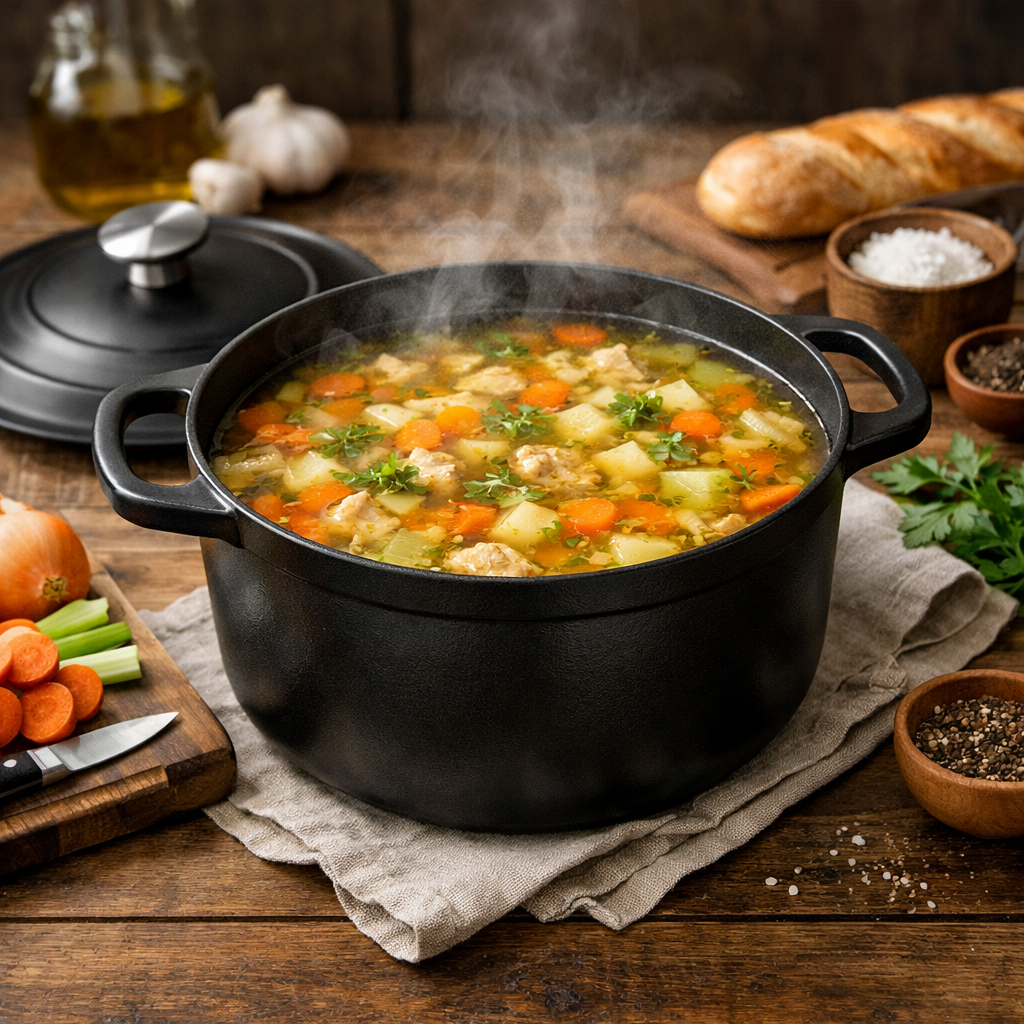
Six years ago I bought a 4-quart Le Creuset because it was on sale and I lived alone. Made great soup for two years — lentil, tomato, the occasional broth when I had chicken bones around. Fine. Then my partner moved in. Every pot of chicken noodle turned into a stress exercise: watching the liquid, rationing noodles, eating immediately because nothing would be left for tomorrow. I didn’t need better technique. I needed a different pot.
Most sizing guides just repeat “1 quart per person” and leave it there. For soup specifically, that rule falls apart — and I’ll explain exactly why. Soup isn’t just liquid. It’s liquid plus vegetables that expand, beans that triple, pasta that swells and keeps absorbing for 20 minutes after it already looks done. The pile you’re looking at raw and the pot 40 minutes into cooking are completely different situations.
I tracked this across four pot sizes over years of regular cooking — 4 qt, 5.5 qt, 7 qt, 9 qt, same recipes, same stove. The “right” size depends on household size, what kinds of soups you make, and whether leftovers are built into your plan. This guide covers all of it.
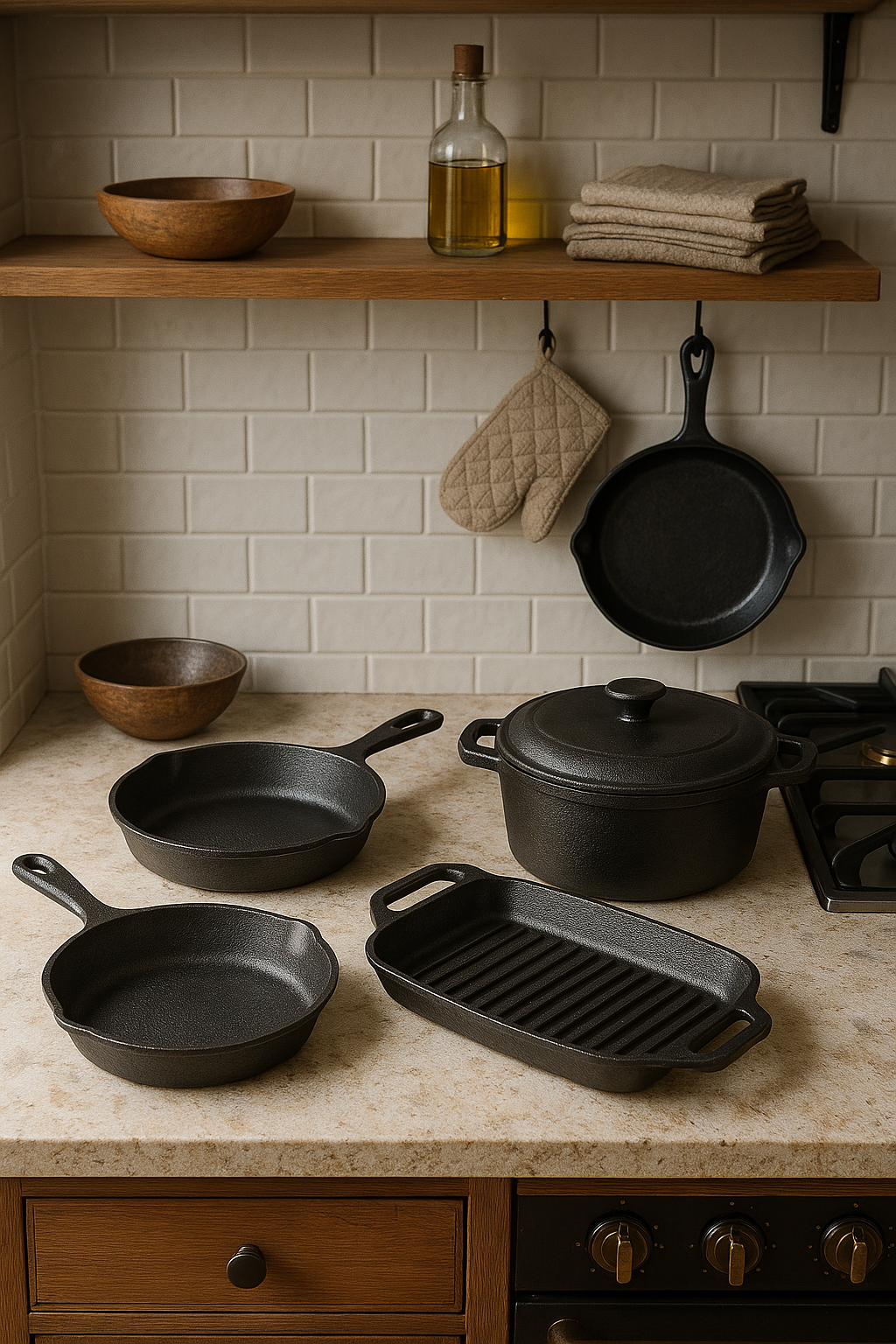
Quick note on terminology: Dutch oven, French oven, cocotte, casserole — these all refer to the same type of pot. A heavy, lidded, cast iron vessel that moves from stovetop to oven. Le Creuset uses “French oven” and “cocotte” interchangeably with Dutch oven. The sizing logic is identical regardless of what name is on the label.
Quick Answer
The best Dutch oven size for soup is a 5.5- to 7-quart model. It gives enough room for ingredients, liquid, and active simmering without overflow risk, and handles 4 to 8 servings depending on the recipe. For most households of 3–4 people, a 6-quart is the most practical size.
Dutch Oven Capacity Chart
The quart number on the label is brim volume — filled to the absolute top. Nobody cooks at the brim. Safe working capacity for soup is around 70–75% of stated volume, after accounting for simmering headroom and ingredient expansion.
Size
Metric equiv.
Usable soup volume
Servings (12 oz bowls)
Best for
3 qt
~2.8L
~8 cups
3–4
Solo cook, small side soups
4 qt
~3.8L
~12 cups
4–5
Couples, simple weeknight soups
5 qt
~4.7L
~15 cups
5–6
Small families, light batch cooking
5.5 qt
~5.2L
~16 cups
6–7
Family of 4 — bestselling size
6 qt
~5.7L
~18 cups
7–8
Family of 4–5 with planned leftovers
7 qt
~6.6L
~21 cups
9–10
Family of 5–6, weekly batch cooking
9 qt
~8.5L
~27 cups
12–14
Entertaining, freezer batches
Serving = 12 oz bowl as a main dish. Usable volume assumes 70–75% fill.
How Dutch Oven Capacity Actually Works
Three things eat into your working volume. The third one bites people most.
The fill ceiling. You need at minimum 2 inches of clearance from the top for anything that simmers actively. Soup rises. It foams. Minestrone with tomato paste boils up in quick bursts. A pot filled to 90% will overflow during a 45-minute simmer — it’s when, not if.
Ingredient displacement. Dry lentils triple when cooked. Pasta swells and absorbs liquid for 20 minutes after it looks done. A pound of kale wilts to almost nothing, but three large diced potatoes stay exactly as large as you cut them. Always visualize the cooked state of your ingredients, not the raw pile going in. That’s the mental shift that prevents overflow situations.
Convection space for long simmers. Bone broth, beef stew, anything going 3+ hours — the liquid needs to circulate. Overfill the pot and the bottom layer scorches while the top barely moves. This is worse in enameled cast iron than thin stainless, because the enamel conducts heat more intensely at the base. Give the soup room and it cooks evenly. Crowd it and you’re burning the bottom before the carrots soften.
My rough working rule: labeled capacity × 0.7 = honest soup capacity. A “7-quart” Dutch oven is realistically a 5-quart soup pot.
That’s also why “1 quart per person” doesn’t work for soup. It’s a rule for finished liquid, not raw ingredients going in. For soup, budget closer to 1.5 quarts of working capacity per person. Anything less and you’re fighting the pot the whole time.
Quarts, Inches, and Depth — What the Numbers Mean
When you shop, you’ll see both quart capacity and diameter in inches. Depth changes the quart number even at the same diameter. A 12-inch round Dutch oven at standard depth might be 6 quarts. That same 12-inch deeper could be 7.5 quarts. Always check the stated quart capacity, not just diameter.
Approximate diameter guide for round Dutch ovens:
9–10 inches (23–25cm) → roughly 3.5–4 qt
10–11 inches (25–28cm) → roughly 5–5.5 qt
11–12 inches (28–30cm) → roughly 6–6.75 qt
13 inches and up (33cm+) → 7 qt and above
Standard-depth Dutch ovens distribute heat more evenly — better for braises and stovetop cooking. Extra-deep models work better for soups and stews: the extra wall height prevents overflow and slows reduction during long simmers. If soup is your main use case, look for a deeper model in whatever quart size you’re buying.
One practical thing about Dutch ovens that doesn’t get mentioned enough: they’re designed to go from stovetop directly to the table. That cook-to-serve nature — lid on, pot on a trivet, ladle the soup right there — is part of why they work so well for soups. No decanting, no second dish to wash.
Best Dutch Oven Size for Different Households
For 1–2 people
A 4-quart is fine. Two to three real portions — dinner for two, maybe one leftover serving. The 3-quart works for one person who never batch cooks: lighter, heats faster, easier to deal with.
If you’re a couple and leftovers matter, a 5-quart shifts everything. Not a dramatic size jump — maybe two pounds heavier — but the batch capacity difference in actual soup-making is real enough that I’d push most couples toward it over the 4-quart.
For 3–4 people
The 5.5- to 6-quart range. I lean toward 6 over 5.5 specifically because of vegetable-heavy soups: a full minestrone or ribollita loads the pot with an enormous pile of raw veg before liquid goes in. The extra half-quart is real working room. If your soup repertoire is mostly simple brothy stuff — lentil, tomato, quick chicken — 5.5 qt is fine.
Lodge officially recommends their 6-quart for families of four. Le Creuset points to the 5.5-quart round as their most versatile everyday size. Both are defensible.
For 5–6 people
7 quarts. A 6-quart for five or six people gives you dinner with nothing left, which means making soup again tomorrow. The 7-quart handles 6–8 real servings, takes a double recipe without splitting between pots, and has enough base surface area to properly brown meat before liquid goes in. That browning matters — it’s where the Maillard reaction happens, and the Maillard reaction is a significant part of where soup flavor comes from. A crowded 5.5-quart doesn’t give meat enough surface contact to brown properly. It steams.
Large families and entertaining
9 quarts and up. A specific tool, not an everyday pot. A full 9-quart loaded with soup is around 25 pounds. Worth it for serious batch cooking or regular large gatherings. If it’s coming out three times a year, probably not worth the storage real estate.
Best Dutch Oven Size for Different Types of Soup
Soup type
Min. size (4 people)
Why
Chicken noodle
6 qt
Pasta absorbs and swells — needs real headroom throughout cooking
Vegetable / minestrone
6 qt
Enormous raw vegetable volume before any liquid is added
Chili
5.5 qt
Dense, less expansion, but beans swell and it boils aggressively
Beef stew
5.5–6 qt
Large chunks + root veg displace a lot; liquid reduces during long braise
Seafood chowder
5 qt
Dairy-based, moderate volume; scorches badly if overfilled on high heat
Tomato soup (blended)
4–5 qt
Low solid displacement; leave 25%+ empty for safe blending
Bone broth
7–9 qt
High water volume, large bones take real space, long simmer needs circulation
Lentil / bean soup
6–7 qt
Legumes triple; heavy foam forms at the surface
Freezer-batch soup
9 qt
The point is 10–12 portions at once — don’t fight the pot size
5-Quart vs 7-Quart Dutch Oven for Soup
The 5-quart heats faster. Less cast iron mass, quicker response when you adjust the heat. For simple brothy soups on a weeknight it’s a comfortable pot to use — you can pick it up one-handed when it’s half-full, which matters more than you’d think when you’re ladling into bowls over a hot stove.
The 7-quart is a different animal. Wide base means you can sear a pound of chicken thighs without crowding them. Crowded meat steams instead of browning — no Maillard reaction, no crust, flat flavor before the liquid even goes in. That’s the biggest functional reason to size up for soups built on browned meat. Six to eight real servings per batch. Right for households that cook once and eat all week.
5-quart strengths: heats evenly when lightly loaded, lighter and easier for daily use, clean 2–4 servings of simple soups, lower price across all brands, fits in most cabinets without thought.
5-quart limits: tight with high-volume vegetables, no real batch cooking capacity, noodle soups crowd the pot fast, a family of 4 gets zero leftovers, sear surface too small for more than a couple of chicken pieces.
7-quart strengths: 6–8 real servings per batch, wide base for proper browning and deglazing, handles double recipes without splitting, bone broth and long simmers work well, built for weekly meal prep.
7-quart limits: heavy — 12–14 lbs empty, 20+ full — underfilled batches heat unevenly, takes real cabinet space, too much pot for one or two people.
If you’re stuck between them: buy the 6-quart. It covers the scenarios where a 5-quart runs out of room, weighs less than a 7-quart, and doesn’t punish you when cooking for three on a Tuesday.
Is Bigger Always Better?
No. Buying too large is the more expensive mistake, and it’s more common.
Underfilled cast iron heats badly. A thin layer of liquid in the wide base of a 9-quart pot reaches scorching temperature before it even starts to simmer. All that thermal mass dumps heat into a small liquid volume fast. You burn the bottom while the vegetables above it are still raw. Fill that same pot to 75% and it behaves completely differently.
Lid performance suffers too. A Dutch oven’s tight-fitting lid is designed to circulate steam back down onto the food — the condensation bumps on many lids exist for this. When the pot is significantly underfilled, the air space between liquid surface and lid breaks that circulation. You lose moisture faster. For long-simmered soups reducing over 3+ hours, this changes the result.
Storage friction is real. A 9-quart Le Creuset is around 15 lbs empty. Most people store Dutch ovens in lower cabinets. Pulling 15 lbs from a low shelf, using it, washing it, putting it back — that friction adds up, and expensive cookware that stays in the cabinet is not an investment. When storing: stack lids upside down inside the pot to save shelf space, and use felt pan protectors between pots to prevent enamel chipping.
Round, not oval, for soup. Oval Dutch ovens overhang standard round burners, creating hot spots at the base edge. For soups and one-pot meals on the stovetop, round gives consistent heat across the whole base.
Common Dutch Oven Sizing Mistakes
Buying small because the price is lower. A 4-quart that limits your cooking for the next decade costs more in frustration than the $50 gap to a 6-quart upfront. This one is responsible for more buyer regret than any other mistake on this list.
Buying large for “versatility.” A 9-quart is large, not versatile. The most versatile sizes are 5.5 and 6 quart.
Not thinking about raw vs cooked volume. Dry beans triple. Pasta doubles and keeps absorbing. Raw potatoes stay the size you cut them. Thirty seconds imagining the cooked state prevents most overflow situations.
Sizing for one meal, not leftovers. Size one step up from “just enough” and you cook once, eat three times. That’s literally why most people make soup.
Not checking lid height before buying. Tall lids eat cabinet space fast. A 9-quart with a high-domed lid may not fit a standard 15-inch cabinet shelf. Measure first.
Ignoring weight. Lodge’s 7-quart runs about 12 lbs empty, Le Creuset’s 7.25-quart about 13.5 lbs. Full of soup add 8–10 lbs. If you have wrist issues or store pots awkwardly, this is part of the decision.
Best Dutch Oven Sizes for Meal Prep and Batch Cooking
Batch cooking math is different from everyday math. Think in freezer containers. A standard quart freezer bag holds about 3–4 portions. To fill four bags you need roughly 4 quarts of finished soup — which, accounting for fill level and ingredient displacement, means 6–7 quarts of actual working capacity. That’s a 9-quart Dutch oven. A 7-quart works for slightly smaller batches.
For weekly meal prep — cooking enough Sunday to eat through the week — the 7-quart is the practical size. Eight portions of minestrone, refrigerated in a sealed container, reheated by the portion. Dutch ovens cool slowly, which is easier on the enamel than going from hot to fridge immediately.
The stovetop-to-oven technique is worth using deliberately, not accidentally. Start on the stovetop — brown aromatics and meat, deglaze the browned bits from the base with a splash of wine or stock, scrape everything up — then move the whole pot into a 325°F oven for the long simmer. Oven heat surrounds the pot from all sides. More even, less scorching, no stirring every 20 minutes. A thin stockpot can’t do this safely. It’s one of the real reasons a Dutch oven makes better slow-cooked soups.
Enameled cast iron handles stovetop-to-oven up to 450–500°F depending on knob material — check before cranking the heat. Bare cast iron tolerates higher temperatures but reacts with acidic ingredients: tomatoes, wine, citrus leach metallic flavor into the soup and discolor the seasoning over time. For soup, enameled is the better choice.
A side note for bread bakers who also make soup: the sweet spot for sourdough is a 4.5–5 quart Dutch oven, which traps steam for a proper crust. If you want one pot for both uses, the 5.5 quart handles both competently. The 6-quart works for larger loaves but may produce a slightly flatter boule.
Dutch Oven Size Recommendations by Use Case
Who you are
Recommended size
Why
Single cook
3–4 qt
Right for 1–2 portions; light enough for real daily use
Couple, everyday
5 qt
2–3 portions comfortably; works for braises and one-pot meals
Couple, wants leftovers
5.5 qt
Small weight increase, meaningful batch capacity gain
Family of four
5.5–6 qt
Full dinner plus leftovers; covers most soups without crowding
Family of five or six
7 qt
6–8 portions per batch; double recipes without splitting pots
Weekly meal prepper
7 qt
8 portions per session; heavy but manageable for regular use
Freezer batch cook
9 qt
12+ portions per batch; fills four quart containers in one session
Regular entertainer
9 qt + 6 qt
Large pot for crowds, medium for every other day
A Note on Brands, Price, and Induction
Most Dutch oven guides turn into Le Creuset ads by paragraph five. The sizing logic here works for every enameled cast iron Dutch oven. A 6-quart is a 6-quart regardless of brand.
Real differences between a $65 Lodge and a $400 Le Creuset: enamel durability over 10+ years (Le Creuset holds up better under heavy daily use), lid fit (Staub’s tight-fitting lid retains more moisture for long braises — noticeable on 4+ hour simmers), and handle geometry (Le Creuset is better balanced when the pot is full). None of that changes what size you need.
On induction: cast iron and enameled Dutch ovens are magnetic and work well on induction cooktops — the heavy flat base makes excellent contact with the induction surface. The one issue is overhang: a 9-quart oval may extend beyond your burner’s effective heating zone, creating uneven heating at the base edge. Round Dutch ovens in the 5.5–7-quart range fit most standard induction burners without this problem. Measure your burner if buying a 9-quart.
Frequently Asked Questions
Is a 5-quart Dutch oven big enough for soup? For 3–4 modest portions of simple soups — yes. Where a 5-quart starts feeling tight is high-expansion recipes: chicken noodle where pasta swells throughout cooking, minestrone with a big raw vegetable pile, anything built around dried beans. For a family of four wanting dinner and leftovers, the 5.5 or 6-quart is the better call. The 5-quart isn’t a bad pot — it has a specific capacity that works fine until you push against it.
What size Dutch oven do most people need? 5.5 to 6 quart. These are the bestselling sizes at every major brand, which tracks with actual cooking patterns — most households are 2–4 people, most recipes target 4–6 servings, most people want leftovers. A 6-quart handles roughly 80% of what home cooks make.
Is a 7-quart Dutch oven too large for everyday cooking? For one or two people — yes, underfilled cast iron heats unevenly and it’s more pot than makes sense at small batch sizes. For a family of five or a household that batch cooks weekly, a 7-quart is exactly right. One question answers it: will you fill it most of the time?
How much soup fits in a 6-quart Dutch oven? About 18 cups — roughly 7 to 8 bowls of 12 oz each as a main. That’s with the pot at 75% fill, the safe working zone for active simmering.
What size Dutch oven does Le Creuset recommend for soup? Their 5.5-quart round — their bestselling size globally. The 7.25-quart round for larger households or batch cooking.
Can I make soup in a 4-quart Dutch oven? Yes. Keep batches to 2–3 portions, fill to 70% max, avoid high-expansion recipes. For one person or a couple who doesn’t need leftovers, a 4-quart is a real choice.
Dutch oven vs stockpot for soup — same sizing logic? Capacity math is the same. Cooking behavior is different. A thin stainless stockpot heats faster and responds more quickly to heat adjustments — better for simple broths where temperature precision matters. A Dutch oven’s cast iron mass holds steady temperature during long simmers, moves from stovetop to oven, and lets you deglaze browned bits into the soup base in the same pot. Different tool for different cooking styles. Same sizing math.
Does pot size affect soup flavor? Yes, indirectly. A correctly-sized pot allows even simmering and proper liquid convection. Overfilled pot simmers unevenly, may need higher heat to maintain temperature, muddies delicate flavors. Underfilled pot in a large Dutch oven scorches the bottom layer before the vegetables above it soften. Right-sized pot, right-sized batch, the soup cooks how it’s supposed to.
Bottom Line: What Size Dutch Oven Should You Buy for Soup?
6 quart — best overall. Covers a family of four with leftovers. Works for braises, one-pot meals, bread, and everything else a Dutch oven does. Light enough to use every week. One answer for most people.
5 quart — for two people who cook regularly and want occasional leftovers. The 4-quart if you cook for one and never batch cook — correctly sized, not a compromise.
7 to 9 quart — for batch cooking and larger households. Feeding five or six regularly, or cooking once to stock the freezer — don’t downsize here. A 7-quart for weekly meal prep, a 9-quart if you’re filling freezer containers in bulk.
5.5 quart — the default when you don’t know yet. New kitchen, changing household, still figuring out how you cook — the 5.5-quart works across more scenarios than any other single size without a meaningful penalty in either direction.
Wrong Dutch oven size doesn’t break your cooking. It makes it harder than it needs to be — overflow anxiety, scorched bottoms, cramped stirring, no room for leftovers. Get the size right and you stop thinking about the pot.