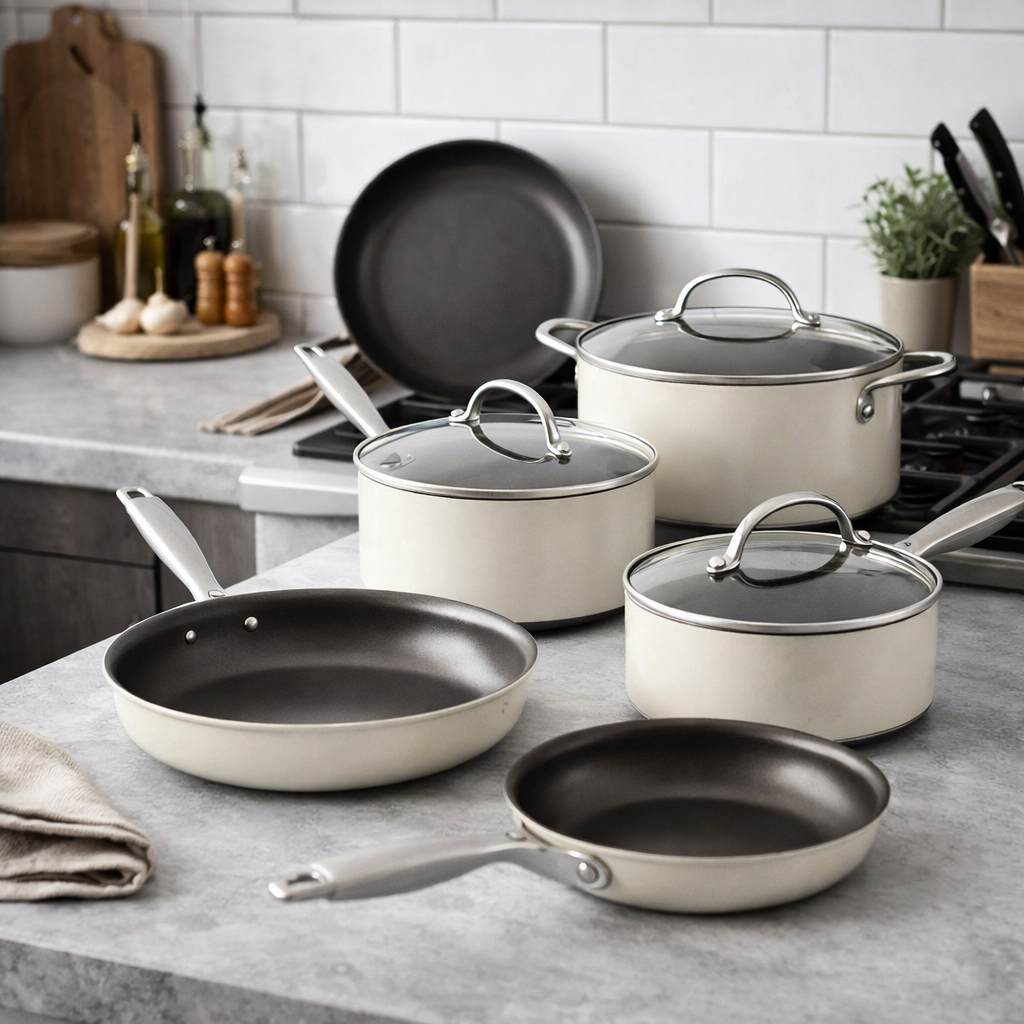
I’ve been cooking with these pans for three years—including models from lines I honestly didn’t expect to like—and I’m going to tell you how it really went. I’ll cover both the pros and cons, including the warranty situation, which nobody is honestly talking about right now.
First, the short version: Advanced Home for nonstick pans, Tri-Ply Clad for stainless steel, Anolon X if you really want to sear something. Achieve—a complete waste of money. Nouvelle Copper—nice, but a bit overpriced. Everything else falls somewhere between “okay” and “really good.” You’ll find a complete list of Anolon’s pros and cons by product line below.
Now for the detailed version.
🍳 ANOLON Complete Database 2026
Every Collection, Every Model, Every Spec — Official USA Market Data
15
Collections
80+
Models
40+
Years
1000°F
Max Temp
∞
Warranty
USA
Market
⚖️
Collection
Type
Core Construction
Cooking Surface
Layers
Oven Safe
Induction
Dishwasher
Metal Utensil
Handles
Lids
Available Pieces
Colors
Warranty
MSRP Range
Best For
⚖️
Select Collections to Compare
Go back to the "Full Specs" view and check the boxes next to up to 4 collections, then tap "Compare Now"
0 selected
Collection Details
Quick Answer: Is Anolon Cookware Good?
Good enough that I use it myself. Good enough that when people ask me what they should buy for their first kitchen, I usually recommend “Advanced Home.”
But I’d be lying if I claimed there weren’t any issues. The complaints about peeling coatings on Trustpilot since late 2024—several reviewers who appear to have no connection to one another, all describing chipping despite careful use—I can’t just brush that off. Whether it’s a bad production batch or a systemic problem, I don’t know. What I do know is that this pattern exists.
And Meyer Corporation’s customer service. Goodness gracious. Several people have submitted five separate warranty claims and received no response. One reviewer described sending the same email five times to get someone to respond to a defective pan. This is documented, this is current, and you should factor it into your decision.
The pros and cons of Anolon cookware don’t cancel each other out—they coexist. The cooking performance is genuine. The durability is above average for the price. The warranty service is currently a mess. You decide what that’s worth to you.
In any case, I still cook with these pans. The reviews of Anolon nonstick cookware that completely dismiss the brand are over the top. The reviews of Anolon stainless steel cookware that ignore the Tri-Ply model overlook one of the best options currently available in the mid-range price segment.
How I Actually Tested These
Three years. Seven collections. No sponsored reviews—just the items I actually own and use for cooking.
My main test for nonstick performance is child’s play: a fried egg, medium to low heat, no butter. Just the coating. Either it comes off or it doesn’t, and you can’t fake that. I did this every morning for six weeks at the start with different series, then at regular intervals to monitor wear and tear.
For the heat tests, I used chicken thighs with skin. I seared them over medium to high heat and waited until the fat had rendered. This is where you see whether a pan actually reaches high temperatures or just pretends to. The difference between what Anolon X does to the chicken skin and what Advanced Home does—is not subtle.
I checked weekly to see if the handles were loose. I ran 20 dishwasher cycles with pans labeled as “dishwasher-safe.” I specifically prepared braised tomatoes and lemon-butter pan sauces in the stainless steel pans to test reactivity and the formation of pan residue. I documented the condition of the coating after 6, 12, 18, and 24 months.
I then compared everything with real user complaints on Trustpilot, Reddit’s r/cookware, and in Slickdeals threads. My kitchen is one data point. Yours are hundreds.
Anolon as a Brand
The Meyer Corporation owns Anolon. It also manufactures Circulon and Farberware, which is significant in that it explains why Anolon and Circulon are so similar in design—they come from the same manufacturing infrastructure.
The brand was founded in 1986. Hard-anodized nonstick material was the founding technology and remains the backbone of every nonstick product line. Anodization is an electrochemical process in which the aluminum surface is transformed into a much harder layer of aluminum oxide—in fact, harder than stainless steel. This is why hard-anodized pans outperform stamped aluminum in terms of durability, and why the Achieve line (which omits the anodization process) represents a completely different category.
Manufacturing takes place in China and Thailand. Just like with Calphalon, just like with most Ninja products, just like with many other well-known brands. The build quality from Meyer’s partner factories is significantly better than that of random Amazon imports—more even coating, better riveting. Not All-Clad. But not junk either.
I’ve already addressed the customer service situation. Things to know before buying: Keep your receipts, take photos of the pan upon receipt, and if you have a warranty issue, contact customer service through multiple channels and be prepared to be persistent..
All Anolon Collections at a Glance
Collection
Construction
Coating
Induction
Oven Max
Price
Verdict
Anolon X
Hard-anodized Al + SS mesh
Hybrid PTFE/SS
No
500°F
$$$
Best searing nonstick
Advanced Home
Hard-anodized Al
3-layer PTFE + sapphire
No
400°F
$$
Best everyday value
Advanced
Hard-anodized Al
3-layer PTFE
No
400°F
$$
Older — skip for Advanced Home
Accolade
Forged aluminum
Moonslide™ PTFE
Yes (select)
450–500°F
$$$
Premium nonstick
Achieve
Stamped aluminum
Basic 2-layer PTFE
No
400°F
$
Skip it
Ascend
Hard-anodized Al
PTFE
No
400°F
$$
Only on deep sale
Nouvelle Copper
Hard-anodized + copper base
PTFE
No
400°F
$$$
Beautiful, slightly overpriced
Tri-Ply Clad
Fully-clad SS/Al/SS
None — SS surface
Yes
500°F
$$
Best stainless value
Accolade Stainless
Fully-clad SS/Al/SS
None — SS surface
Yes
500°F
$$$
Premium stainless
Authority
Hard-anodized Al
PTFE
No
400°F
$$
Discontinued, skip
One issue that causes problems for many people: the Accolade nonstick cookware line. Some models—including the 10-piece set at Costco—are listed as induction-compatible (“Compatible with all cooktop types, including induction”). Not all Accolade products are the same. If induction compatibility is important to you, check the specific product page before purchasing.
Anolon X Review
Three years ago, I would have dismissed this as a HexClad knockoff. I was wrong.
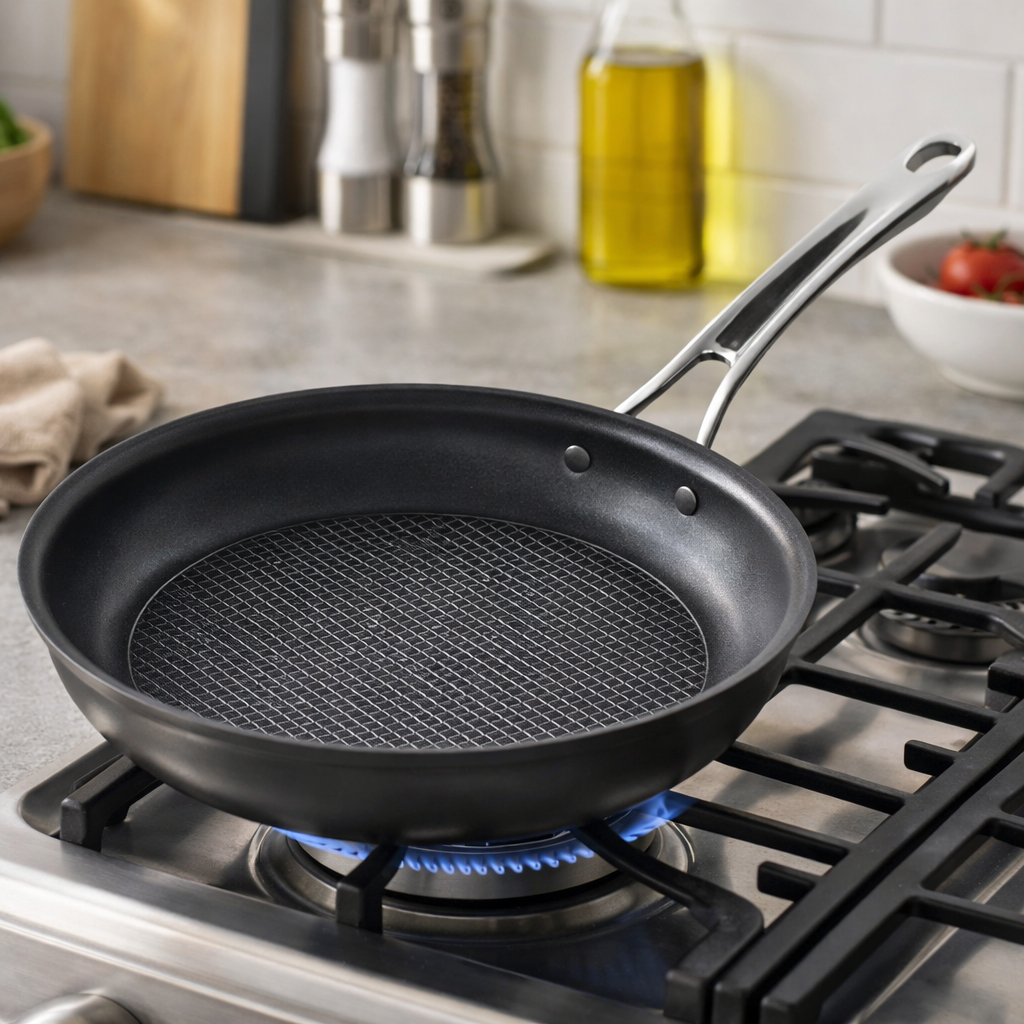
The construction consists of: a hard-anodized aluminum base, a stainless steel grid on the cooking surface, and a PTFE nonstick coating that sits in the recessed grooves between the raised steel ribs. The hot stainless steel comes into contact with the food during searing. The non-stick grooves provide the non-stick effect. The technology is genuine.
What Prudent Reviews found in their direct comparison tests—and this aligns with my experience—is that the Anolon X grid is flatter than HexClad’s laser-etched hexagonal pattern. The PTFE grooves are more exposed. This means a higher risk of scratching from metal utensils. Both are marketed as “safe for metal utensils.” Certainly on the stainless steel ribs of the grid. But not really in the non-stick grooves, at least not over time.
When it comes to chicken skin, Anolon X makes up for its price. In any ordinary nonstick pan—regardless of the brand—chicken skin doesn’t brown properly or become crispy. The coating prevents surface temperatures from reaching the point where the Maillard reaction occurs. You end up with pale, soft skin. Every single time.
With the Anolon X: golden brown. Melted fat. True color. The stainless steel ridges get hot enough. I fried the same bone-in chicken thighs side by side—Advanced Home vs. Anolon X—and the skin on the Advanced Home was gray and soft. The skin on the X actually turned out well.
Steak, same story. Not as good as cast iron. Better than any standard nonstick pan. Cleaning is significantly easier than with plain stainless steel—the nonstick grooves catch most of the residue. Warm sponge, 30 seconds, almost done.
The issues: no induction, period. After about six months of regular use, carbon residue builds up in the grooves, which must be removed weekly with a soft brush. Eggs turn out well, but not effortlessly—there’s a slight friction from the grooved pattern that you don’t get with a pure non-stick coating. For omelets and delicate scrambled eggs, I still reach for a special non-stick pan.
Pros:
Hybrid searing actually works — real browning, not pale nonstick results
More PTFE exposed than HexClad — higher long-term scratch risk
Grid needs deliberate cleaning routine
Not ideal for delicate egg work
Anolon X vs HexClad:
Anolon X
HexClad
Base construction
Hard-anodized aluminum
Fully-clad tri-ply stainless
Grid type
Flat steel mesh, more PTFE exposed
Laser-etched hexagons, deeper channels
Induction
No
Yes
Oven safe
500°F
500°F
Scratch risk from metal
Higher
Lower
Heat-up speed
Faster
Slightly slower
12″ skillet price
~$80–100
~$130–160
Pick this if…
No induction, budget matters
Induction, max durability
Anolon Advanced Home Review
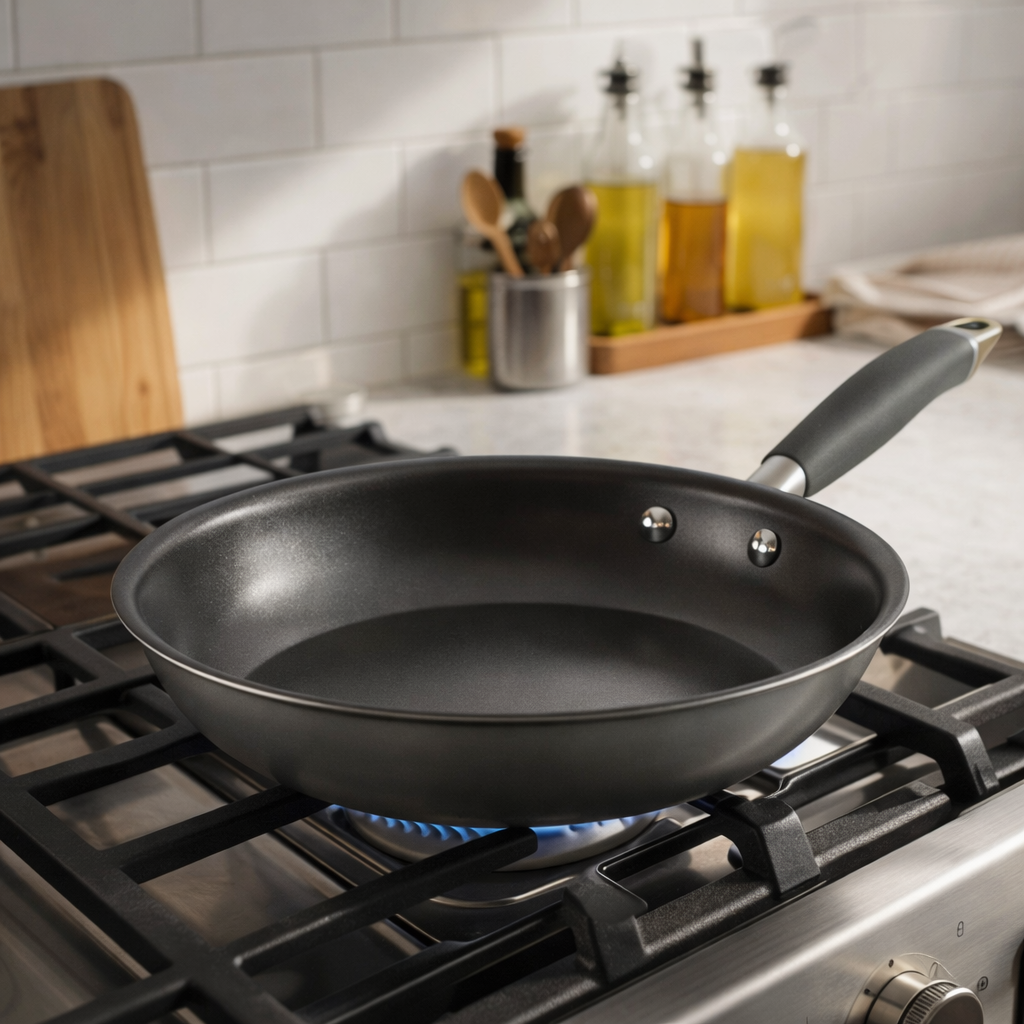
This is the model I recommend. And I’ve been recommending it for three years now.
Hard-anodized aluminum, three layers of sapphire-reinforced PTFE, double-riveted stainless steel handles. The sapphire reinforcement is a real improvement over the older Advanced series—it makes the coating more scratch-resistant. The measurement markings inside the pots are small, but I use them more often than I would have expected.
I’ve been frying eggs in it every day for six weeks without anything sticking. After 22 months, the eggs still slide cleanly out of the pan with a thin film of butter. The four-year-old Advanced Home pans I tested are still working. That’s above-average PTFE durability for this price range, and I’ve tested many pans in this price range.
The aluminum construction is just as important as the coating. Hard-anodized aluminum conducts heat quickly and distributes it evenly without hot spots. Three pancakes in a 12-inch pan brown evenly. No burnt spots in the middle, no pale edges. This is what even heat distribution looks like in practice.
The 8-inch skillet is my actual daily egg pan. Two years. Under $60. I haven’t found anything in this price range I’d rather use.
The honest part:
After 18 to 24 months of daily cooking, the center of the surface will start to look dull. Performance doesn’t drop off suddenly—it gradually declines over the course of several months. It will still work in the third year. By the fifth year, it’s time to replace it. That’s just how PTFE works, and there isn’t a single version of this pan where that isn’t the case.
The silicone handle has a seam where it meets the metal body. Grease accumulates there. This isn’t dangerous, just annoying. Clean it thoroughly every now and then.
Most complaints about food sticking can be traced back to three things: dishwasher cycles, metal spatulas, or cooking at more than medium to high heat. This pattern runs through every forum thread and review site I’ve read. If you do all three of these things, this pan will become unusable in less than a year, no matter what the packaging says.
Pros:
Excellent nonstick performance, sustained with proper care
Zero hot spots — genuinely even heat
Sapphire coating upgrade over older Advanced
Complete 10-piece sets for $150–200 on sale
Comfortable, balanced handle
Cons:
No induction
Handle seam collects grease
400°F oven cap
Consumable — plan for replacement around year five
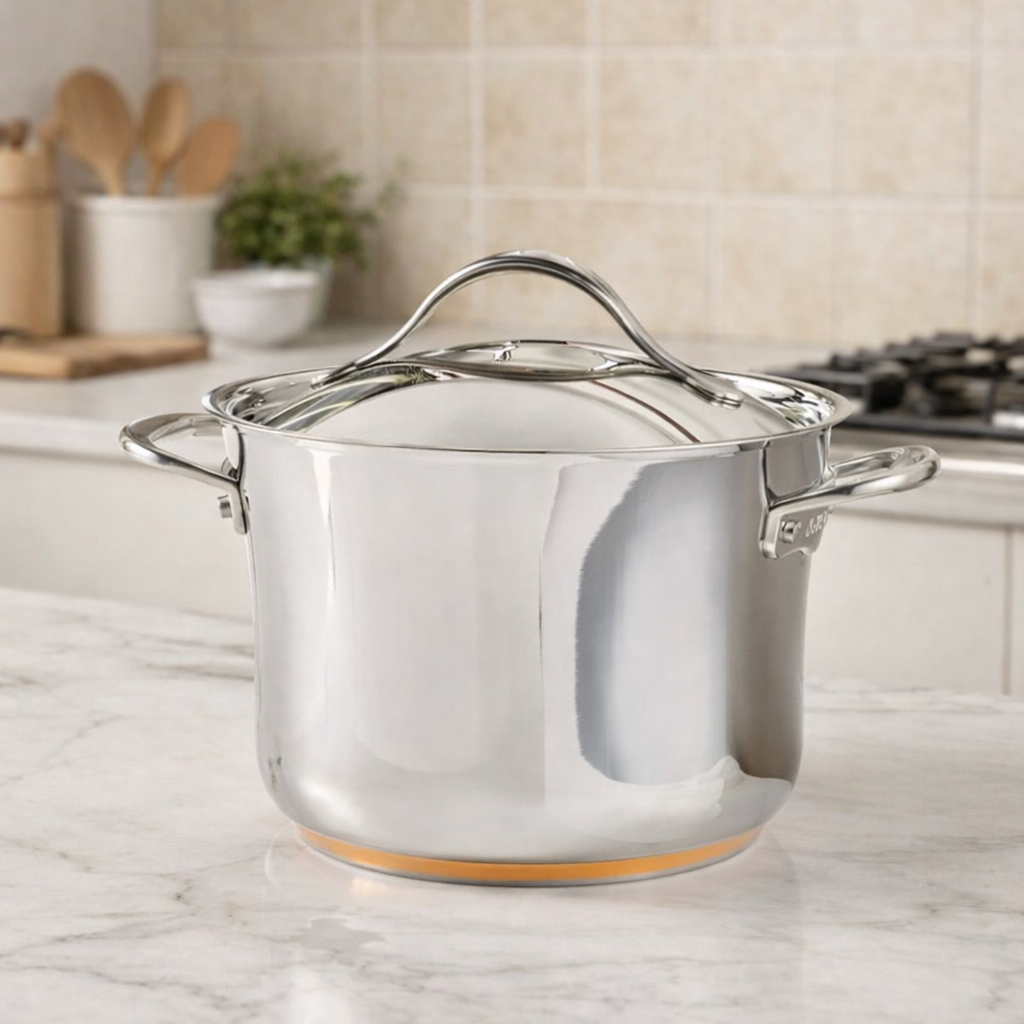
Anolon Nouvelle Copper Review
It’s more beautiful than it needs to be. I’ll admit that right away.
Copper conducts heat about five times faster than aluminum. The practical benefit of this pan: it heats up faster and responds more quickly when adjusting the heat. If you turn the heat down, the pan cools off faster. If you turn it up, it reaches the desired temperature faster. For a beurre blanc or a wine reduction—anything where precise temperature control is important—this responsiveness is truly useful.
For scrambled eggs on a weekday? Functionally, there’s no visible difference from the Advanced Home model.
The PTFE cooking surface is in the same category as the “Advanced Home” model. Nonstick performance, coating durability, cleaning—essentially identical. The copper provides better thermal responsiveness at the base, not better non-stick performance.
The copper exterior scratches easily. Scratches will form if stored without a pan protector. If aesthetics matter—and for some people they really do; these pans look beautiful on a shelf—you should keep in mind that they will show signs of use.
Pros:
Faster thermal response — real advantage for sauce work
Gorgeous copper base if aesthetics matter
Even heat at the base
Cons:
Copper band scratches easily
Price premium not fully justified by cooking performance alone
Same 400°F oven limit as Advanced Home
No induction
Buy it if precision sauce work is a regular thing in your kitchen, or if you’ll display these and care how they look. Otherwise, Advanced Home does 95% of the same job for less money.
Anolon Tri-Ply Stainless Steel Review
Fully clad three-layer design: stainless steel exterior, aluminum core, stainless steel cooking surface, seamlessly connected from bottom to rim. “Fully clad” isn’t just a marketing term—it means that heat rises along the sides of the pan and isn’t just distributed across the bottom. When braising, if liquid touches the sides, that’s where the heat is needed. Cheap stainless steel cookware with a flat bottom only heats the bottom, leaving cold spots on the sides.
I prepared the same recipe side-by-side using All-Clad D3. Searing chicken thighs, then braising them in wine and broth. All-Clad provided slightly more even browning at the very edge of the pan—perhaps 10% of the surface. The braising result was identical. Blind taste test. I couldn’t tell them apart.
The fond formation is excellent. Those caramelized protein deposits that stick to the stainless steel and dissolve into a pan sauce—the Tri-Ply ensures they form properly. That’s the difference in cooking technique between home cooking and restaurant food that most people don’t realize comes down to the pan. Stainless steel forms a fond. Nonstick coating does not. The sauce you get from a properly seasoned stainless steel pan is fundamentally different.
Pros:
Fully-clad — real heat up the walls
Induction compatible
500°F oven safe
Excellent fond development for pan sauces
Competes with All-Clad D3 at roughly half the per-piece price
Doesn’t wear out
Cons:
Requires preheat technique — 2–3 minutes at medium before food goes in
Sticks without proper technique. Learning curve, not a defect
Heavier than nonstick
All-Clad’s distribution marginally better at the outer rim edges
Anolon Accolade Review
The premium nonstick, and the one that actually fixes the legitimate complaints about Advanced Home.
Forged aluminum—pressed from a single piece, not stamped from sheet metal. Heavier, more dimensionally stable, and more resistant to deformation under thermal stress. The Moonslide™ coating feels noticeably better than conventional PTFE right out of the box. The first eggs in a new Accolade pan: The nonstick performance is different. Not dramatic, but distinct—less resistance, smoother glide, the kind of difference you notice and then forget because it just works.
The forged construction makes a bigger difference in the long run than on day one. Hard-anodized, stamped aluminum (the kind used by Advanced Home) is solid. Forged aluminum is more solid. After two years of daily use, the Accolade pans in the test showed no deformation whatsoever. Advanced Home also showed no deformation—but the Accolade’s dimensional stability under high heat is truly better.
The situation with induction cooktops is really confusing, and it’s worth doing some research. The 10-piece Accolade set at Costco is listed as induction-compatible (“Compatible with all cooktops, including induction”). On Anolon.com, some Accolade configurations are also listed as induction-compatible. However, not all Accolade items have the magnetic base layer—this is not the case for some models made of forged aluminum. If you want to buy the set for its induction compatibility, check the specific product page before purchasing.
Depending on the item number, oven-safe up to 450–500 °F—a significantly higher upper limit than the 400 °F for Advanced Home, which is important if you want to finish cooking dishes at higher oven temperatures.
Is the upgrade from Advanced Home worth it? For casual cooks: probably not, as the price difference is significant. For someone who cooks daily and wants the best nonstick product from Anolon—the Moonslide coating lasts significantly longer with regular use, and the forged construction is more durable. Those who cook daily will notice the difference after two or three years.
Forged aluminum — superior warp resistance vs stamped Advanced Home
Induction compatible on select configurations (verify SKU)
Higher oven temp ceiling (450–500°F)
More refined handle design
Cons:
Significant price premium over Advanced Home
Induction compatibility varies by SKU — must verify before buying
Coating still degrades with abuse — Moonslide isn’t indestructible
Less widely available than Advanced Home
Anolon Achieve Review
Short review because there isn’t much to say.
Extruded aluminum, not hard-anodized. Two-layer PTFE base coating. Some models have plastic handles. A commenter on Slickdeals summed it up perfectly: “The lifespan is usually less than two years.” That matches my experience exactly.
The coating works well when new—food comes off easily, and heat distributes evenly. After ten or eleven months of daily use, the center of the cooking surface shows visible signs of wear. By the fourteenth month, you’re adding extra butter and oil to compensate. By the eighteenth month, food sticks. The wear curve is steeper than with any other Anolon series, and it’s impossible to miss when it happens.
The plastic handles on some Achieve models can come loose before the coating even fails. Cheaper series use less material and shorter shafts for the rivets—they hold at first, then they wobble.
Pros:
Cheap entry point
Works fine when new
Acceptable for occasional or temporary use
Cons:
Coating degrades noticeably earlier than any other Anolon line
Plastic handles on some pieces prone to loosening
Often priced only $15–20 less than Advanced Home — savings disappear in under a year
If Advanced Home is even $20 more, buy Advanced Home. One Advanced Home pan outlasts two Achieve pans in daily use. The math isn’t close.
Anolon Ascend Review
Exists to fill a price gap between Achieve and Advanced Home. Suffers for it.
Hard-anodized construction—a real improvement over Achieve’s stamped aluminum. The quality of the PTFE coating falls somewhere between Achieve’s basic formulation and Advanced Home’s sapphire-reinforced version. Cooks well. Even heat distribution across the entire surface. The handle fits comfortably in the hand and is securely riveted.
Coating durability in testing: better than Achieve, but still falls short of Advanced Home in comparable price ranges. After 14–16 months of daily use, I noticed signs of wear in the center of the Ascend pans, while the Advanced Home pans were still functioning perfectly.
The real issue is the price positioning. Ascend and Advanced Home are often only $10–$20 apart—sometimes even closer. With this price difference, there’s no logical argument for choosing Ascend. The difference in the coating between the two products becomes more pronounced over time. Ultimately, you’ll have to replace the Ascend sooner and end up spending more overall.
Pros:
Hard-anodized construction — more durable than Achieve
Decent everyday nonstick performance
Even heat across cooking surface
Comfortable, well-riveted handle
Cons:
Rarely meaningfully cheaper than Advanced Home
Coating durability falls short of Advanced Home at similar prices
No practical reason to choose over Advanced Home unless on deep clearance
Buy it only when it’s genuinely significantly cheaper than Advanced Home — $30+ difference on a comparable piece. Otherwise spend the extra and get Advanced Home.
Anolon Authority Review
Phased out. Hard-anodized aluminum, PTFE — the template that became Advanced Home, before the sapphire coating update.
If you find it at deep clearance pricing with intact coating, it cooks fine. No reason to seek it out.
Pros:
Hard-anodized base holds up
Adequate nonstick if coating is intact
Clearance finds occasionally worthwhile
Cons:
Phased out — no current catalog support
Predates Advanced Home improvements
No advantage over current lines at equal prices
Best Anolon Cookware By Category
Category
Pick
Runner-Up
Why
Best Overall
Advanced Home
Anolon X
Complete, reliable, 4–5yr coating
Best Nonstick
Accolade
Advanced Home
Moonslide + forged body
Best Stainless
Tri-Ply Clad
Accolade Stainless
Fully-clad, induction, fond
Best for Induction
Tri-Ply Clad
Accolade (verify SKU)
Only reliable induction lines
Best Budget
Advanced Home
Ascend (sale only)
Achieve not worth the “savings”
Best Premium Nonstick
Accolade
Nouvelle Copper
Moonslide vs copper thermal edge
Best for Beginners
Advanced Home 10-pc
—
Complete kitchen, proven
Best for Serious Cooks
Anolon X + Tri-Ply combo
Accolade + Tri-Ply
Full spectrum without All-Clad price
Best for Searing
Anolon X
Tri-Ply Clad
Hybrid grid enables real browning
Best for Sauces
Tri-Ply Clad
Nouvelle Copper
Fond + thermal precision
Real Cooking Tests
Heat Distribution
Hard-anodized aluminum distributes heat quickly and evenly. Over medium heat, the temperature variation across a 12-inch pan from the “Advanced Home” series is less than 15 °F across the entire cooking surface. That’s why pancakes turn out so well—they brown evenly from edge to edge without having to rotate the pan.
The three-layer composite construction also conducts heat to the side walls, which isn’t the case with flat-bottomed pans. This is important for braising. All-Clad D3 is slightly more even at the very edge. You won’t notice this in everyday home cooking.
Anolon X has an interesting heat profile: The aluminum base heats up faster than HexClad’s three-layer stainless steel. The stainless steel ribs on the cooking surface get hotter than the PTFE channels. It is precisely this temperature difference that causes the browning.
Heat Retention
Aluminum conducts heat quickly—that’s the trade-off for its speed. If you place a cold chicken breast in an Advanced Home pan, the sizzling sound becomes noticeably quieter. This is exactly why overfilling nonstick pans prevents browning. Putting too much cold food in at once causes the pan’s temperature to drop, so the proteins start to steam instead.
Tri-Ply Clad retains heat better. The stainless steel layers provide more thermal mass. If you place a cold steak in it, the drop in temperature is less pronounced. The pan returns to frying temperature more quickly. This is a mechanical reason why stainless steel is better suited for high-temperature cooking than non-stick aluminum.
Food Release
Advanced Home after 6 months: Eggs, fish, crêpes—nothing sticks with proper care. Thanks to the sapphire reinforcement, this pan lasts longer than the older Advanced series.
Anolon X: Good nonstick performance, but not flawless. The grid allows food to come into contact with the stainless steel ribs. Good for chicken and vegetables, but requires a bit more effort with delicate foods.
Tri-Ply Clad: technique-dependent. Water droplets should bead up and slide off the surface before adding food. If you skip this step, everything will stick. If done correctly, even eggs can be removed cleanly.
Ease of Cleaning
Advanced Home: warm water, sponge, done. Most meals clean in under a minute. Avoid abrasive pads.
Anolon X: 80% easy, 20% requires a soft brush in the grid channels. More maintenance than pure nonstick, less than pure stainless.
Tri-Ply Clad: requires more deliberate work. Fond and browned bits need a soak or deglazing. Barkeeper’s Friend handles discoloration. Not hard — just different habits than nonstick.
Eggs
Advanced Home, medium-low, thin film of butter. No sticking at month one, month twelve, month twenty-two. Seen four-year-old Advanced Home pans still releasing cleanly with proper care.
Anolon X: releases fine, but the grid texture creates slight friction. Not a problem, just different from pure nonstick. For omelets, I still reach for the dedicated nonstick.
Tri-Ply Clad: preheat on medium two minutes, butter in, let it shimmer, then eggs. Without that sequence, you’re scraping. With it, clean every time.
Pancakes
Advanced Home wins this. Even heat means uniform browning across the whole surface — no burnt center, no pale edges. Three pancakes in the 12-inch, all identical.
Chicken
Standard nonstick — any PTFE pan — cannot properly render chicken skin. The coating prevents reaching Maillard browning temperatures. Pale gray skin every time.
Anolon X changes this. Stainless ridges get to real searing temps. Same thighs side by side: Advanced Home skin was gray. Anolon X skin was golden-brown and rendered. The difference was not subtle.
Tri-Ply Clad is the best Anolon option for chicken. Full stainless contact, heat up the sides, restaurant-quality browning. The fond left in the pan becomes a sauce.
Steak
Same logic. Nonstick is wrong for steak. Anolon X is better than any standard nonstick, not as good as cast iron. Tri-Ply Clad with proper preheat produces genuinely good crust.
Sauces
Nonstick for cream sauces, butter sauces, anything low-heat. Easy, no sticking, fast cleanup.
Tri-Ply Clad for pan sauces. Proteins leave deposits on stainless during searing. Add wine, stock, butter — those deposits dissolve into the sauce. Flavor depth nonstick cooking can’t replicate. Deeper. More complex. Professional kitchens don’t use PTFE for a reason.
Boiling Pasta
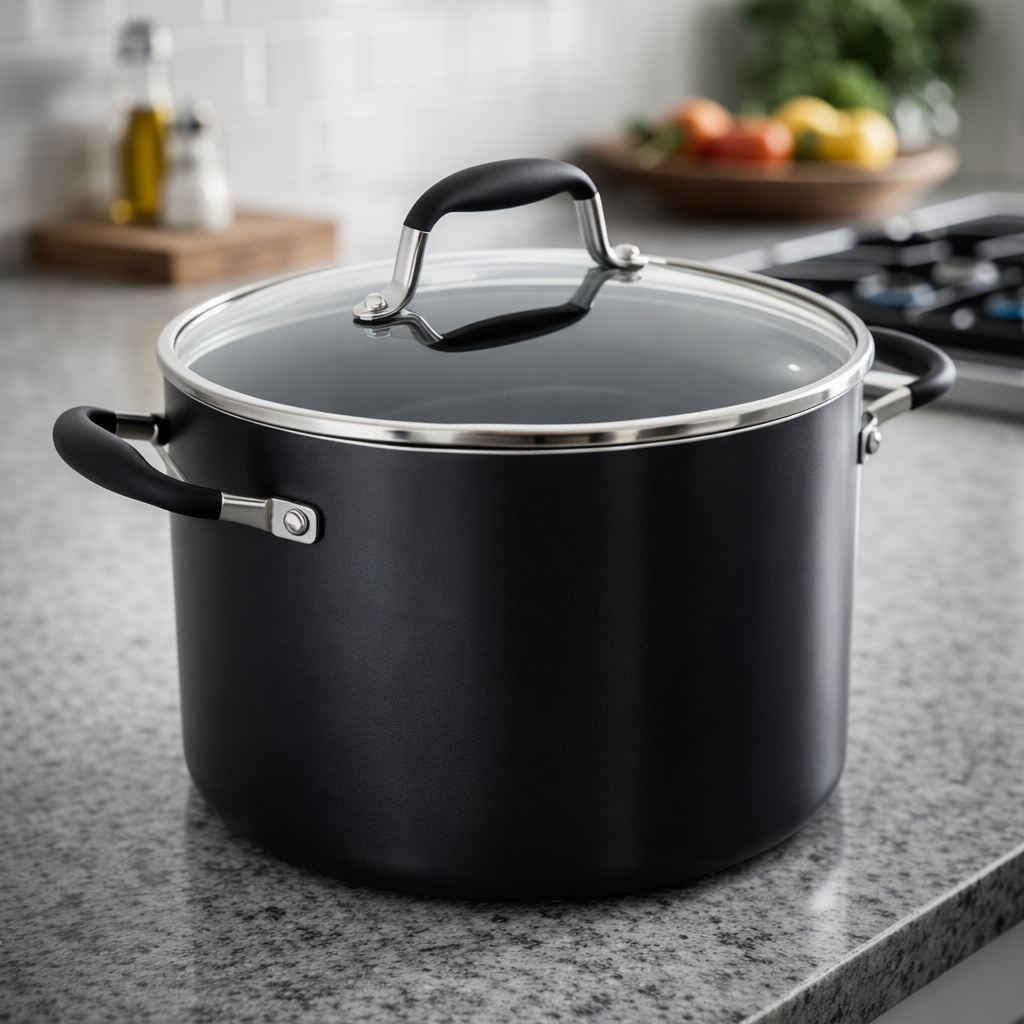
Anolon stock pots heat water efficiently. No meaningful difference from other mid-range pots at this task. The 8-quart in the Advanced Home set handles a pound of pasta without drama. Nonstick interior means the starchy water wipes clean.
Daily Cooking
The real test of durability. Not just a single Sunday meal—but dinner every night, for two years.
Advanced Home handles daily cooking with ease. Eggs on Monday, vegetables on Tuesday, gravy on Wednesday. With proper care, it delivers consistent performance month after month. Nothing exciting happens. The pan just works until it eventually stops working—which happens around the fourth or fifth year.
Anolon X in daily use requires this weekly cleaning of the grate. Once it becomes a habit, it’s no longer a burden. The reward is a pan that’s suitable for both weekday eggs and weekend stir-fries, without having to switch pans.
Durability
Coating Lifespan
With proper care — hand washing, silicone utensils, medium heat — Advanced Home: 3–5 years of good performance. Accolade Moonslide: 5–7 years. Without proper care — dishwasher, metal spatulas, high heat — any PTFE pan degrades inside 12 months. That’s physics, not an Anolon problem.
The Chipping Issue
Real and documented. Multiple unrelated Trustpilot reviews from 2024–2025 describe visible chipping — actual pieces coming off, not just dulling — despite silicone-only utensils and hand washing. One: “The top edges have started to chip in several places.” Another: “Multiple chips of the coating. One pan was used for blackening one time at medium heat and permanently stained.”
The pattern across independent reviewers suggests a quality control issue in certain production batches. PTFE doesn’t normally chip under careful use. If your pan chips, file a warranty claim immediately and document everything.
Scratch Resistance
Hard-anodized base is genuinely hard. The PTFE coating on top is not. Metal utensils shorten it on every line regardless of “metal utensil safe” marketing. Use silicone. The coating lasts significantly longer.
Warping
None across three years of testing hard-anodized lines. The gauge handles thermal stress that warps cheap thin pans.
Handles
Dual-riveted handles on Advanced Home, Accolade, and X — zero loosening at two years. Silicone grip holds without peeling.
Achieve’s plastic handles on some pieces can loosen before the coating even fails.
Stainless Lifespan
Indefinite. Tri-Ply Clad doesn’t wear out under normal use. This changes the long-term value math completely.
Safety
PTFE and PFOA
All current Anolon is PFOA-free. PFOA was phased out of manufacturing globally by 2013. Not in any current product.
Some buyers saw PFAS disclosure labels on Anolon products in California and Colorado and got concerned. Context: those states require disclosure of fluoropolymers — which includes PTFE — because of how they classify PFAS compounds. The disclosure is about regulatory transparency, not a health warning. PTFE at normal cooking temperatures is considered safe by the FDA and health agencies worldwide.
Don’t preheat an empty nonstick pan on high heat and leave it. At 570°F+ PTFE starts to degrade. Under normal cooking this never happens.
Metal Utensil Claims — What’s Real
Anolon markets Anolon X and Accolade as metal-utensil safe. The stainless grid ridges on Anolon X handle metal tools fine — the steel takes it. The recessed PTFE channels don’t, not long-term. Accolade’s Moonslide is more durable than standard PTFE but still degrades faster with metal contact.
The marketing is technically defensible — the hard-anodized pan body handles metal. The nonstick coating above it doesn’t. Use silicone on any PTFE surface, full stop.
Oven Safety
Collection
Oven Max
Handle
Anolon X
500°F
Metal + silicone grip
Advanced Home
400°F
Metal + silicone grip
Accolade
450–500°F (check SKU)
Metal + silicone
Nouvelle Copper
400°F
Metal + silicone
Tri-Ply Clad
500°F
All-metal
Accolade Stainless
500°F
All-metal
Achieve
400°F
Plastic — verify before using
Common Anolon Complaints
“Pan started sticking at six months”
In the majority of documented cases: dishwasher damage, metal utensils, or high heat. The pattern across forums and Trustpilot is consistent enough to trust it.
Not always user error though. A pan failing at six months under genuinely careful use is a defect. File a warranty claim, document everything, and be persistent because the response may be slow.
“Coating chipped”
Real and documented as noted above. If it’s chipping, not just dulling — file warranty immediately. Don’t accept “normal wear” as the explanation for actual chips.
“Customer service won’t respond”
Consistent and documented in 2024–2025. Multiple verified reviews describe warranty requests going unanswered for weeks. One user sent five separate requests. If you need warranty service, use multiple contact channels (email, phone, social media), document every attempt, and be prepared for a slow process.
“Not induction compatible”
True for most lines. Hard-anodized aluminum isn’t magnetic. Clearly labeled on packaging, but people miss it. Only Tri-Ply Clad and select Accolade configurations work on induction.
Weight
12-inch Advanced Home skillet: roughly 3.5 lbs. Not cast iron, not light. For most cooks, fine. For anyone with wrist or grip issues, worth handling before buying.
Functionally the same category. Same materials, same price tier, same construction approach. Anolon nonstick coating performs slightly better long-term in testing. Calphalon Premier stainless has a marginal edge. In daily cooking the gap is negligible. Buy whichever is on sale — they’re genuinely that close.
Both Meyer brands. Circulon’s groove pattern on the cooking surface protects nonstick in the grooves — similar philosophy to Anolon X’s grid but in traditional nonstick format. Circulon’s coating resists scratching slightly longer in direct tests. Anolon has better overall heat distribution and a more complete lineup including stainless.
Anolon vs HexClad
HexClad is better-built: tri-ply stainless base, induction across all lines, deeper grid that protects PTFE channels better. Long-term durability edge is real. Price premium of 40–60% per piece is also real.
Non-induction kitchen on a budget: Anolon X. Induction or maximum longevity: HexClad.
Different coatings entirely. GreenPan uses ceramic (Thermolon) — zero PTFE. Ceramic degrades faster: 1–2 years of good performance versus 3–5 for Advanced Home. If PTFE-free is a hard requirement, GreenPan. If longer nonstick life matters more, Anolon.
Ninja’s Foodi NeverStick line uses hard-anodized aluminum at aggressive prices. Some Ninja lines include induction-compatible nonstick — something Anolon hard-anodized can’t offer. If you need nonstick on induction without paying HexClad prices, Ninja is worth looking at. At equal prices on non-induction cooking, Anolon Advanced Home has better coating durability in my testing.
Anolon vs All-Clad
Different tier, different purpose. All-Clad D3 is better than anything Anolon makes — thicker core, heavier gauge, made in Pennsylvania, built for decades. For a serious daily cook building a forever kitchen, All-Clad is the right call.
Anolon Tri-Ply Clad delivers roughly 90% of All-Clad D3’s results at about 50% of the per-piece cost. For a home cook building a decent stainless setup without a $1,200 outlay, Anolon Tri-Ply is the smart move.
Price vs Value
Advanced Home 10-piece, $150–200 on sale: Complete nonstick kitchen. 4–5 year coating lifespan with care. Cost-per-year: $35–45 for everything. Hard to beat.
Anolon X pieces, $80–120 each: Buy as targeted additions, not a full set. One 12-inch X skillet plus Advanced Home for everything else is smarter than an all-X setup.
Tri-Ply Clad set, $220–300: Best cost-per-year in the lineup because the pans don’t wear out.
Cost-Per-Year Breakdown
Collection
Price
Lifespan
Annual Cost
Anolon Achieve 10-pc
$80–120
1.5–2 yrs
$50–75/yr
Anolon Advanced Home 10-pc
$150–200
4–5 yrs
$35–45/yr
Anolon Accolade 10-pc
$250–350
5–7 yrs
$40–55/yr
Anolon Tri-Ply Clad 10-pc
$220–300
15+ yrs
$15–20/yr
Anolon X 12″ skillet
$80–100
5–8 yrs
$12–20/yr
Achieve costs more per year than Advanced Home. The math doesn’t work.
Who Should Buy Anolon
Beginners: Advanced Home 10-piece set. Everything you need, works well immediately, lasts long enough to figure out what you actually cook.
Families cooking daily: Advanced Home for nonstick. Add a Tri-Ply Clad skillet and sauté pan for chicken, searing, and pan sauces.
Cooking enthusiasts: Anolon X plus Tri-Ply Clad. The hybrid surface changes how chicken and steak come out. The stainless teaches you proper pan sauce technique. This is the setup for someone who cooks deliberately and wants real results without All-Clad prices.
Serious home cooks: Same X plus Tri-Ply combination — covers the full range of technique except what you’d need cast iron or carbon steel for anyway.
Health-conscious: All current Anolon is PFOA-free. PTFE is safe at normal cooking temps per FDA guidance. Zero-PTFE requirement: GreenPan or Caraway.
Induction users: Tri-Ply Clad for stainless. Select Accolade configurations for nonstick — verify the SKU. Don’t buy hard-anodized Anolon if you’re on induction without confirming compatibility.
Budget-constrained: Achieve only if the constraint is absolute. Stretch to Advanced Home if at all possible.
Who Should Skip Anolon
Induction users who want nonstick specifically: Most Anolon nonstick doesn’t work on induction. HexClad, Ninja Foodi NeverStick, and All-Clad HA1 are cleaner options.
PTFE-free cooks: GreenPan, Caraway, Our Place. Anolon makes nothing without PTFE.
“Buy it once” types: Nonstick is a consumable. Always. If you want cookware that outlasts you, invest in All-Clad stainless.
Anyone who washes everything in the dishwasher: Anolon nonstick will degrade faster than expected. Consider stainless or ceramic-coated pans instead.
Anyone who’s recently had a bad warranty experience: The customer service issues are documented and real. Factor that in.
FAQ
Is Anolon cookware worth it? For most cooks, yes. Advanced Home and Tri-Ply Clad deliver genuine performance at honest prices. Know the limitations — nonstick degrades, customer service is currently a problem — and the value holds.
What do anolon cookware consumer reports and independent reviews say? Consistent finding across independent anolon cookware sets reviews and user data: solid mid-market nonstick, above-average durability with proper care, below-average customer service responsiveness in 2024–2025. Sticking complaints usually trace to user behavior. The chipping reports in 2024–2025 look like a QC inconsistency worth watching.
How long does Anolon cookware last? Advanced Home: 3–5 years with proper care. Accolade Moonslide: 5–7 years. Stainless: indefinitely.
Is Anolon made in the USA? No. China and Thailand. Standard for the mid-market segment.
Is Anolon safe? Yes. PFOA-free across all current lines. PTFE safe at normal cooking temperatures per FDA.
Can Anolon go in the oven? Yes, with limits by line. Advanced Home: 400°F. Accolade: 450–500°F varies. Anolon X and Tri-Ply: 500°F.
Is Anolon better than Calphalon? Essentially equivalent. Anolon nonstick slightly edges Calphalon in durability. Buy whichever is cheaper.
What’s the best Anolon cookware line? Nonstick: Advanced Home for value, Accolade for premium. Stainless: Tri-Ply Clad. Best single pan: Anolon X 12-inch for non-induction kitchens.
Is Anolon X better than HexClad? HexClad is better-built — induction, deeper grid, more protected PTFE. Anolon X is meaningfully cheaper with comparable hybrid cooking for non-induction use.
Does Anolon work on induction? Tri-Ply Clad: yes. Select Accolade sets: yes (verify SKU). All hard-anodized lines including Advanced Home, Nouvelle Copper, and X: no.
Can I use metal utensils? On Anolon X’s stainless grid ridges: yes. On the PTFE channels in any pan: not long-term. Use silicone.
Is Anolon dishwasher safe? Some lines say yes. Dishwasher shortens PTFE life on every nonstick pan. Hand wash to extend coating lifespan.
Why is my Anolon pan sticking? Most likely: dishwasher damage, metal utensils, or high heat. If it’s relatively new and you’ve been careful, document it and file a warranty claim.
Does Anolon have a warranty? Limited Lifetime Warranty on most lines — covers manufacturing defects, not normal wear. Customer service response has been slow in 2024–2025. Keep receipts, use multiple contact channels, be persistent.
What’s the difference between Anolon Advanced and Advanced Home? Advanced Home added sapphire-reinforced coating, measuring marks, updated handle. It’s the better pan. If both are available, buy Advanced Home.
Is Anolon Nouvelle Copper worth extra cost? Only if precise thermal control for sauce work matters to you, or you care about the aesthetic. For pure value, Advanced Home wins.
Is Anolon X induction compatible? No. Hard-anodized aluminum base isn’t magnetic.
Final Verdict
Best Overall: Anolon Advanced Home. The right answer for most kitchens.
Best Value: Anolon Advanced Home 10-piece set at $150–200 on sale. Complete nonstick kitchen, 4–5 year lifespan, best cost-per-year in the nonstick tier.
Best Premium Nonstick: Anolon Accolade. Moonslide and forged construction are genuinely better than Advanced Home for daily cooks.
Best for Beginners: Anolon Advanced Home 10-piece. Nothing complicated, works well from day one.
Best for Serious Cooks: Anolon X 12-inch skillet plus Tri-Ply Clad sauté pan and saucepan. Full cooking spectrum coverage.
Bottom Line
Is Anolon cookware worth buying in 2026?
For most home cooks — yes.
Advanced Home delivers 3–5 years of solid nonstick at a price that makes sense. Tri-Ply Clad competes with stainless sets costing twice as much. Anolon X is the honest practical alternative to HexClad for non-induction kitchens.
The caveats are real: customer service complaints are documented and current. The chipping reports in some 2024–2025 batches look like a QC issue. Nonstick is always a consumable. None of that makes the cookware bad — it means you go in with eyes open.
Start with Anolon Advanced Home 10-piece around $150–180 on sale. Add Anolon X 12-inch when you want better searing. If you’re on induction, build around Tri-Ply Clad from the start.
Skip the Achieve. Think hard before paying Nouvelle Copper prices unless the thermal precision and aesthetics genuinely matter. Don’t mistake the older Advanced for Advanced Home. And don’t expect any PTFE pan to last forever — treat it right and it lasts longer than you’d think; treat it wrong and it doesn’t.
The pans cook well. The price is honest. That’s what matters when you’re actually trying to make dinner.